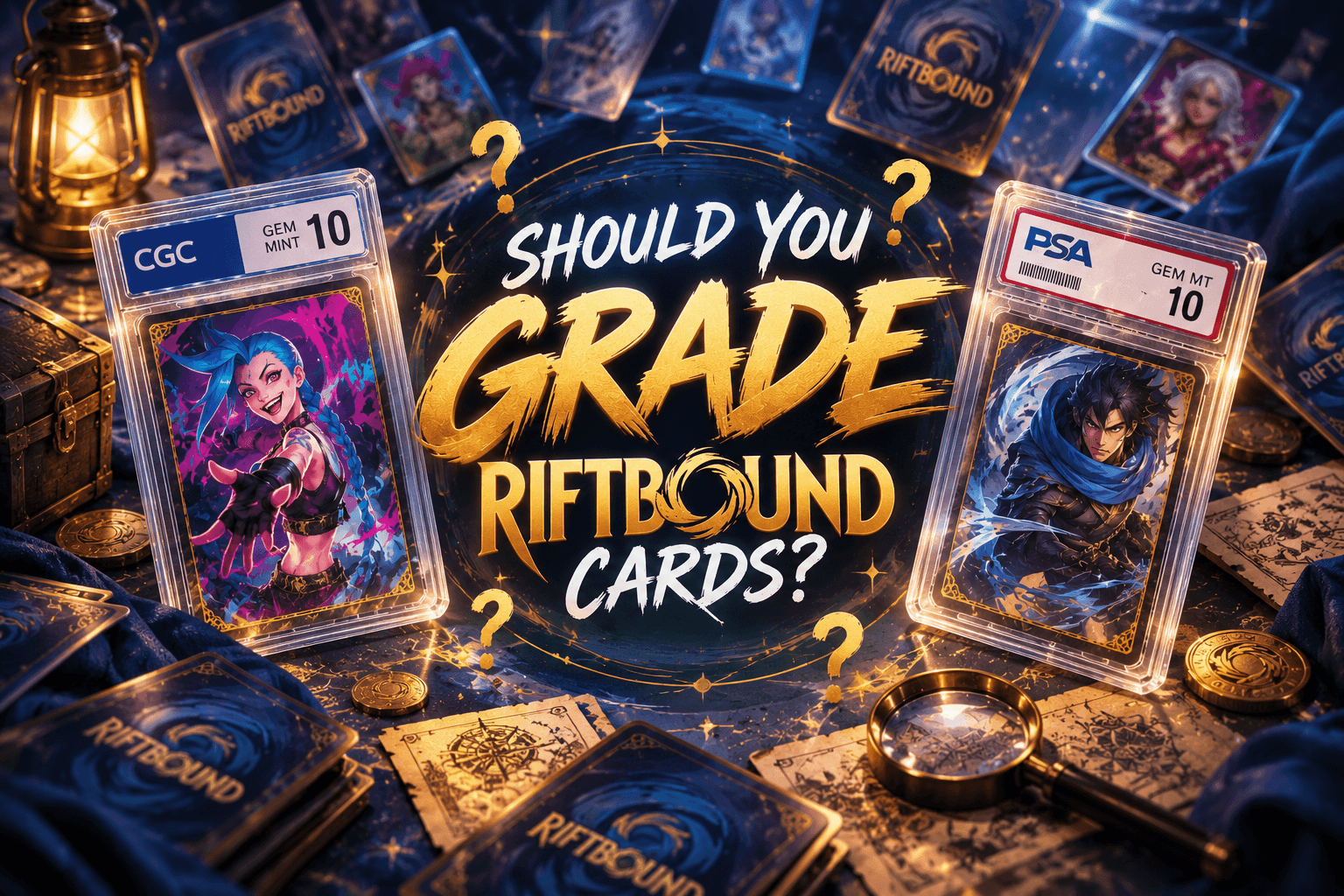
Should You Grade Riftbound Cards?
Roughly nine in ten Riftbound submissions come back as a PSA 10. Population data puts the gem rate at about 91% for Spiritforged and 88% for Unleashed.
That single number answers most of this question. If almost everyone who submits gets a perfect grade, a PSA 10 isn't scarce, and the slab adds very little.
This guide covers what the gem rates mean, what the sold prices confirm, and the small number of cards where grading genuinely pays. Prices come from PriceCharting's aggregated sold data, pulled 6 October 2026.
Why a 91% gem rate changes everything
Context makes the number land properly.
Vintage Pokémon cards from the WOTC era often gem at 10 to 30%. Black borders chip, foil scratches, and 25-year-old cards have been handled. A PSA 10 on one of those is genuinely rare, which is why the grade carries such a premium.
Riftbound is a one-year-old game with modern printing, thick stock and cards that go straight from pack to sleeve. Centring is good and surfaces are clean.
So the grade confirms something most copies already are. You're not discovering scarcity, you're documenting the norm.
Public population trackers such as PCG Pop Report and grading guides like PreGrade Cards' Riftbound guide follow these numbers as they develop.
What the sold prices independently confirm
Here's the part that makes this more than theory. The price data agrees with the population data, from a completely separate source.
| Card | Raw | PSA 10 | Premium |
|---|---|---|---|
| Teemo, Swift Scout [Signature] | ~$1,948.12 | $2,066.30 | 6% |
| Baron Nashor [Ultimate Foil] | ~$2,067.39 | $3,223.61 | 56% |
| Lillia, Bashful Bloom [Signature] | ~$515.57 | $970.00 | 88% |
| Ahri, Inquisitive [Signature] | ~$5,000.00 | $9,450.00 | 89% |
Teemo is the clearest case. A $1,948 card gains $118 from a PSA 10. That will not cover a submission fee, shipping both ways, and the risk of a 9.
Worse, Baron Nashor's PSA 9 sits at $2,063.22 against a $2,067.39 raw price. Grade it and land a 9 and you've lost money before fees.
Two independent datasets, pop reports and sold comps, saying the same thing.
The cards where grading does pay
It isn't universally bad. A handful of cards show genuinely wide gaps.
| Card | Set | Raw | PSA 10 | Multiple |
|---|---|---|---|---|
| Rengar, Pridestalker [Signature] | Unleashed | ~$347.05 | $2,016.93 | 5.8x |
| Lonely Poro | Unleashed | ~$346.61 | $1,616.67 | 4.7x |
| Ahri, Alluring [Launch Promo] | Origins | ~$125.24 | $838.25 | 6.7x |
| Yasuo, Unforgiven (standard) | Origins | ~$83.00 | $520.00 | 6.3x |
| Viktor, Leader [Stamped] | Origins | ~$80.00 | $413.64 | 5.2x |
Values move with the market.
Notice what these have in common. They're cheaper cards, mostly between $80 and $350, and several are promos or stamped printings rather than the headline Signatures.
That's the pattern. The expensive Signatures are already graded heavily, so their populations are large and their premiums are thin. RiftCompare's variant glossary explains how the treatments differ. The cheap and overlooked cards have small populations, so a slab still means something.
The same effect appears across other games: the card nobody submits is the one where grading adds value.
The arithmetic you should actually run
Three numbers decide every submission.
The raw cost. What you paid, or what the card is worth unslabbed.
The realistic grade. With gem rates near 90%, assume a PSA 10 is likely. That sounds good until you realise everyone else assumed the same.
The all-in cost. Submission fee plus shipping in both directions plus insurance. On a cheap card that total can exceed the card's value.
Then compare. If the PSA 10 price minus the all-in cost doesn't comfortably beat the raw price, don't submit.
For Teemo at a 6% premium, the answer is obvious. For Rengar at 5.8x, it's equally obvious the other way.
When to grade regardless of the maths
Two legitimate reasons that aren't about money.
Authentication on high-value cards. A $5,000 Ahri Signature benefits from third-party verification even if the price premium is thin, because it removes buyer doubt on resale.
Protection and presentation. A slab is a good long-term holder. If you're keeping a card for display rather than sale, that has value the price data won't show.
Neither reason justifies submitting a $70 card, but both are real.
What Radiance will change
Radiance releases 23 October 2026, and new sets always start with empty populations.
That creates a brief window where graded copies are genuinely scarce because nobody has submitted yet. Early PSA 10s of a new set often sell high, then settle as supply arrives.
Be careful with that window. It's a timing play rather than a scarcity play, and it rewards people who submit immediately on release rather than those who buy early slabs at the peak.
The one Radiance card where grading will plausibly matter long-term is the Ultimate, at roughly 0.025% of packs. Our Radiance Ultimate Rare guide covers that tier, and the Radiance pull rates guide separates published rates from inference.
Practising before you spend
If you want to test your eye on grade calls before committing submission money, Before the Slab runs practice markets on real cards heading out for grading.
It costs nothing and uses simulated balances, which makes it a reasonable way to learn what separates a 9 from a 10 without paying to find out.
How JK Index helps
We index the full Riftbound catalog with sold history for every printing, and we keep raw and graded prices in separate columns rather than blending them.
Riftbound is the strongest argument for that approach we've found. When grading adds 6% to one card and 580% to another in the same game, a blended average describes neither. You can browse Origins, Spiritforged, Unleashed and Vendetta, track holdings in your portfolio, or check the marketplace.
The takeaway
For most Riftbound cards, don't grade. Gem rates near 90% mean a PSA 10 isn't scarce, and the sold prices confirm it: Teemo, Swift Scout Signature gains 6% from a perfect grade, and Baron Nashor's PSA 9 trades below its raw price.
The exceptions are the cheap and overlooked cards. Rengar at $347.05 raw and $2,016.93 graded, and the Ahri Launch Promo at $125.24 and $838.25, both beat every expensive Signature on multiple, because nobody has been submitting them.
FAQ
What are PSA gem rates for Riftbound cards?
Around 91% for Spiritforged and 88% for Unleashed, meaning roughly nine in ten submissions return a PSA 10. Vintage Pokémon cards by comparison often gem at 10 to 30%.
Is it worth grading Riftbound cards?
For most cards, no. High gem rates mean PSA 10s aren't scarce. Teemo, Swift Scout Signature gains only about 6% from a perfect grade, which won't cover submission costs.
Which Riftbound cards are worth grading?
The cheap, overlooked ones. Rengar, Pridestalker Signature at $347.05 raw and $2,016.93 graded is 5.8x, and the Ahri, Alluring Launch Promo at $125.24 and $838.25 is 6.7x.
Why do expensive Riftbound cards gain so little from grading?
Because they've already been graded heavily. Ahri, Inquisitive has over 900 PSA 10s recorded, so the graded population is large and the premium over raw stays thin.
Can a PSA 9 be worth less than a raw card?
Yes, and it happens in Riftbound. Baron Nashor's PSA 9 trades around $2,063.22 against a raw price of $2,067.39, so landing a 9 loses money before fees.
Should I grade cards from a brand new set?
Only if you submit immediately. New sets start with empty populations so early slabs sell high, but that's a timing advantage that disappears as submissions arrive.
Are there non-financial reasons to grade?
Two. Authentication on high-value cards removes buyer doubt on resale, and a slab is a good long-term holder if you're keeping a card for display rather than sale.
How do I decide whether a specific card is worth submitting?
Compare the PSA 10 price minus your all-in cost, meaning fees plus shipping both ways, against the raw price. If it doesn't comfortably beat raw, leave the card unslabbed.