Disarm, Reveal and Show Off: Riftbound's Newer Keywords
Radiance adds three keywords. One of them, Disarm, is the first real answer Riftbound has printed to a single oversized threat. Another, Reveal and Show Off, asks you to turn cards face up to unlock effects.
Neither is as simple as its name. Disarm stacks, which changes how you sequence attacks. Reveal works from your board as well as your hand, which changes what counts as a resource.
Radiance releases 23 October 2026. Mechanic details come from riftbound.gg, with reveal tracking at riftbound.zone.
Disarm: cutting Might during an attack
Disarm reduces an enemy Unit's Might during an attack, and crucially, the effects stack.
That stacking clause is the whole mechanic. A single Disarm shaves a point or two off a threat. Several Disarm sources applied to the same attack compound into something that can neutralise a Unit no individual card could handle.
It's a combat trick rather than removal. The Unit survives, it just hits for less in that exchange.
Why stacking matters more than the number
Most games give you answers that scale with a threat: bigger removal for bigger creatures. Disarm scales with how many cards you commit instead.
That has a specific consequence. A deck running several cheap Disarm effects can beat a single large Unit by spending multiple small cards, which is a trade most decks are happy to make if the target is a Legend-tier threat.
It also makes Disarm a resource you can overcommit. Spend three Disarm effects on an attack your opponent then declines to make, and you've wasted all three.
So the skill is in reading when the attack is actually coming, not in holding the biggest answer.
Where Disarm fits against Radiance's own cards
There's a neat internal tension in this set.
Radiance introduces Deploy, which puts Gear directly onto a Battlefield where it's destroyed if your opponent takes that space. Taking a Battlefield means winning combat there.
Disarm is a combat tool. So the set ships a mechanic that plants value on contested ground and, in the same breath, a mechanic that helps you win the fights over that ground.
That's not an accident. Sets usually include their own answers, and here the pairing is unusually direct.
Reveal and Show Off: paying with information
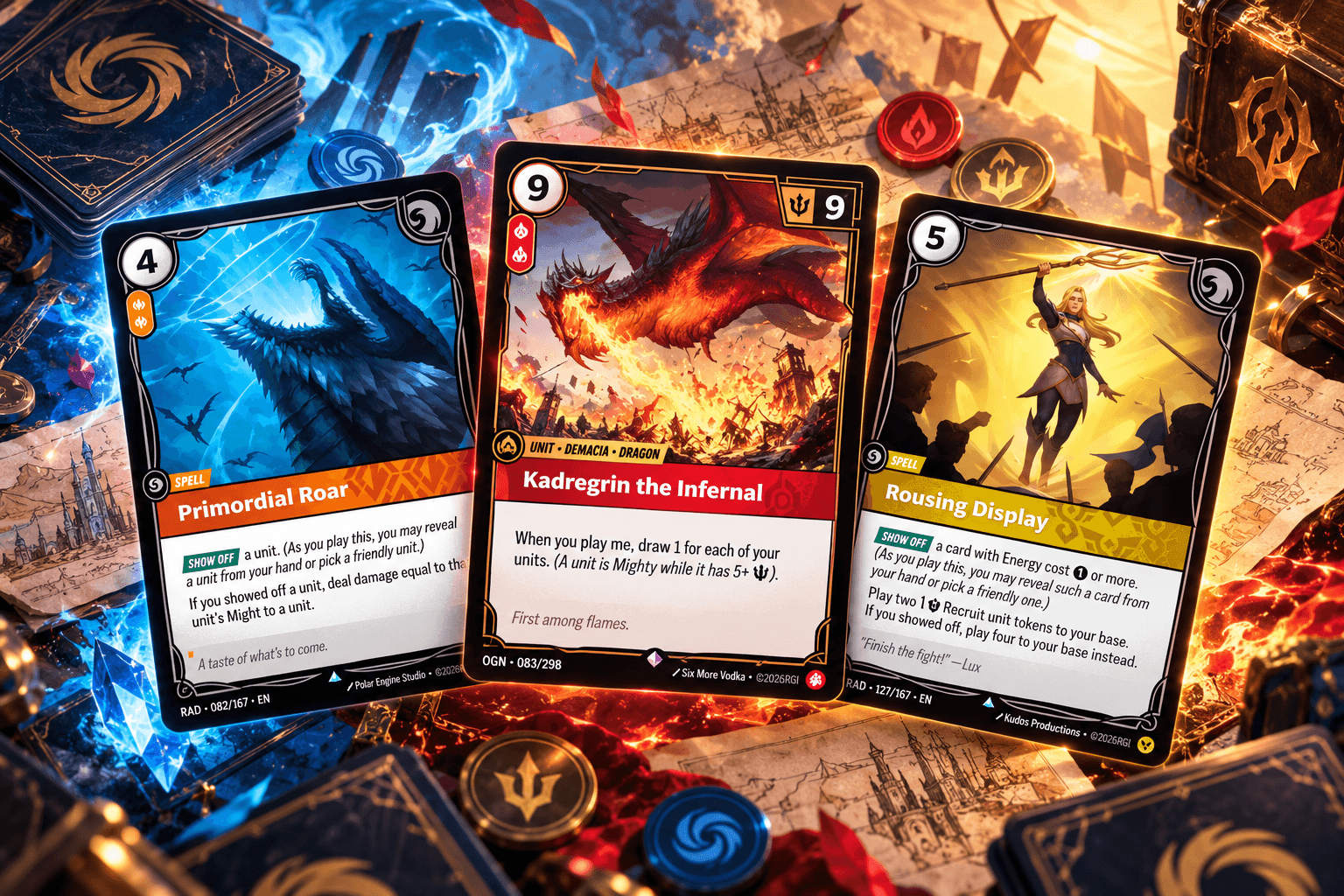
The second keyword works differently. It lets you reveal qualifying cards from your hand or board to unlock additional effects.
Two details matter more than the headline.
It reads your board as well as your hand. Most reveal mechanics in card games only look at your hand. Including the board means cards already in play can pay the cost, which is a much softer requirement.
The cards aren't spent. You show them, you don't discard them. The cost is information rather than material.
That makes Reveal cheap in resource terms and expensive in a different currency: your opponent learns what you're holding.
The hidden cost of revealing
This is the part worth thinking about before building around it.
Card games are partly about uncertainty. An opponent who doesn't know whether you're holding a trick has to play around it. An opponent who has seen your hand does not.
So a Reveal effect that costs "nothing" has actually cost you the threat of the unknown. Against a strong opponent that can matter more than a card.
The flip side is that revealing works best when what you're showing is already obvious. If your deck telegraphs itself anyway, you're paying a cost you'd already conceded.
What "qualifying cards" means
Riot has described the mechanic without publishing the full condition set.
What's confirmed is that cards must qualify to be revealed, so there's a restriction rather than a free choice. What's not confirmed is what the qualifications are, and they may differ card by card.
That's a meaningful gap. A Reveal effect requiring three cards of one domain is a hard build-around. One requiring any two Units is close to free.
Until the full card list lands, treat Reveal as a mechanic whose strength is genuinely unknown rather than one we're being coy about.
What's still unpublished
As of early October, roughly half of Radiance's 180 cards were public, with preview season closing 9 October.
Open questions on both keywords:
- How many cards carry Disarm, and at what cost
- Whether Disarm has a floor, or can reduce Might below zero
- What conditions qualify a card for Reveal and Show Off
- Whether Show Off is a separate keyword or the second half of Reveal
That last one matters for deckbuilding and is still ambiguous in the published material. RiftCompare's set page is tracking each reveal as it lands. Our Radiance card list tracks confirmations as they land.
How these compare to earlier Riftbound keywords
Radiance isn't starting from scratch. Vendetta introduced Empower, which Ekko uses in this set, and Seraphine's Radiance card introduces Recruit, which creates 1 Might token units.
That gives Radiance four mechanics in play at once: two new ones in Disarm and Reveal, one carried forward in Empower, and one introduced alongside in Recruit.
For a set that also adds Equipment Units and Bomb Tokens, that's a lot of moving parts. Our Radiance Legends guide covers which champions tie to which mechanic, and the Seraphine guide explains Recruit in full.
How JK Index helps
We index the full Riftbound catalog with sold history for every printing, including the cheap Spells and Gear that carry new keywords.
New-mechanic cards are routinely mispriced at release. A keyword that reads weak in preview and proves strong in play reprices sharply, and that only shows up if someone tracked the card from day one. You can browse earlier sets including Origins, Spiritforged, Unleashed and Vendetta, track what you own in your portfolio, or check the marketplace.
The takeaway
Disarm reduces enemy Might during attacks and stacks, which makes it a way to beat one big threat with several small cards rather than one big answer.
Reveal and Show Off unlocks effects by turning qualifying cards face up from hand or board. It costs no material, only information, and the full qualification rules haven't been published yet.
FAQ
What does Disarm do in Riftbound?
Disarm reduces an enemy Unit's Might during an attack, and multiple Disarm effects stack on the same attack. It's a combat trick rather than removal, so the Unit survives but hits for less.
Do Disarm effects stack?
Yes, and that's the defining feature. Several Disarm sources applied to one attack compound, letting a deck answer a single large threat by spending multiple cheap cards.
What is Reveal and Show Off?
A Radiance keyword that lets you reveal qualifying cards from your hand or board to unlock additional effects. The cards are shown rather than spent, so the cost is information rather than material.
Can I reveal cards from my board, not just my hand?
Yes. Reveal reads both hand and board, which makes it a softer requirement than most reveal mechanics in card games, since cards already in play can pay the cost.
What counts as a qualifying card for Reveal?
Not published. Riot has confirmed there's a qualification requirement but not what it is, and conditions may vary card by card. Expect clarity with the full card list.
Which set introduces Disarm and Reveal?
Radiance, Riftbound's fifth set, releasing 23 October 2026. It also introduces Deploy, plus two new card types in Equipment Units and Bomb Tokens.
Is Disarm the same as removal?
No. Removal destroys a Unit. Disarm only reduces Might during an attack, so the Unit survives the exchange and is still there afterwards at full strength.
How do these keywords interact with Deploy?
Indirectly but meaningfully. Deploy cards are destroyed when an opponent takes the Battlefield they sit on, and Battlefields change hands through combat, which is exactly where Disarm operates.