Riftbound Card Rarities Explained: The Complete Guide From Origins to Vendetta
By Groovy
Riftbound's rarity system looks simple until you pull a foil Legend, a card numbered 230*/219, or one marked SP3/006.
Then four basic rarities turn into a much longer list of questions.
Is a Legend rarer than an Epic? Is every foil a hit? What makes an Overnumber different from an alternate art? Does the asterisk mean the card is serialized? Are Vendetta's connecting cards one pull or two? Where does Unleashed's Ultimate Baron Nashor fit?
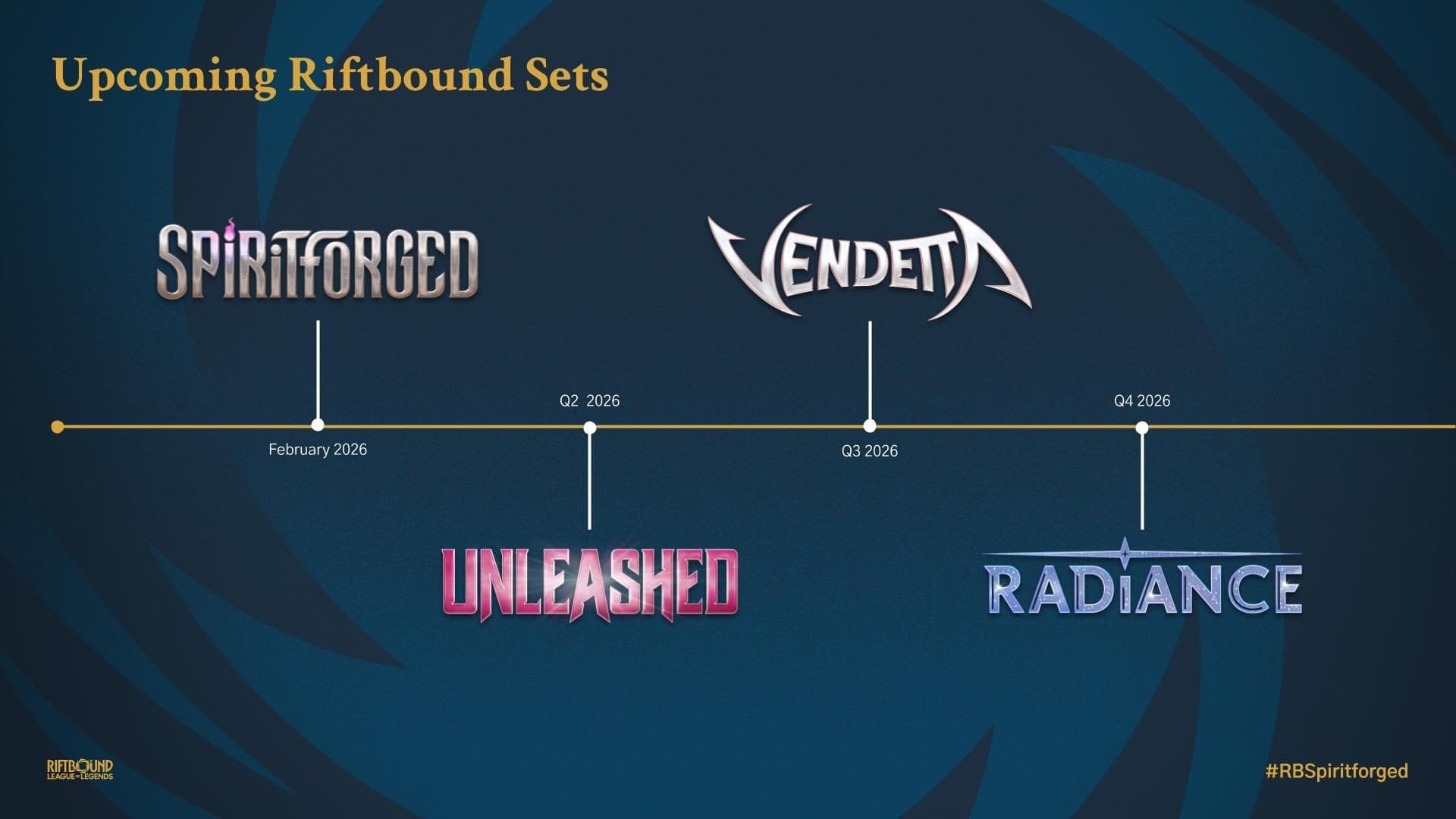
This guide answers those questions from the beginning and tracks how Riftbound's collector system changed across Origins, Spiritforged, Unleashed, and Vendetta.
The first thing to understand is that Riftbound does not have one rarity system. It has several card attributes layered on top of each other.
The short version
- Riftbound has four functional rarities: Common, Uncommon, Rare, and Epic.
- A foil is a finish, not a separate rarity.
- A Legend is a card role, not a rarity. Champion Legends are normally Rare.
- Alternate Art cards use different art and usually add an
ato the collector number. - Overnumbered cards have a collector number higher than the main set total.
- Signature Overnumbers add a printed foil artist signature and an asterisk to the collector number.
- Unleashed introduced Ultimate rarity with one card: Baron Nashor.
- Vendetta introduced six Special numbered Crystal Rose cards, numbered
SP1/006throughSP6/006. - Vendetta also introduced 22 connecting-art Rival Overnumbers that form 11 two-card scenes.
SP1/006does not mean copy one of six. It identifies a card within a six-card Special subset.- Pull rates are averages across a print run. A booster box does not guarantee the average result.
The four attributes behind every Riftbound card
Most confusion disappears once these four attributes are kept separate.
| Attribute | What it tells you | Examples |
|---|---|---|
| Card type or role | How the card functions in the game | Legend, Unit, Champion Unit, Spell, Gear, Battlefield, Rune |
| Functional rarity | Where the normal card sits in the playable rarity system | Common, Uncommon, Rare, Epic |
| Finish or collector treatment | How that printing looks and how it is numbered | Foil, Alternate Art, Overnumber, Signature Overnumber, Ultimate, Special Alt |
| Distribution source | Where that printing can be found | Booster, Champion Deck, Showdown Deck, Proving Grounds, Pre-Rift, Nexus Night, tournament promo |
A card can occupy one position on every axis at the same time.
For example, a Champion Legend can be a Rare card with an Overnumbered treatment pulled from a booster. A Common can have a foil version. A Signature Spell can be an Epic without having an artist signature anywhere on the card.
The words are similar. The meanings are not.
Riftbound's four functional rarities
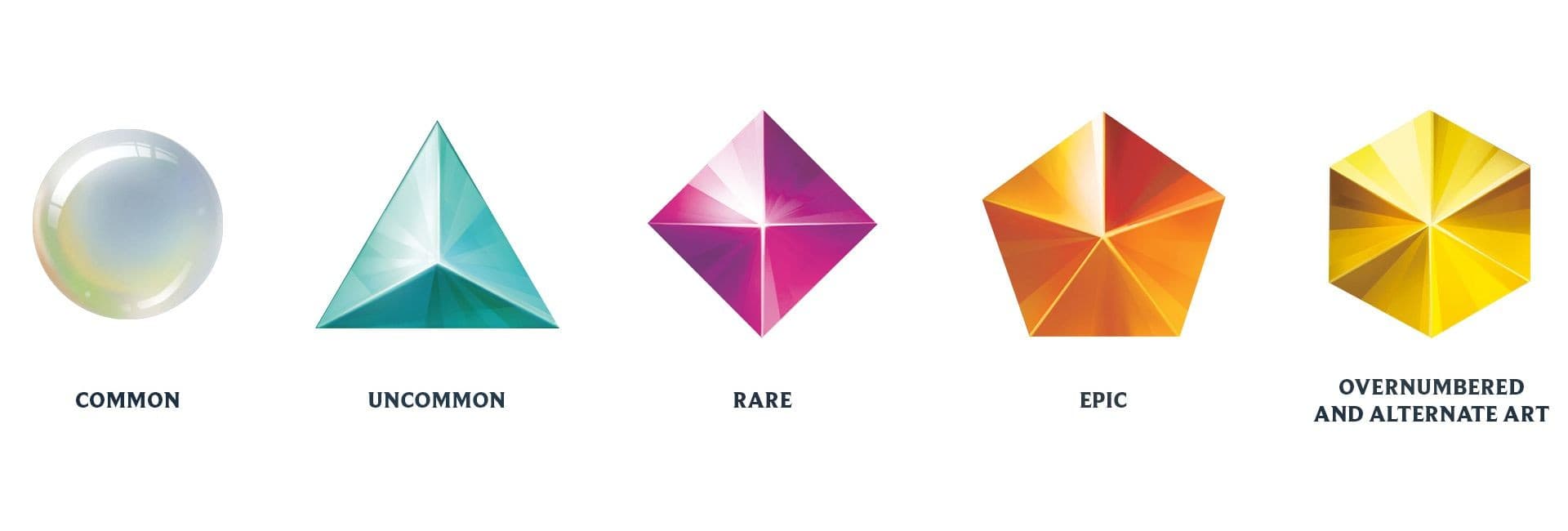
Functional rarity describes the standard version of a card. Riot uses both the frame and the gem near the bottom of the card to make each rarity recognizable.
| Rarity | Frame | Gem | What it usually means |
|---|---|---|---|
| Common | Bronze | Circle | Clear, foundational cards that fill common deck roles |
| Uncommon | Silver | Triangle | More specialized, synergistic, or mechanically involved cards |
| Rare | Gold full-art frame | Square | Legends, Champion Units, and other cards intended to feel impactful |
| Epic | Minimal gold frame | Pentagon | The highest normal gameplay rarity, often used for Champion Units and Signature Spells |
Rarity does not measure competitive strength with perfect accuracy. A Common can be essential to a top deck. An Epic can be narrow. Rarity describes distribution and design positioning, not a promise that one card will outperform another.
Common
Common cards are the foundation of a set. They are designed to be readable, useful, and available in enough volume to support deckbuilding and Limited play.
A standard booster has seven Common slots.
Uncommon
Uncommons tend to ask for more context. They may support a particular strategy, reward a synergy, or handle a more specific job.
A standard booster has three Uncommon slots.
Rare
Rare is where many of Riftbound's Champions and Legends enter the set. Riot intentionally placed Champion Legends at Rare so the card that defines a deck would not begin at the game's highest functional rarity.
That distinction matters for new players: Legend is not a rarity. It is the card you place in your Legend Zone to define the domains and identity of your deck.
Epic
Epic is the highest functional rarity. In Origins, Riot published an average appearance rate of roughly one Epic per four booster packs. An Epic replaces one of the two Rare-or-better cards in a pack, and a pack can contain two Epics.
Many Champion Units and Signature Spells appear at Epic.
Another important distinction: a Signature Spell is not a signed card. “Signature” is a gameplay term connecting certain cards to Champions and deckbuilding. A Signature Overnumber is a collector treatment with a printed artist signature.
What is inside a Riftbound booster pack?
The core booster structure has remained remarkably stable across the first four sets.
Each 14-card booster contains:
- 7 Common cards
- 3 Uncommon cards
- 2 Rare-or-better cards
- 1 foil card that can be Common, Uncommon, Rare, or Epic
- 1 Token, Rune, or alternate-art Rune
Packs also include an informational insert, which is not one of the 14 game cards.
Rares and Epics are already foil. That means a normal pack generally contains three foil cards: the two Rare-or-better cards plus the dedicated foil slot.
The exact wording of the two premium slots expands by set. Unleashed lists Rare, Epic, Alt, Overnumber, or Ultimate. Vendetta lists Rare, Epic, Alt, Special Alt, or Overnumber.
What the foil slot can and cannot tell you
Foil does not automatically mean rare.
The dedicated foil slot can contain a foil Common or Uncommon. Those versions are less common than their nonfoil counterparts, but the card's functional rarity remains Common or Uncommon.
The finish changes. The underlying rarity does not.
How to read a Riftbound collector number
The collector number is the fastest way to identify most special treatments.
| Example | Meaning |
|---|---|
061/298 | Standard card number 61 in a 298-card main set |
061a/298 | Alternate-art printing of card 61 |
299/298 | Overnumbered card printed beyond the main set total |
299*/298 | Signature version of that Overnumbered card |
238/219 with Ultimate treatment | Unleashed Ultimate Baron Nashor, outside the 219-card main set |
SP1/006 | First card in Vendetta's six-card Special numbered subset |
The denominator identifies the numbered main set or special subset. It is not the number of physical copies printed.
If a Vendetta card says SP1/006, Riot did not print six copies. There are six distinct Crystal Rose Special cards in that numbered sequence.
Foils, alternate arts, Overnumbers, and Signature cards
These collector treatments sit above the four functional rarities.
Foil cards
Foil is the most common treatment distinction. Commons and Uncommons can appear as either nonfoil or foil cards in booster packs. Rares and Epics are foil by default.
This is why the words “foil Rare” do not identify an alternate art or Overnumber. That is the normal finish for a Rare.
Alternate Art cards
Alternate Art cards use a different illustration and a more elaborate treatment while preserving the underlying card's gameplay text.
They are usually easy to identify through two details:
- a hexagonal collector gem; and
- an
aafter the collector number, such as039a/298.
An Alternate Art is still the same functional card for deckbuilding purposes. You cannot bypass the normal copy limit by mixing standard and Alternate Art printings.
Origins established the baseline at roughly two Alternate Art cards per 24-pack display. Riot described that as a rough average, not a guarantee.
Overnumbered cards
An Overnumbered card has a collector number above the main set denominator. If the set contains 298 cards, an Overnumber begins at 299.
Overnumbers feature special artwork and premium treatments. They are also meaningful for format legality. Riot has explained that an Overnumbered reprint does not make the card a new main-set printing for rotation purposes. It remains tied to the legality of its original card printing.
Riot has also committed not to reprint an existing Overnumber with the same art and frame.
That makes an Overnumber different from a normal Alternate Art in two ways:
- its collector number sits outside the main set; and
- it does not reset the underlying card's legality as a new main-set printing.
Signature Overnumbered cards
Some Overnumbers have a second version with a printed foil signature from the artist. The collector number includes an asterisk, such as 299*/298.
These are not hand-signed cards. The signature is part of the manufactured treatment.
For Origins, Riot stated that roughly one in ten Overnumbers would be a Signature version. Combined with the published Origins Overnumber rate of about one per three boxes, that produces an average of:
- 1 Overnumber per 72 packs; and
- 1 Signature Overnumber per 720 packs, or 30 booster boxes.
That is the rate for pulling any Signature Overnumber in Origins. The probability of pulling one specific Champion's Signature card is lower.
Set-by-set rarity guide
The functional rarities stayed stable. The collector layer kept expanding.
Origins: the foundation
Set code: OGN
English release: October 31, 2025
Main set: 298 cards
Origins established Riftbound's four functional rarities and the basic collector language still used today.
Its key treatments are:
- foil versions of the main set;
- Alternate Art Champion Units;
- alternate-art Runes;
- 12 Legend Overnumbers; and
- Signature versions of those Overnumbers.
Riot's preview material states that 24 Champion Unit cards in Origins are available with an Alternate Art treatment. The separate collectability guide describes those treatments through the set's 12 core Champions.
Origins pull rates published by Riot
| Pull | Published average |
|---|---|
| Epic | About 1 in 4 packs |
| Alternate Art | About 2 per 24-pack box |
| Overnumber | About 1 per 3 boxes, or 72 packs |
| Signature Overnumber | About 1 in 10 Overnumbers |
| Any Signature Overnumber, calculated | About 1 per 30 boxes, or 720 packs |
None of these averages guarantees a hit in a specific display or case.
The Origins loose-pack issue
After launch, Riot confirmed that a small percentage of individual Origins packs were missing one intended Rare card. Riot said box-level rarity distribution was not affected and created a replacement process for qualifying loose-pack purchases.
This matters when reviewing older opening data. A defective loose pack should not be treated as the intended rarity structure.
Spiritforged: a much broader Overnumber pool
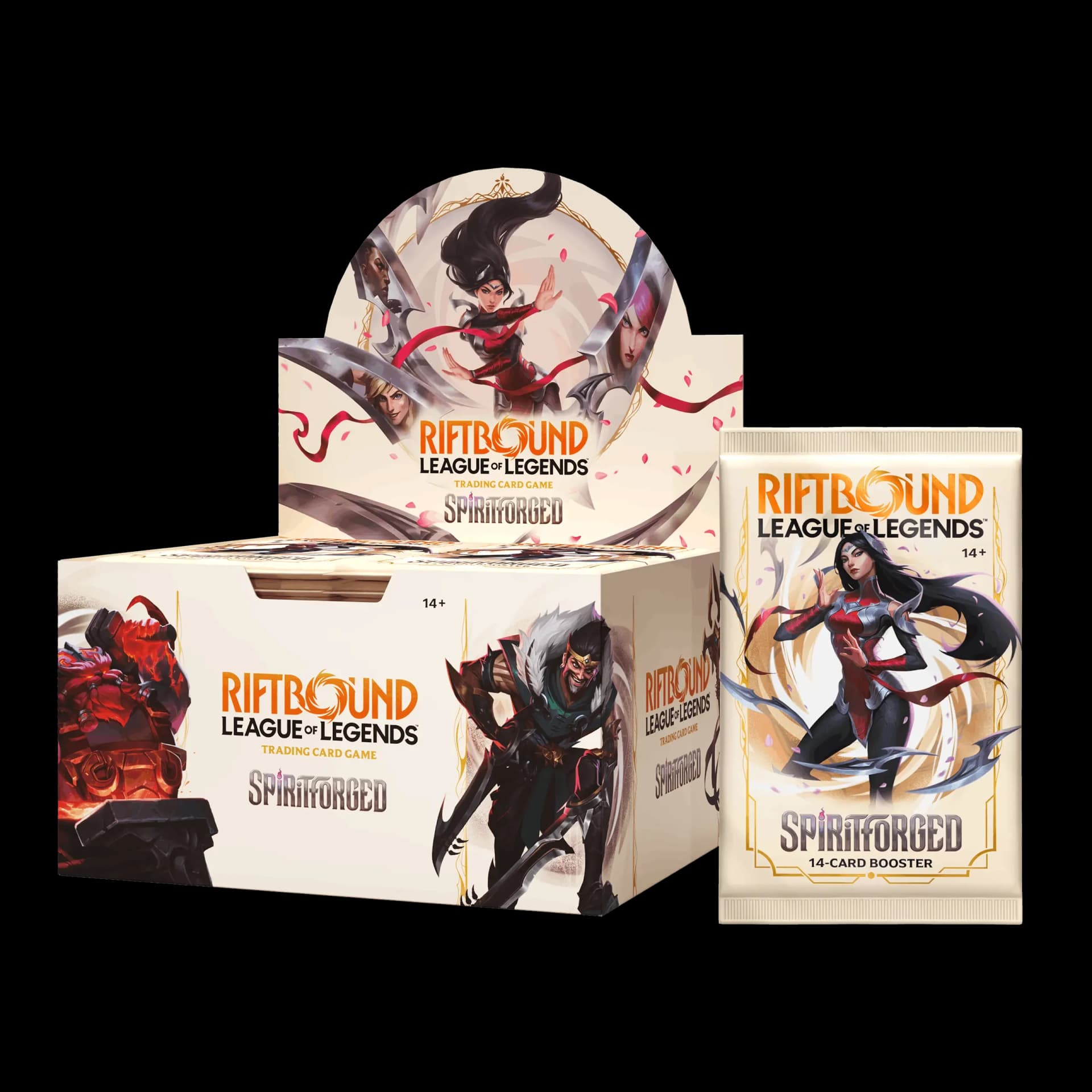
Set code: SFD
English release: February 13, 2026
Main set: 221 cards
Spiritforged kept Alternate Arts and Overnumbers, but it widened what an Overnumber could be.
Origins focused its Overnumber treatment on the 12 core Champion Legends. Spiritforged added 30 Overnumbered cards, with 12 receiving Signature variants. Its Overnumbers include Legends, Champion Units, Gear, and new treatments for cards first printed in Origins.
That last category is important. An older card can receive a new Spiritforged Overnumber without becoming a Spiritforged main-set card for format legality.
Spiritforged published box expectations
UVS Games' official Spiritforged sell sheet describes a 24-pack display with, on average:
- more than six Epic cards; and
- more than two special Alternate Art cards.
The same sheet describes more than 220 cards and more than 60 alternate or showcase-style variants in the product pool.
The average is not a guarantee. A box can land above or below it.
Riot also warned that the rare-slot packing issue seen in a small number of Origins loose packs would continue into some Spiritforged loose packs. Box-level totals were again described as unaffected. Riot said the production correction would be complete with the third set.
What Riot did not publish clearly for Spiritforged
The English-facing sources used for this guide do not give a clean, product-specific rate for Spiritforged Overnumbers or Signature substitutions. Community references often quote case or box averages, and Chinese packaging is frequently cited for more precise odds, but those numbers should not be presented as a universal English-product guarantee without the relevant packaging disclosure in hand.
Unleashed: the first Ultimate Rare
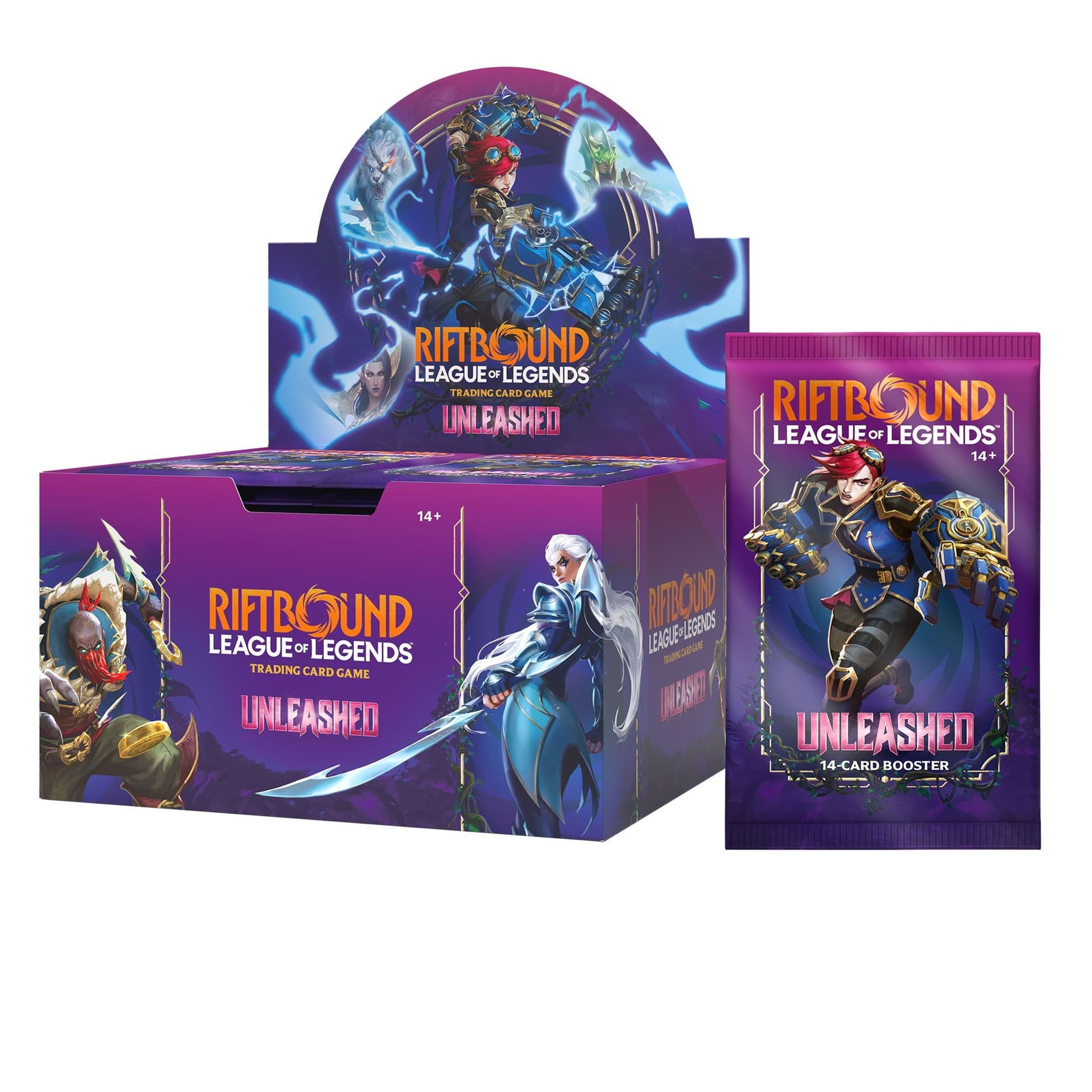
Set code: UNL
English release: May 8, 2026
Main set: 219 cards
Unleashed introduced Riftbound's first new named collector rarity: Ultimate.
There is only one Ultimate card in the set:
Baron Nashor, numbered 238/219.
It is an overnumbered printing in the literal sense because 238 sits above the 219-card main set. Riot still treats Ultimate as its own named rarity and says Ultimate cards will not appear in every set.
The official Ultimate rate
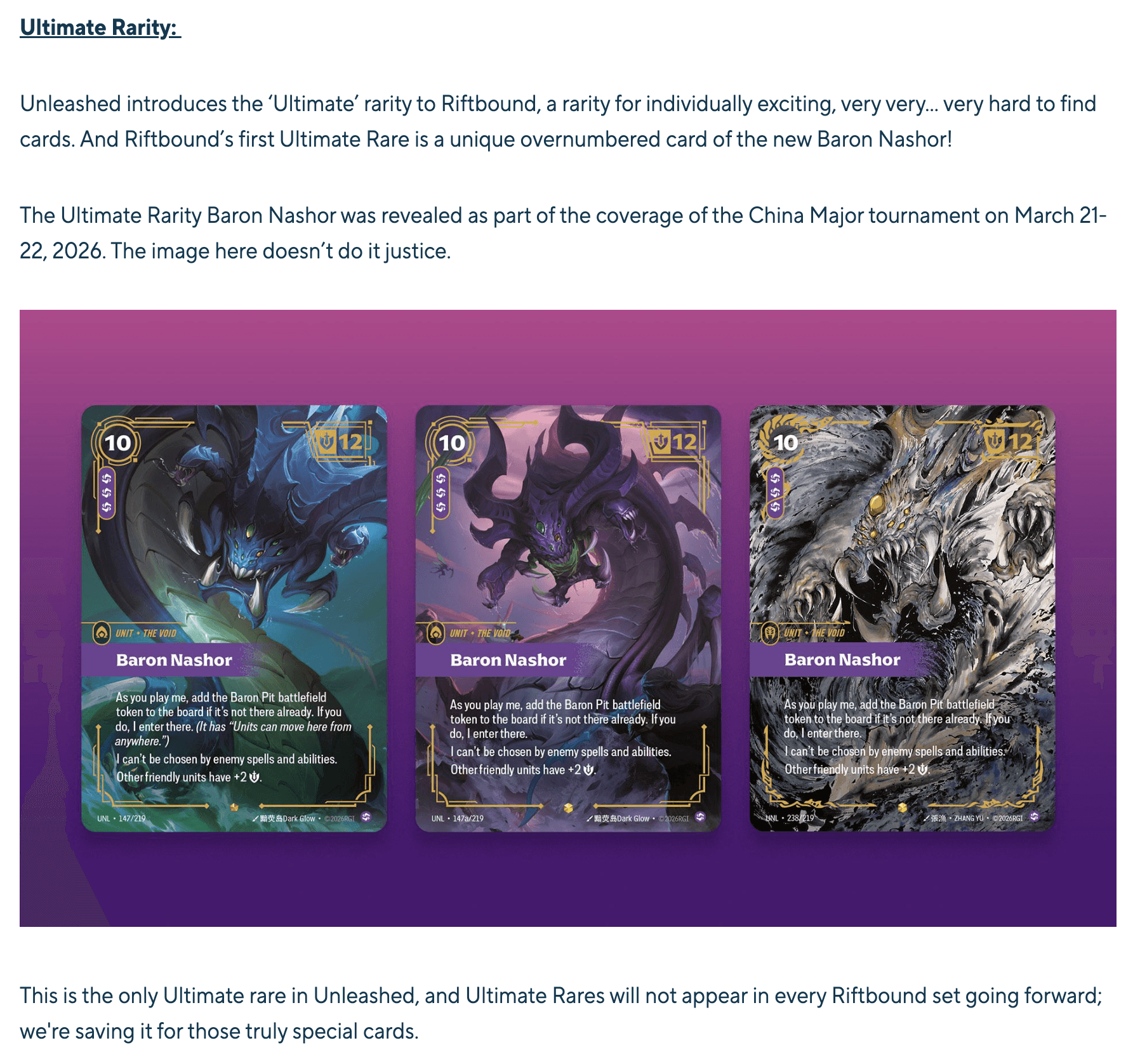
Riot states that Ultimate cards appear in less than 0.1% of Unleashed packs. A pack can contain no more than one Ultimate.
Less than 0.1% means fewer than one per 1,000 packs on average. Riot did not publish a more precise English-language rate, so “one per 1,000” should not be treated as the exact number.
Unleashed also includes normal Alternate Arts, Overnumbers, and Signature Overnumbers. Its Overnumbered run spans six Poro treatments and 12 Champion Legends before Baron Nashor closes the sequence as card 238.
Is Ultimate rarer than a Signature Overnumber?
The answer depends on whether you mean any Signature card or one specific Signature card.
Using Origins' published averages:
- any Origins Signature Overnumber appears around once per 720 packs; and
- Unleashed Ultimate Baron Nashor appears in less than one out of 1,000 packs.
On those disclosed set-level rates, Ultimate Baron Nashor is rarer than pulling any Signature Overnumber from an Origins pack. A specific Champion's Signature Overnumber is much rarer than the combined “any Signature” rate because that pool is divided among multiple cards.
Vendetta: Special numbering and connecting art
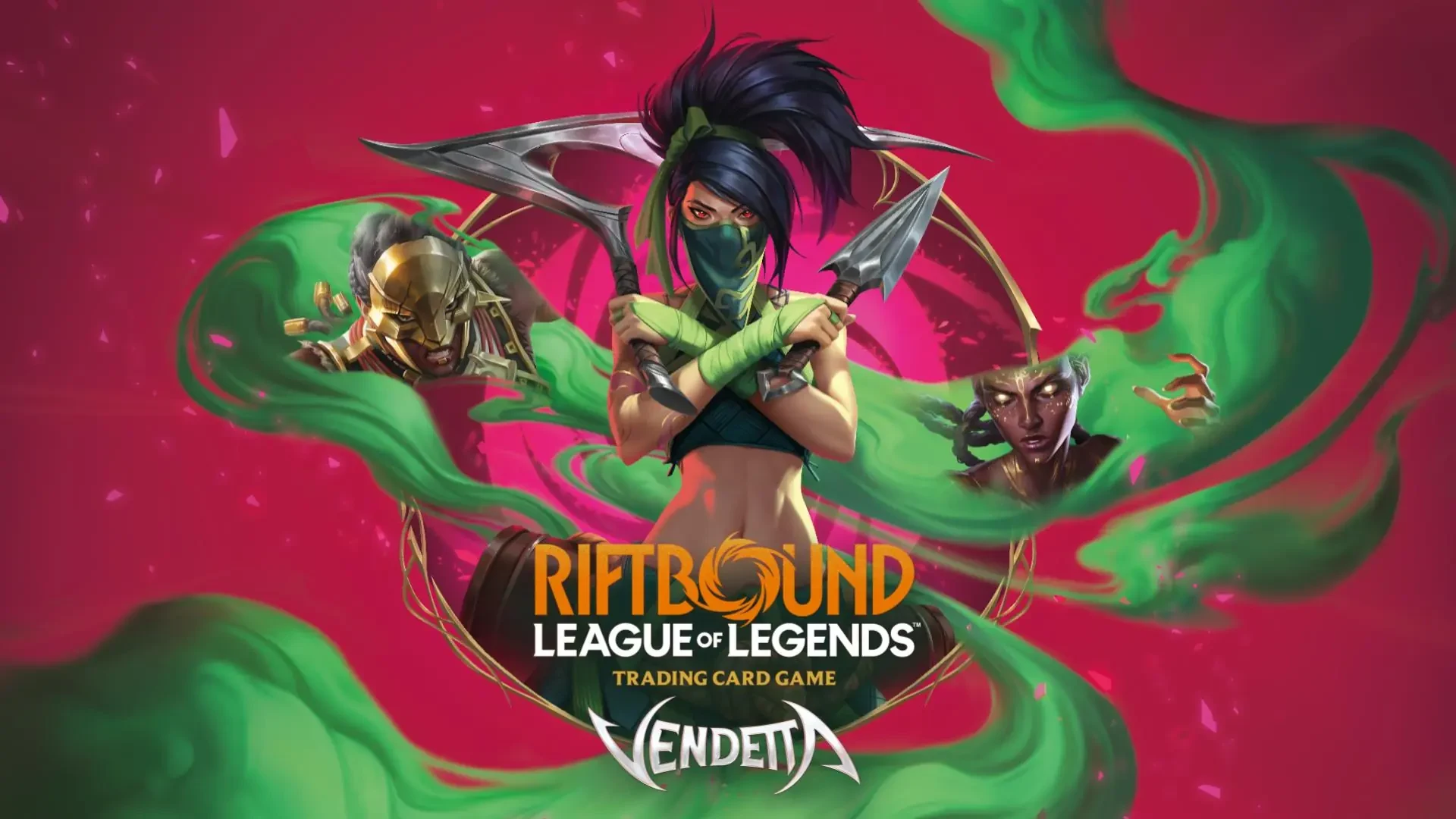
Set code: VEN
English and Chinese release: July 31, 2026
Main set: 166 cards
Showcase treatments: More than 50 cards across the collector layer
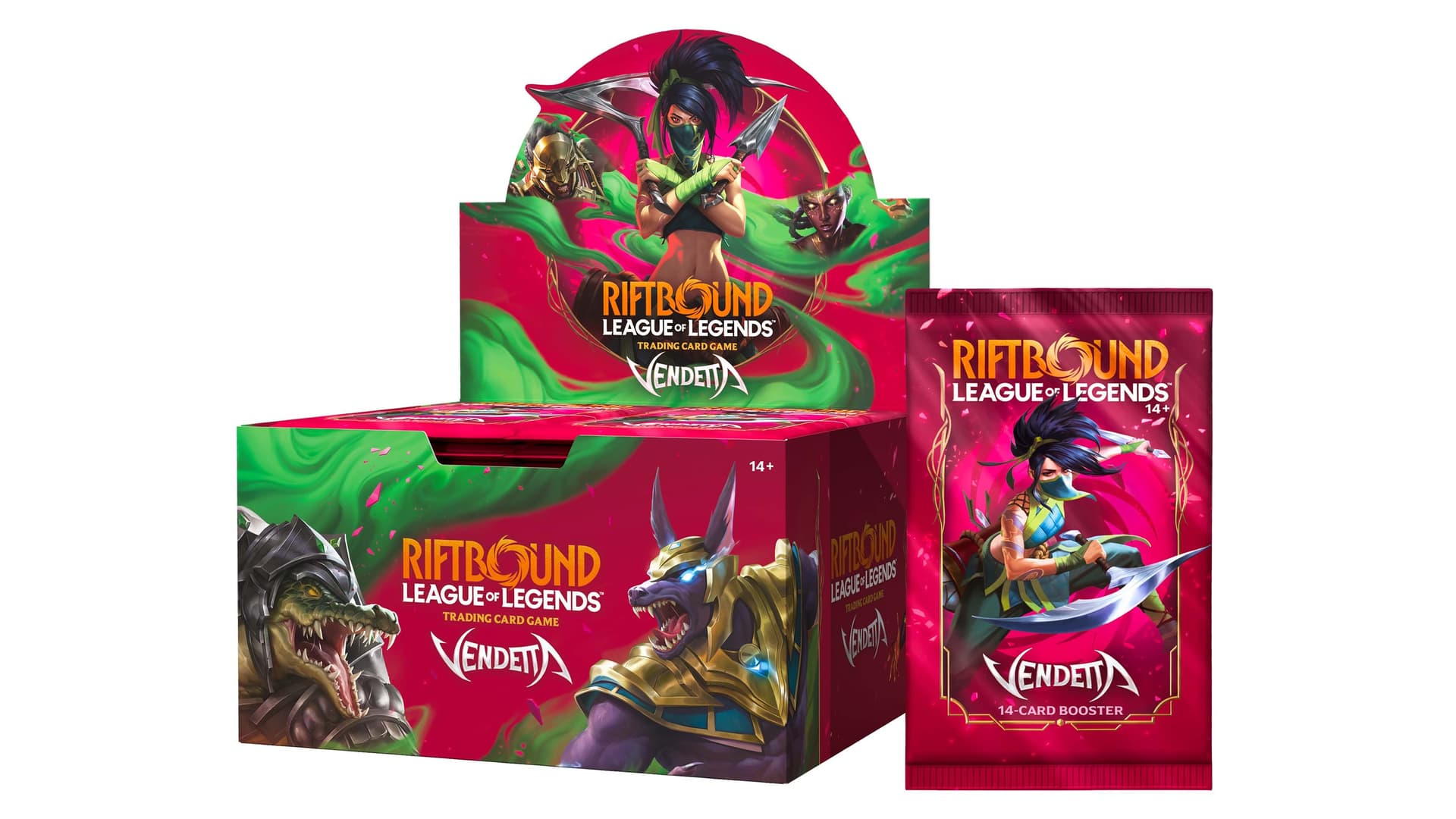
Vendetta makes the collector system more visual and more complicated.
It adds two major ideas:
- six Crystal Rose Special Alt cards with
SPnumbering; and - 22 Rival Overnumbers designed as 11 connecting-art pairs.
It also includes nine Overnumbered versions of the set's new Legends. Riot confirms that those nine Legend Overnumbers can appear with artist-signature variants.
Vendetta's Crystal Rose SP cards

The six Crystal Rose cards use art from Wild Rift's Crystal Rose skin line. They form their own collector sequence:
| SP number | Card |
|---|---|
SP1/006 | Kai'Sa, Survivor |
SP2/006 | Sona, Harmonious |
SP3/006 | Ahri, Inquisitive |
SP4/006 | Sett, Brawler |
SP5/006 | Ezreal, Prodigy |
SP6/006 | Lux, Crownguard |
These are sometimes called a new “SP rarity,” but Riot's own Vendetta language is more precise: they are Special numbered Crystal Rose Alternate Arts.
Riot says they appear as often as other Alternate Art cards in Vendetta and should not be treated as Overnumbers.
Three points matter:
SPis a special collector sequence, not a serial-numbered print run.- A Crystal Rose card occupies an Alternate Art-level distribution category, not the Overnumber category.
- The art comes from Wild Rift, while Riot reserves the Overnumber label for art created for Riftbound.
Vendetta's connecting-art Rival Overnumbers
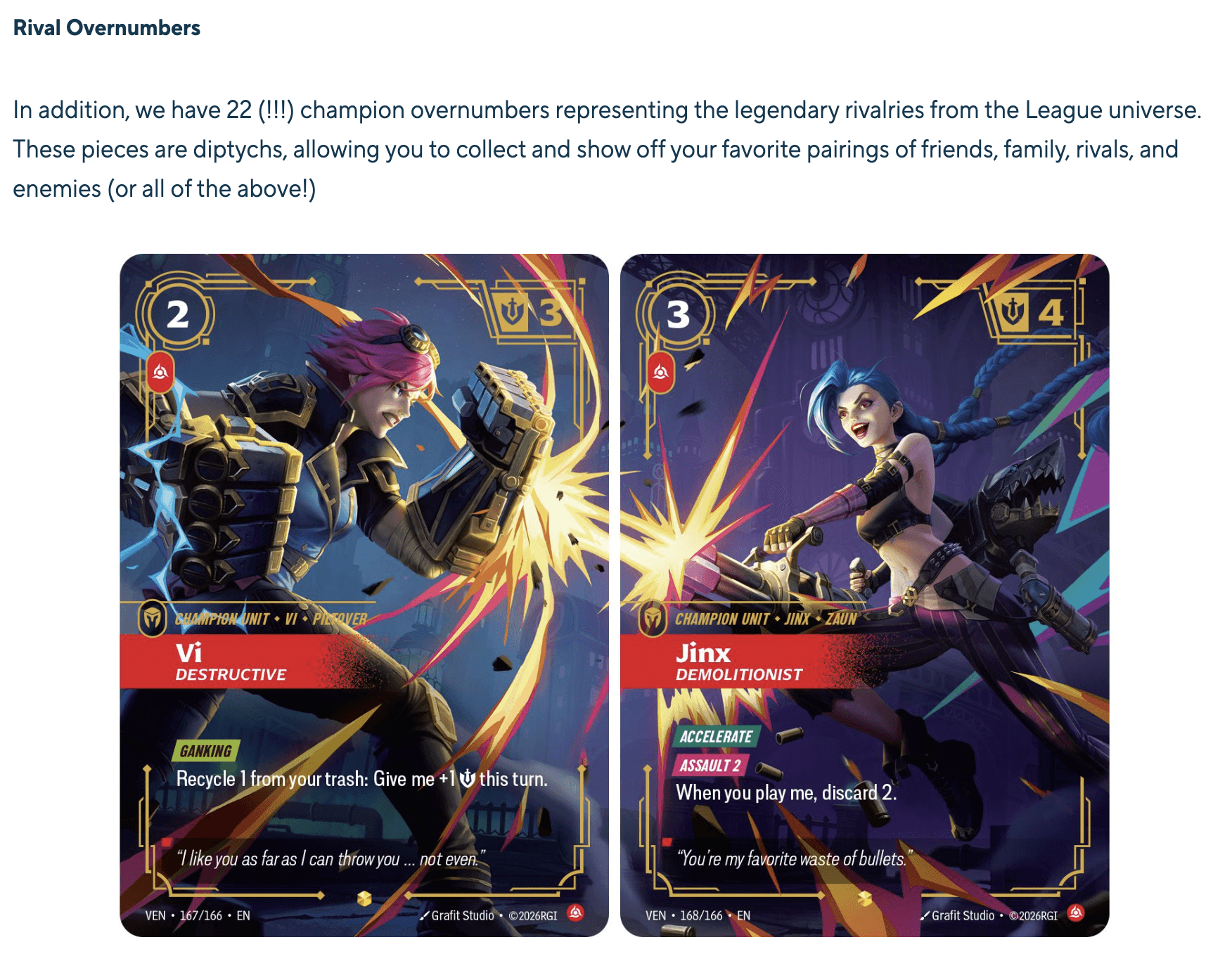
Vendetta contains 22 Champion Unit Overnumbers arranged into 11 diptychs. Each pair forms one larger scene when the two cards are placed side by side.
The pairs are:
| Left/right pairing | Relationship represented |
|---|---|
| Vi and Jinx | Sisters of Zaun |
| Jayce and Viktor | Piltover and Zaun rivals |
| Rengar and Kha'Zix | Rival hunters |
| Gangplank and Illaoi | Bilgewater conflict |
| Zed and Shen | Former brothers and ideological rivals |
| Ambessa and Mel | Mother and daughter |
| Diana and Leona | Targon opposites |
| Nasus and Renekton | Shuriman brothers |
| Swain and Irelia | Noxus and Ionia |
| Draven and Riven | Arena rivals |
| Kayle and Morgana | Divine sisters |
Each half is a separate card and a separate pull. Opening Vi does not mean Jinx is in the same pack, box, or case. Collectors need both cards to complete the full composition.
Some of these cards reprint gameplay identities from Origins, Spiritforged, or Unleashed with new Vendetta Overnumber artwork. That does not turn the original card into a Vendetta main-set printing for legality.
What is known about Vendetta pull rates
Riot published the pack structure and confirmed that Crystal Rose SP cards appear at the same frequency as Vendetta's normal Alternate Arts.
Riot did not publish exact English-language rates for:
- any Vendetta Alternate Art;
- any Crystal Rose SP card;
- any Vendetta Overnumber;
- a connecting-art Overnumber;
- or a Vendetta Signature Overnumber.
Early box openings are useful observations, but the sample is too small to replace a print-run disclosure. A guide should not turn release-week luck into an official ratio.
Rarity does not equal value
Scarcity matters, but it is only one part of a card's market.
A less scarce playable Epic can be worth more than a standard Overnumber because competitive players may need three copies while collectors only need one premium printing. Character popularity, artwork, language, condition, metagame demand, and supply all matter.
The label on the card tells you where it sits in the product. It does not set the price.
For Vendetta in particular, release-week prices for Crystal Rose and connecting-art cards should not be mistaken for settled values. The set had only just released when this guide was verified.
A collector's checklist for opening Riftbound
When you open a card that looks unusual, check it in this order.
- Read the collector number. Look for an
a, a number above the denominator, an asterisk, or anSPprefix. - Check the gem and frame. This identifies the functional rarity or special treatment.
- Separate card role from rarity. Legend, Champion Unit, and Signature Spell describe gameplay, not collector scarcity.
- Confirm the set code.
OGN,SFD,UNL, andVENtell you where that printing belongs. - Check the source. Booster cards, fixed deck cards, and tournament promos follow different distribution rules.
- Inspect condition before handling. Look at centering, corners, edges, foil surface, and print defects before sleeving.
- Use a current card database. New Overnumbers are sometimes revealed through discovery, and set checklists can change during preview season.
If the card is a Vendetta Rival Overnumber, also identify its matching half. If it is a Crystal Rose card, remember that the SP denominator is a checklist number, not a population count.
Common Riftbound rarity mistakes
“My Legend is rarer than a Rare.”
Legend is a card role. Most Champion Legends are functionally Rare.
“Every foil is a chase card.”
Every booster has a dedicated foil slot, and all normal Rares and Epics are foil. Foil alone does not identify an Alternate Art or Overnumber.
“Signature Spell means the artist signed it.”
Signature Spell is a gameplay category. Signature Overnumber is the collector treatment with a printed artist signature and an asterisked collector number.
“SP1/006 means there are six copies.”
It means the card is number one in a six-card Special subset.
“A connecting-art pull includes both cards.”
Each card is pulled independently. The art only connects once both halves are collected.
“Two Alternate Arts per box is guaranteed.”
Riot described the Origins rate as rough, and the Spiritforged box figure as an average. Random collation creates variance.
“A new Overnumber resets tournament legality.”
Riot says an Overnumbered reprint does not count as a new main-set printing for format legality.
Pull-rate reference table
| Set | Officially published premium-rate information | What remains unconfirmed in the English sources |
|---|---|---|
| Origins | Epic about 1 in 4 packs; Alt Art about 2 per box; Overnumber about 1 per 3 boxes; about 1 in 10 Overnumbers signed | Exact odds for a specific Alt Art, Overnumber, Signature, or alt Rune |
| Spiritforged | UVS sell sheet: more than 6 Epics and more than 2 special Alt Arts per box on average | Clean product-specific English rate for Overnumbers and Signature substitutions |
| Unleashed | Ultimate appears in less than 0.1% of packs; no more than one Ultimate per pack | Exact Ultimate rate and exact English rates for other premium treatments |
| Vendetta | Crystal Rose SP cards appear as often as normal Vendetta Alt Arts | Exact English rates for Alt, SP, Overnumber, connecting art, and Signature Overnumber |
The system in one sentence
Common through Epic tells you the card's normal rarity. The collector number tells you whether you found something outside the normal printing.
That is the cleanest way to read Riftbound.
Once those two layers are separated, the rest becomes much easier: a for Alternate Art, a number above the set for Overnumber, * for a Signature Overnumber, Ultimate for Unleashed's Baron Nashor, and SP for Vendetta's six-card Crystal Rose subset.
The cards will keep changing. The reading system should hold.
Sources
- Riot Games: Collectability in Riftbound: Origins
- Riot Games: What to Expect During Preview Season
- Riot Games: Riftbound Origins Launch Learnings
- Riot Games: Recap of Our PAX Unplugged Panel
- UVS Games: Spiritforged Sell Sheet
- Riot Games: The Unleashed Overview
- UVS Games: Unleashed Sell Sheet
- Riot Games: The Vendetta Overview
- UVS Games: Vendetta Sell Sheet
- Riot Games: Official Riftbound Card Gallery
- Sheep Esports: Vendetta Connecting Art Overnumbers