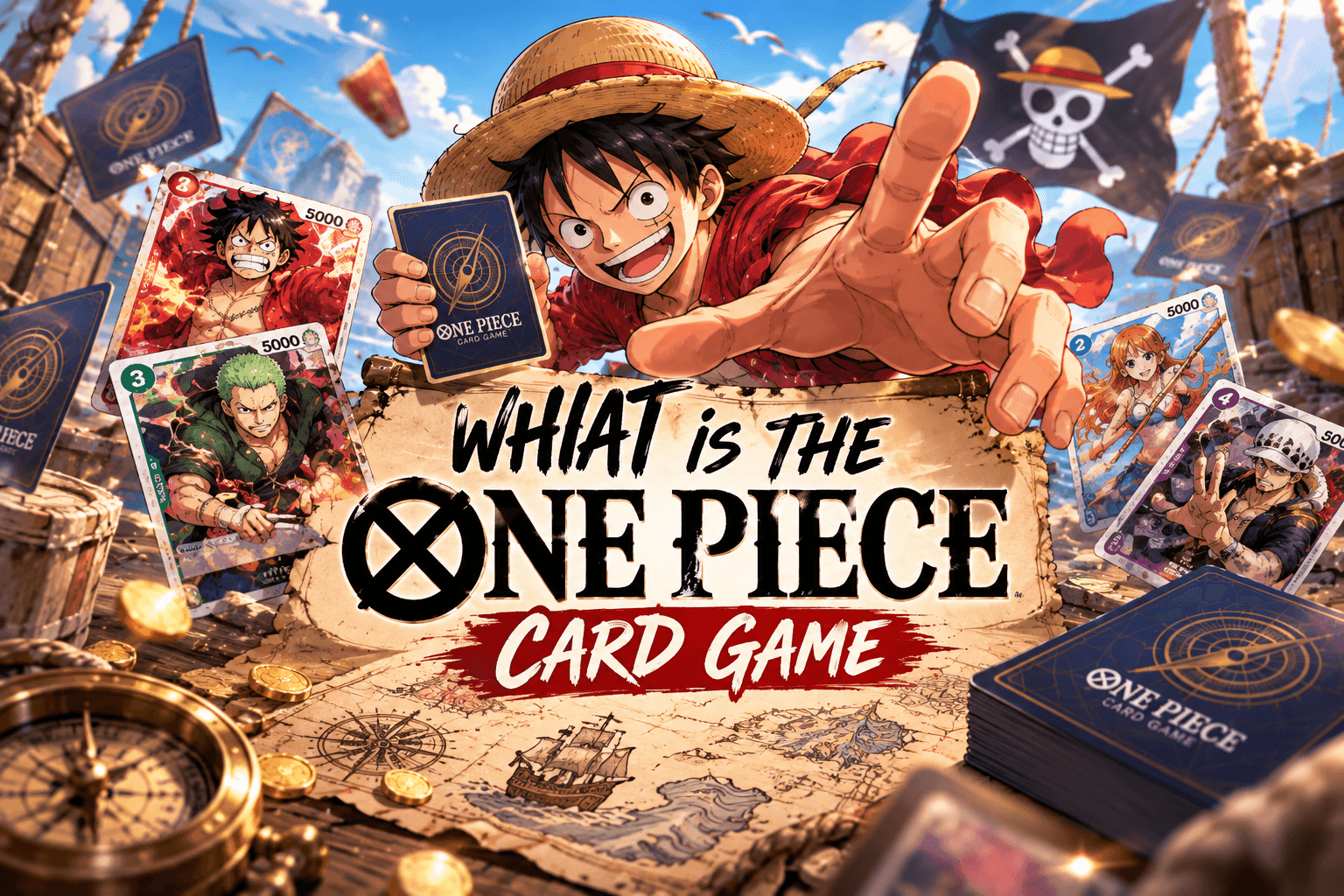
What Is the One Piece Card Game? A Complete Beginner's Guide
The One Piece Card Game runs on a resource called DON!!, and the whole game lives in one decision: do you spend a DON!! to play a card, or attach it to a character to make it hit harder?
That single choice, repeated every turn, is what separates this game from almost every other trading card game.
Launched in December 2022 by Bandai, it's now eighteen main sets deep, with the full release history catalogued on Wikipedia. This guide covers the rules, the deck structure, and how to start. Rules detail comes from TCG Talk's beginner guide and the OPTCG rules reference.
What's in a deck
A One Piece deck has three distinct parts.
| Component | Requirement |
|---|---|
| Leader | Exactly 1 |
| Main deck | 50 cards matching your Leader's colour |
| DON!! deck | 10 cards |
Your Leader is the centrepiece. It carries a life value, a power stat and a special ability, and it defines your deck's colour identity and play style.
Every card in your 50-card deck must match your Leader's colour, and you can run up to 4 copies of any one card number.
The DON!! deck is separate from everything else and is where your resources come from.
How DON!! actually works
This is the mechanic worth understanding properly, because it's unusual.
During your main phase you give active DON!! cards from your field to your Leader or to any character you control. From there you have two options:
Rest a DON!! to pay a cost. This is the conventional use, spending resources to play cards.
Attach a DON!! to a character or Leader already in play for a flat +1000 power. No cost paid, no card played, just a permanent-feeling power boost on something already on the board.
So the same resource either develops your board or strengthens it. Most card games separate those two things into different card types. One Piece makes them compete for the same pool every single turn.
That's the strategic core. A player who always spends on new cards gets outmuscled in combat. A player who always pumps power runs out of board presence.
The turn structure
A turn runs through five phases: Refresh, Draw, DON!!, Main, End.
Refresh readies your cards. Draw takes a card. The DON!! phase adds resources. Main is where you play and attack. End wraps up.
One detail matters enormously: the player going first takes only one DON!! on their very first turn. That's the balancing mechanism for the first-player advantage, and it shapes how opening turns are played.
How you win
You win by reducing your opponent's Life to zero and then hitting their Leader once more.
Life cards aren't a counter, they're actual cards. You start with as many as your Leader prints, usually four or five, and when you take damage you move a Life card into your hand.
That produces something unusual: taking damage gives you cards. Falling behind on life means gaining resources, which keeps losing positions playable far longer than a simple life total would.
It also means the last point of damage is a separate hurdle. Stripping all the Life isn't enough; you need one more successful attack after that.
Starting out: what to buy
Three routes, cheapest first.
A Starter Deck. These come ready to play with a fixed Leader and a legal 50-card deck. For learning the game this is the correct first purchase, and no collection is required.
Singles. Once you know which Leader you want to build around, buying the specific cards is far cheaper than opening packs hoping for them.
Booster boxes. Good for collectors and openers, poor value if your goal is a specific functioning deck.
The main sets are the backbone, but Bandai also prints Extra Boosters (EB) and Premium Boosters (PRB) that sit outside the main numbering, which is worth knowing before you shop.
The colours and what they do
Your Leader's colour determines your entire card pool, so it's the first real decision you make.
Rather than committing to a colour before you understand the game, the usual advice is to pick a Leader whose character you actually like from the series. You'll play the deck more, and at beginner level the differences between colours matter less than familiarity with your own cards.
You can browse every printing across the One Piece catalog on JK Index to see what each colour's cards look like before committing.
What makes it different from Pokémon or Magic
Three things stand out if you're coming from another game.
The dual-use resource. DON!! paying costs or boosting power is genuinely novel. In Magic, lands only pay costs. In Pokémon, Energy only pays costs.
Damage gives you cards. Life cards going to hand means being behind has a built-in comeback mechanism.
The Leader is permanent. It never leaves play, never gets removed, and its ability is always available. There's no equivalent in Pokémon, and it's closer to a Commander in Magic than to anything else.
The game's scale in 2026
One Piece has released eighteen main sets since December 2022, running from OP-01 Romance Dawn through to OP-18, plus five Extra Boosters and two Premium Boosters.
That's roughly one main set per quarter sustained for four years, which is a healthy, established release cadence rather than a new game finding its feet.
The most recent additions are EB-05 Heroines Edition vol.2 on 30 October 2026 and OP-18 The Dominance of God on 20 November 2026.
How JK Index helps
We index the full One Piece catalog with its own sold history for every printing, including the Japanese releases alongside their English counterparts.
That second part matters more in One Piece than in most games, because Japanese sets release ahead of English ones and the two markets price differently. You can browse sets including Romance Dawn, Paramount War and Two Legends, track what you own in your portfolio, or check listings on the marketplace.
The takeaway
The One Piece Card Game is built around DON!! cards that either pay for what you play or add a flat +1000 power to something already in play. Choosing between those two uses every turn is the game.
A deck is one Leader, 50 cards matching its colour, and a 10-card DON!! deck. You win by stripping your opponent's Life to zero and landing one more hit on their Leader.
FAQ
What are DON!! cards in One Piece?
Your resource system. You can rest a DON!! to pay a card's cost, or attach it to a character or Leader already in play for a flat +1000 power. The same resource does both jobs.
How many cards are in a One Piece deck?
Exactly one Leader, a 50-card main deck matching the Leader's colour with up to 4 copies of any card number, and a separate 10-card DON!! deck.
How do you win the One Piece Card Game?
Reduce your opponent's Life to zero, then hit their Leader once more. Stripping all the Life cards isn't enough on its own; you need that additional successful attack.
What happens when you take damage?
A Life card moves into your hand. That means taking damage gives you cards, so falling behind on life comes with a built-in resource gain that keeps losing positions playable.
What does the Leader card do?
It defines your deck's colour identity and play style, and carries a life value, a power stat and a special ability. It never leaves play, so its ability is always available.
How do I start playing One Piece Card Game?
Buy a Starter Deck. They come ready to play with a fixed Leader and a legal 50-card deck, so you need no existing collection to sit down and play a game.
Who goes first in One Piece?
Either player can, but the player going first takes only one DON!! on their very first turn. That reduced resource is the game's balance for the first-player advantage.
How many One Piece sets are there?
Eighteen main sets since December 2022, running from OP-01 Romance Dawn to OP-18, plus five Extra Boosters and two Premium Boosters sitting outside the main numbering.