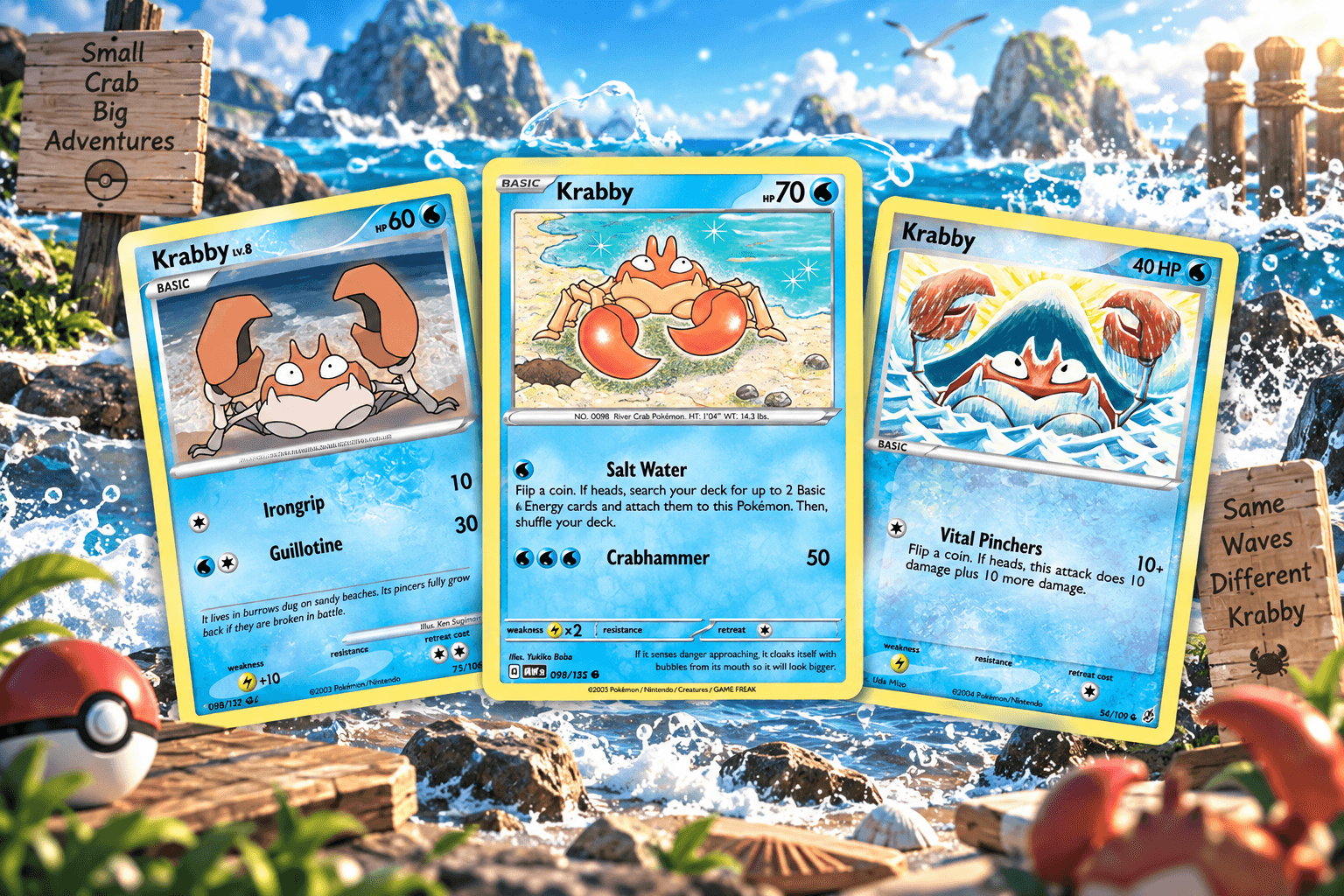
How Much Is a Krabby Card Worth in 2026?
Krabby is a card almost nobody sets out to collect, and that is exactly what makes its numbers interesting. Across more than forty prints in over twenty sets, the vast majority of Krabby cards sell for well under a dollar raw. The graded market, though, runs on a completely different logic. According to DoubleHolo's tracking, PSA 10 Krabby copies sell for a median of 13.8 times their raw near-mint price, and the largest premiums land on the plainest commons.
The headline here is a condition story, not a rarity story. The 2002 Expedition reverse holo, a card that looks like two-dollar filler, has cleared roughly $479 in a PSA 10 against a raw price near twenty dollars. A 2000 Topps Chrome oddity reaches close to $300 slabbed. And the original 1999 Fossil printing hides a famous Wizards-era error that trades around ninety dollars on its own. None of that surfaces if you only glance at raw prices.
So Krabby is really a grading-arbitrage card: cheap in a binder, occasionally valuable in a slab, and unforgiving if the copy does not gem. This guide ranks every Krabby worth knowing, runs the actual grading math on the ones that matter, and flags where the numbers only work on paper. Figures reflect recent sales and move with the market.
Krabby card value 2026: the top variants ranked
Pricing is drawn from PSA sold comps, Packmagik, DoubleHolo, PriceCharting, and eBay realized sales as of 2026. PSA 10 figures on the thinnest cards rest on limited sales, so treat the very top of the table as directional rather than fixed.
| Rank | Card | Set (Year) | Raw NM | PSA 10 |
|---|---|---|---|---|
| 1 | Krabby Reverse Holo #115/165 | Expedition (2002) | $18–$22 | ~$479 (est) |
| 2 | Krabby #98 | Topps Chrome Series 2 (2000) | $40–$60 | ~$293 |
| 3 | Krabby 1st Edition | Base Expansion Pack, JP (1997) | ~$5 | ~$156 |
| 4 | Krabby #51/62 1st Edition | Fossil (1999) | $1.50–$2 | ~$90–$100 |
| 5 | Krabby Error, incomplete symbol | Fossil (1999) | ~$90 (variant) | condition-based |
| 6 | Krabby Master Ball #098 | 151, JP (2023) | ~$11 | ~$80 |
| 7 | Krabby #51/62 Unlimited | Fossil (1999) | ~$1.15 | ~$98 |
| 8 | Krabby Reverse Holo #098 | 151 (2023) | ~$0.55 | ~$42 |
The pattern to notice: almost none of the value sits in raw prices. On Krabby, the slab is where the money lives, and the biggest multiples belong to old commons that are simply hard to find in gem-mint condition.
Krabby Expedition Reverse Holo value 2026
This is the Krabby that turns heads once you look past raw prices. The 2002 Expedition reverse holo trades around eighteen to twenty-two dollars raw, yet Packmagik's data puts a PSA 10 near $479, one of the largest raw-to-graded jumps on any Krabby card. Graded-focused guides such as Slabfolio point to the same card, noting that Expedition belongs to the condition-sensitive e-Reader era, where edge chipping and surface flaws keep gem populations low.
That scarcity of clean copies is the entire reason the PSA 10 figure is so high. It is a genuine chase, but also a risky grade: the same fragility that props up the price is what stops most raw copies from reaching a 10. If you want this card graded and cannot assess e-Reader surfaces confidently, buying it already slabbed is the safer route.
Krabby Topps Chrome Series 2 value 2026
The oddity, and the one that scrambles price lookups. The 2000 Topps Chrome Series 2 Krabby comes from a chrome-finish set produced outside the main Pokémon card game, and it carries real graded value. Cardbase lists a PSA 8 around $300, and DoubleHolo estimates a PSA 10 near $293, making it one of the priciest Krabby slabs in circulation.
Because it is a non-standard release, it appeals mainly to Topps and cross-brand collectors rather than to set builders. The practical warning is simple: do not confuse it with the common Fossil Krabby, which looks broadly similar but is worth a small fraction of the Topps version.
Krabby Fossil 1st Edition and the famous error value 2026
The vintage anchor, plus a collector curiosity. The 1999 Fossil Krabby #51/62 is a common, with 1st Edition raw copies around a dollar-fifty to two dollars and PSA 10s landing near ninety to one hundred dollars. The Unlimited version is even cheaper raw, roughly a dollar, yet still reaches a similar graded figure, another illustration of the common-card grading premium that defines this species.
The more interesting version is the error. Some unlimited Fossil copies left the factory with an incomplete set symbol, a well-known Wizards-era mistake that DoubleHolo pegs as the most valuable Krabby variant at roughly ninety dollars in its own right. For collectors who prefer Japanese vintage, the 1997 Base Expansion Pack 1st Edition Krabby reaches about $156 in a PSA 10 from a raw price near five dollars.
Krabby 151 and modern prints value 2026
The affordable modern tier. The 2023 Scarlet and Violet 151 Krabby #098/165 is about a dollar raw, with the Japanese Master Ball reverse holo the standout at around eleven dollars and a PSA 10 near eighty. The standard 151 reverse holo is pocket change raw but still reaches roughly forty dollars in a PSA 10, once again showing how much of Krabby's value comes from grading rather than rarity.
Beyond those, the Generations, Sword and Shield, Unbroken Bonds, and Phantom Forces prints are bulk, with graded copies sitting in the twenty to forty dollar range only when flawless. These are fun, cheap pickups and occasional grading experiments, not investments.
Should you grade a Krabby card in 2026?
Krabby is a grader's card more than a buyer's card, but only for specific prints and only in top condition. Here is the honest math.
Expedition Reverse Holo #115 grading math:
- All-in cost: roughly $25 to $35 on the value tier plus shipping
- Raw copy: about $20
- PSA 9 clears well over $100; PSA 10 has reached near $479
- Verdict: the best grading upside of any Krabby, but e-Reader gem rates are low, so this is a real gamble on centering and edges
Fossil 1st Edition #51 grading math:
- All-in cost: roughly $30
- Raw copy: about $2
- PSA 9 lands around $30 to $50; PSA 10 near $90 to $100
- Verdict: worth it only on a pack-fresh copy that can realistically reach a 10, since a 9 barely clears cost
151 Reverse Holo #098 grading math:
- All-in cost: roughly $30
- Raw copy: about $0.55
- PSA 10 tops out near $42
- Verdict: skip unless you are confident of a 10, and even then the margin is thin
Topps Chrome #98: this one already lives in the graded market, so buy it slabbed rather than gambling on a raw submission and cross-region logistics.
Which Krabby card should you actually buy in 2026?
Under $5: a raw 151 Krabby or a Fossil 1st Edition, the cheapest way into the character, with a lottery ticket attached if you later grade a clean copy.
Around $20: a raw Expedition reverse holo, the single most interesting Krabby to own and the one with genuine graded upside.
$90 to $160: a slabbed Fossil error, a Japanese Base Expansion Pack PSA 10, or a graded Topps Chrome for the oddity collector.
$300 to $480: a PSA 10 Topps Chrome or, if you can source one, a PSA 10 Expedition reverse holo, the top of the Krabby market.
Final take
Krabby is proof that cheap and worthless are not the same thing. Nearly every copy is a common you could pull from a bulk bin, yet the species carries one of the higher raw-to-graded multipliers in the hobby, driven by condition-sensitive vintage prints and a couple of true oddities. The Expedition reverse holo is the card to watch, the Topps Chrome and the Fossil error are the curiosities worth knowing, and the modern 151 prints are cheap fun with a small grading kicker.
Buy raw if you just want a Krabby on the shelf. Buy graded if you want the value, because with this card the slab is where almost all the money lives. And before you send anything in, weigh the gem odds honestly, since Krabby rewards clean copies and quietly punishes everything else.