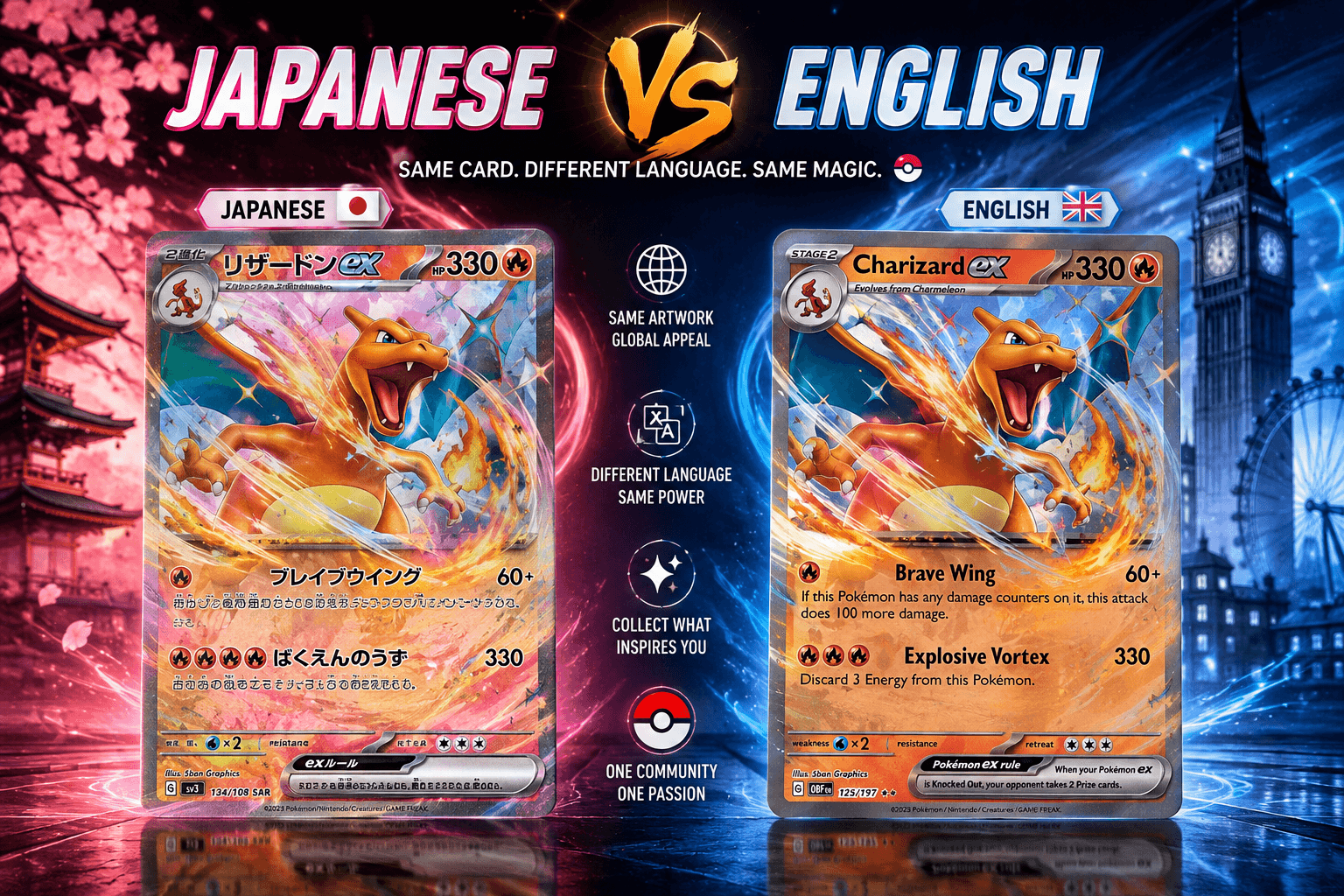
Japanese vs English Pokemon Cards: Which Holds Value Better in 2026?
Japanese vs English Pokemon Cards: Which Holds Value Better in 2026?
Published by JK Index · Updated August 2026
Japanese and English cards each keep value for different reasons, so which holds better in 2026 depends on your goal (resale/liquidity vs. lower cost / collector appeal).
That's the honest one-line answer. The longer analysis has to acknowledge that "which is better" is the wrong question — the two languages behave as different investment products with different demand curves, different scarcity dynamics, and different collector audiences. Understanding which one wins for a specific goal is what actually matters in 2026.
Track live comps for both language segments across the JK Index Pokemon TCG index.
Japanese vs English Pokemon cards: 2026 market direction
The default English preference for investors remains genuinely dominant, and it's worth understanding why before you consider deviating. On r/PokeInvesting, the anchor thread that keeps getting cited on this specific comparison lays out the position directly in its title: "Investing in Japanese cards vs English — seems Japanese [is cheaper but English resells higher]." That's the working consensus. English carries the resale premium; Japanese carries the entry-price advantage.
Japanese trades cheaper partly because the print-run mechanics differ meaningfully from English. On r/PokemonCardValue, a detailed pull-rate breakdown captured why: "Boxes are guaranteed 3 ARs (IRs in English) and 1 SR+, which can be an ex full art, a trainer full art, a hyper rare gold card, or an SAR." That guaranteed hit rate flattens the top-tier chase scarcity — every Japanese box produces roughly the same number of headline cards, which caps the singles ceiling but also reduces the "gamble" component of opening.
When Japanese Pokemon cards outperform English
The Japanese case has specific conditions where it wins genuinely. Japanese-exclusive prints — cards that never got English releases — are the cleanest example. On r/PokeInvesting, one contributor distilled the point into a single line: "Exclusives are the key." When a card is only available in Japanese, the scarcity math flips — international demand can't be met by the English print run because there isn't one, and Japanese sealed becomes the only source.
Long-term Japanese sealed positions bought early have produced genuine multi-year gains for the collectors willing to hold. On r/PokeInvesting, a five-year retrospective captured the compounding pattern: "Majority of the collection was purchased in February '21. Thought people might like to see the numbers at the 5 year milestone." Those five-year holds ended up compounding at rates that rewarded the patience — but the timeline was five years, not five months.
Why English Pokemon cards hold value better in 2026
English demand is bigger globally, and the graded resale market is meaningfully deeper for English cards specifically. PSA-graded English chases sell faster and command higher premiums than PSA-graded Japanese equivalents — the same underlying card, in the same condition, in a different language slab, clears different prices. The pattern shows up consistently in resale threads across r/PokeInvesting discussions on the same core question.
Print-run scarcity dynamics also favor English on the ultra-high-end tier. On r/PokeInvesting, a detailed take on English QC captured the specific mechanic: "English sets with bad QC leads to low PSA 10 rates, which is why chase cards ... command such high prices." Japanese cards, by comparison, have consistently better print quality — which means higher gem-mint rates, which means larger PSA 10 populations, which means lower price ceilings on the top-tier chase cards. The QC gap is a genuine structural reason English tops the value chart at the very top end.
Japanese vs English Pokemon cards: practical buying strategy for 2026
Three profiles cover most collectors, and the right answer depends on your goal.
If you want liquidity and top-dollar flips, favor English graded singles. The market bias is real and durable. On resale-focused threads, the same rule keeps showing up on r/PokeInvesting: "If you want the most value, you go PSA." Combined with the English preference in the resale market, PSA-slabbed English chases remain the highest-liquidity position.
If you want cheaper entry, better pull-rate satisfaction, or unique art, buy Japanese sealed or singles. On r/PokemonTCG, one aesthetics-first collector framed the case honestly: "and all the other sets are like half the price or cheaper in Japanese. I don't really care about the value of the card or the language, I'm only interest in collecting the art of what I pull, I even think Japanese cards have better quality." That's a legitimate position — the collector-satisfaction return is real, even if the resale premium is lower.
For a hybrid approach that captures the best of both, collect Japanese for the fun and buy English for the resale. On r/PokeInvesting, a specific mixed-portfolio strategy has been well-articulated: "I came to the conclusion that I should invest in chase cards in English and collect the same cards or others in Japanese." That's the working framework for anyone who wants both the investment liquidity AND the collector-satisfaction upside.
Verdict: Japanese or English Pokemon cards in 2026?
Both languages keep value, but as of 2026 English is the safer pick for investment liquidity and top resale. Japanese offers lower cost entry, better pull guarantees, and occasional upside on exclusives.
Using both — collect JP, invest EN — is the sensible split that most experienced Pokemon TCG participants converge on over time. Before committing capital to either segment, cross-check current PSA-graded comps on JK Index Marketplace — the English resale premium is genuinely quantifiable, and knowing the specific spread on the cards you're targeting is the difference between guessing and knowing.