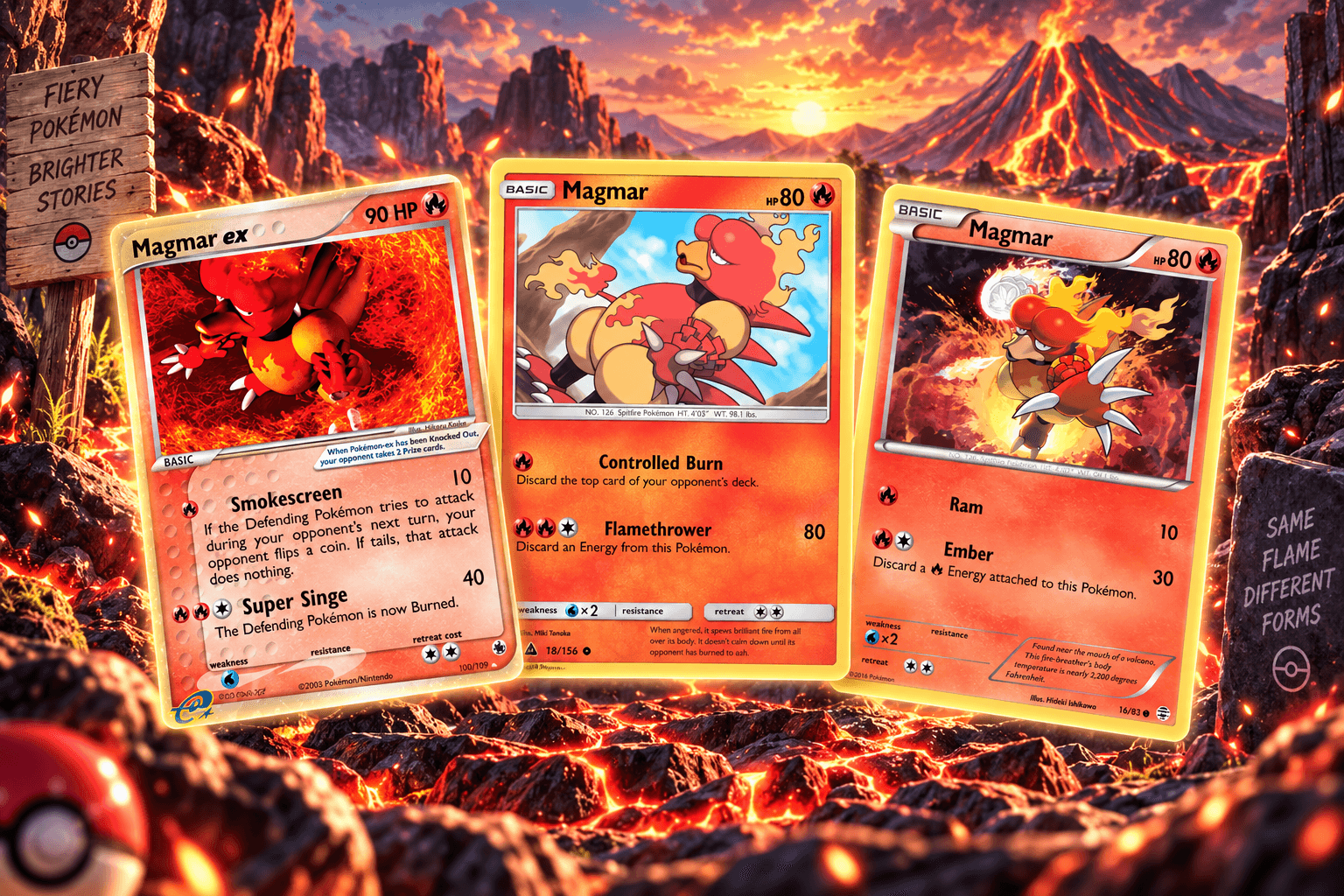
Magmar Card Value 2026: Every Print Compared
Prices based on recent sold listings | Updated September 2026
Magmar has been in the TCG since day one and has never once been the most exciting card in any set it appeared in. Not in Base Set, where Charizard consumed all the oxygen. Not in Fossil, where the prehistoric trio stole the spotlight. Not in Gym Heroes, where Blaine's Magmar played second fiddle to the bigger Gym Leader chase cards. Not in Ruby and Sapphire, where the Magmar ex existed in the shadow of Blaziken ex.
And yet, when you line up every Magmar card printed across 27 years, the collection is more interesting than any individual card's resume would suggest. Fifty-eight unique cards across 57 sets. A price ceiling of $64 raw. A grading multiplier on one modern card that hits 1,170x. A combined collection value north of $3,000 that has appreciated 294.7% from where it started.
Magmar is the card line that proves you do not need a single breakout star to build a collection worth owning. You just need depth, consistency, and 27 years of showing up.
The Headliner That Nobody Headlines
Magmar ex | Ruby and Sapphire #100 (2003) Raw NM: ~$64 | PSA 10: ~$2,588
The most valuable Magmar card exists quietly at the top of the line. Magmar ex from the original Ruby and Sapphire set was part of the first wave of ex-era cards, and its value reflects both the EX-era appreciation trend and the specific scarcity of Gem Mint copies. Only 4.2% of 1,550 PSA submissions have earned a 10. That is a brutally low rate, driven by the early ex-era print quality issues that plague many cards from this set.
At $64 raw, this card is accessible by EX-era standards. The $2,588 PSA 10 is where the real collector interest sits, but reaching that grade requires a copy that survived 23 years in perfect condition. If you have one that might qualify, the grading submission is a straightforward decision. For the right service at this price tier, our PSA vs CGC vs BGS guide covers the options.
The WOTC Foundation
Magmar's vintage cards are not expensive individually. What they offer instead is presence across the entire WOTC era, which makes them the backbone of a timeline collection.
Magmar | Base Set #36 (1999) at $3 to $5 raw. Card number 36 in the original 102. A non-holo rare that every collector who opened Base Set packs had a chance at pulling. The 1st Edition version pushes to $15 to $25. Not glamorous, but it is the beginning of the Magmar TCG story, and that starting point carries permanent significance.
Magmar | Fossil #39 (1999) at $0.81 raw. The second English Magmar card, printed the same year as the Base Set version. Fossil Magmar has gained 211% since release according to tracking data, which sounds dramatic until you realize the starting point was measured in pennies. The 1st Edition version trades around $4.80 with a PSA 10 value of $362.
Blaine's Magmar | Gym Heroes #37 (2000) at $3.90 to $8.79 raw. The Gym Leader connection makes this one matter beyond its price tag. Blaine was the Cinnabar Island Gym Leader, and Magmar was his signature Pokemon. Ken Sugimori illustrated this card, which gives it the official art pedigree that collector purists value. The 1st Edition version carries a premium, and the PSA 10 at $229 reflects solid grading demand.
Magmar | WOTC Promo #44 (2001) at ~$26 raw. A promotional card from the WOTC Black Star Promo series. At $26, it is the second most expensive raw Magmar card behind the Ruby and Sapphire ex. WOTC promos from this era have been climbing across the board, and this Magmar is no exception. The promo distribution was limited enough that top-condition copies are legitimately scarce.
Magmar | Expedition (2002) at ~$5.26 raw. The e-Card era entry. Expedition was the first e-Card set, and every card from it benefits from the broader e-Card appreciation. At $5.26, the Magmar is affordable but positioned to climb if the set continues its trajectory.
Magmar | Neo Genesis #40 (2000) at ~$2.80 raw. The Johto-era Magmar. Neo Genesis was the set that introduced Gen 2 Pokemon to the English TCG, and Magmar appeared as a returning Gen 1 representative. Clean artwork, fair price, fills the era slot. The 1st Edition version at $4.02 pushes into modest premium territory with a PSA 10 around $101.
What makes the WOTC spread compelling is the visual journey. Base Set Magmar looks like a creature from 1999, because it is. The illustration style, the card frame, the holo pattern on the rare. Fossil Magmar is a different artist, different pose, different set aesthetic. Gym Heroes adds the Blaine narrative. Expedition shifts to the e-Card frame. Each card looks and feels like a different era because it is a different era. That progression across five to six cards costing a combined $40 to $50 gives you a visual history of early Pokemon TCG design that most collectors overlook because no single card in the set screams "chase."
The Hidden Grading Play
Here is the number that no competitor page contextualizes.
Magmar | Brilliant Stars #19 (2022) Raw NM: ~$0.20 | PSA 10: ~$234
That is a 1,170x multiplier. Twenty cents to $234. It is one of the highest return multiples for any Magmar card, and it exists because almost nobody bothers grading a $0.20 common from a modern set. The PSA 10 population is tiny. The few copies that have been graded in Gem Mint carry a premium that reflects their rarity at the top grade, not the card's inherent collectibility.
This is not a reliable grading play. The odds of a random Brilliant Stars common grading PSA 10 are decent (modern print quality is good), but the cost of grading ($25+) means you need to be very confident the card is flawless. It makes sense as part of a bulk submission where the marginal cost per card is low. It does not make sense as a standalone submission.
But the number is real, and it tells you something about how thin the graded market is for non-chase modern cards. If you are already sending a batch of Brilliant Stars cards to PSA and have a clean Magmar sitting in the pile, include it.
The Magby to Magmortar Line
Magmar sits in the middle of a three-stage evolution line that was built across two different Pokemon generations. Magby (the baby pre-evolution from Gen 2) comes first. Magmar is the middle stage. Magmortar (the Gen 4 evolution via Magmarizer trade item) is the final form.
This cross-generational construction gives the evolution line a unique collecting property. Magby cards exist primarily in the Gen 2 through Gen 4 era. Magmar spans from Gen 1 through the present. Magmortar starts in Gen 4 and runs through modern sets. Building the complete line across all three Pokemon requires sourcing cards from WOTC sets, EX-era sets, Diamond and Pearl sets, and Scarlet and Violet sets. That breadth turns a simple three-card evolution into a multi-era project.
The combined Magby/Magmar/Magmortar collection runs roughly $4,000 to $5,000 total, with the Magmar ex and various Magmortar Lv.X and GX cards driving the premium end. It is a mid-budget project that gives you one of the more visually interesting Fire-type evolution lines in the franchise. The three-stage progression from baby form through middle evolution to fully realized cannon-armed final form is one of the better visual narratives in the Fire-type roster, and each stage has its own era of peak relevance. Magby belongs to the Gen 2 era. Magmar spans from Gen 1 through the present. Magmortar defines the Gen 4 period. The collection mirrors the franchise's own growth across generations.
The Secret Wonders Spike
One data point worth flagging: the Magmar from Secret Wonders is up 141% in the last 30 days. That is an outlier move for a card that previously traded at $1.50 to $2. The cause appears to be a combination of Diamond and Pearl era collecting interest and thin market liquidity. When only a few copies of a card trade per month, a single motivated buyer can move the price significantly.
Whether the 141% holds depends on whether follow-through demand materializes. If other DP-era Magmar cards start climbing too, it signals genuine generational interest. If the Secret Wonders card reverts while nothing else moves, it was a blip. Worth monitoring, not worth chasing.
Everything Under $2
The majority of Magmar cards trade in pocket change territory.
- Magmar, SV 151 #126 at $1.69. The modern Kanto callback
- Magmar, Evolutions #20 at $1.30. The Base Set nostalgia reprint
- Magmar, Call of Legends at $2.12. HGSS-era reprint set with the shattered-ice holo variant
- Magmar, Furious Fists at $0.18. XY-era filler
- Magmar, Paldean Fates at $0.19. Modern era bulk
- Magmar, Journey Together at $0.06. The floor
The ten cheapest Magmar cards combined cost about a dollar. That is the kind of accessibility that makes it possible to build the bottom half of the collection during a single TCG marketplace browse session without thinking twice about any purchase.
Conclusion
Twenty-seven years, 58 cards, and not one of them was ever the chase card of its set. Magmar's collection is built on quiet consistency rather than explosive moments, and that consistency has produced a combined value of $3,000+ with nearly 300% lifetime appreciation. Sometimes the Pokemon that never headlines is the one worth collecting.
For pricing and set data, visit JK Index. For protecting vintage WOTC cards like the Base Set and Fossil Magmar prints, our storage guide has the essentials.
FAQs
What is the most valuable Magmar card?
Magmar ex from Ruby and Sapphire (#100) at approximately $64 raw. PSA 10 copies trade around $2,588. The 4.2% Gem Mint rate across 1,550 submissions makes top-grade copies genuinely scarce.
How many Magmar cards exist?
58 unique cards across 57 sets in English and Japanese printings. Magmar has appeared in more sets than almost any other non-starter, non-legendary Gen 1 Pokemon.
What is the 1,170x grading multiplier?
The Brilliant Stars Magmar (#19) trades at $0.20 raw and $234 in PSA 10. The multiplier exists because the PSA 10 population is extremely small. Almost nobody submits a $0.20 common for grading, so the few Gem Mint copies carry an outsized premium.
Is Blaine's Magmar worth collecting?
At $3.90 to $8.79 raw, it is one of the better-value Gym Leader cards in the WOTC era. The Ken Sugimori illustration and the Blaine narrative connection give it collector significance beyond its price. The 1st Edition version at PSA 10 ($229) is a legitimate grading target.
How does Magmar relate to Magmortar?
Magmortar is Magmar's Gen 4 evolution, added in Diamond and Pearl (2006). Magmar evolves via trade while holding a Magmarizer item. Building the complete Magby/Magmar/Magmortar line across all eras creates a cross-generational collection project.
Why has the Secret Wonders Magmar spiked 141%?
Likely a combination of Diamond and Pearl era collecting interest and thin market liquidity. A few motivated buyers can move prices significantly when only a handful of copies trade per month. Monitor whether the spike holds before treating it as a new price level.
Can I build a Magmar collection on a budget?
The bottom half of the collection (roughly 30 cards) costs under $20 total. The premium end is concentrated in the Ruby and Sapphire ex ($64), the WOTC Promo ($26), and the Blaine's Magmar 1st Edition ($9). Excluding those three, the entire remaining collection costs well under $100.