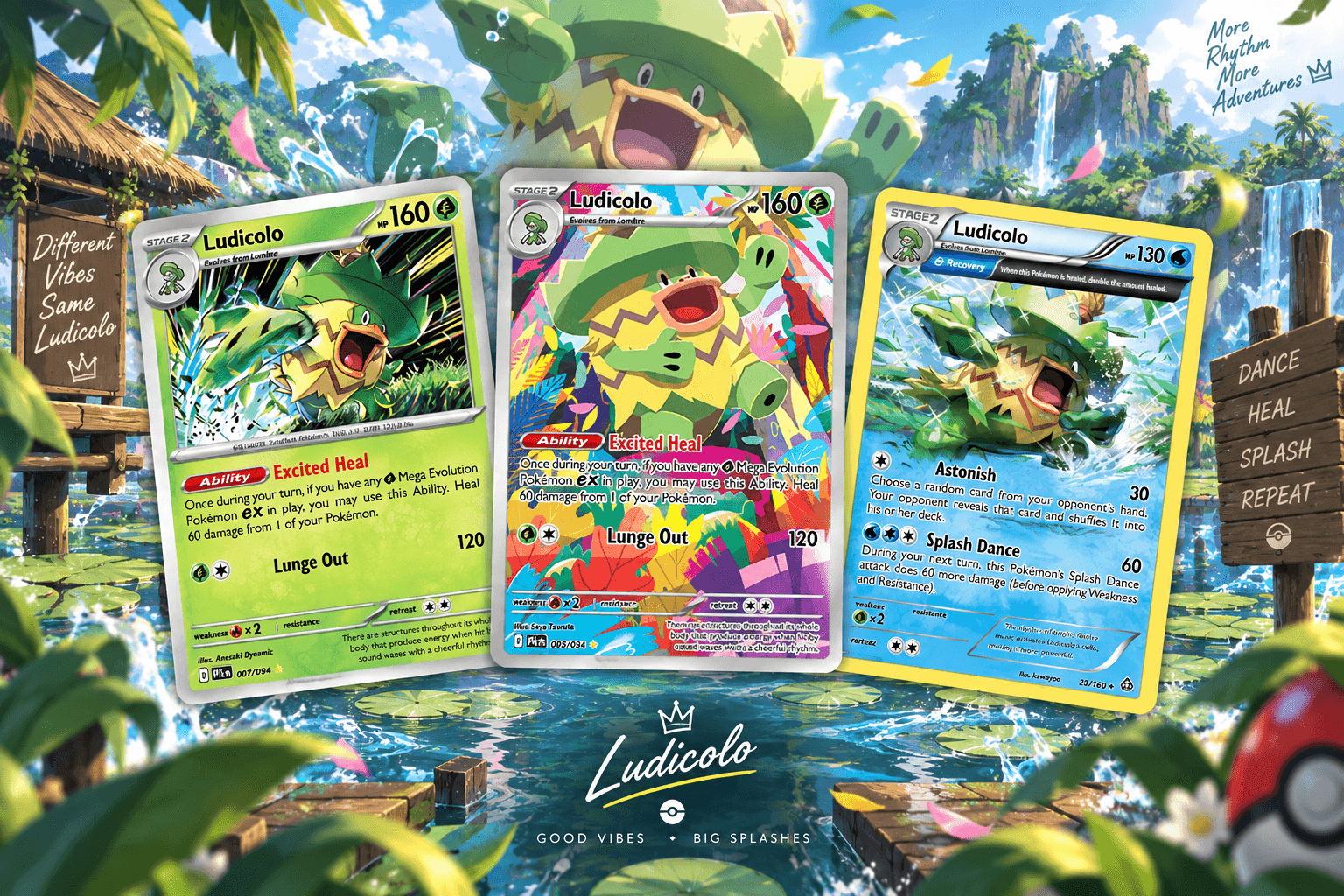
Ludicolo Card Value 2026: Every Print Compared
Published by JK Index · Updated September 2026
Some Pokemon characters earn their collector following through raw power. Charizard burns. Mewtwo dominates. Rayquaza looms over the skies of the franchise like a green serpent god. And then there is Ludicolo, a dancing pineapple duck in a sombrero that earns its following by being, quite simply, one of the most joyful creatures in the entire Pokedex. Nobody looks at a Ludicolo card and thinks about competitive metagames or investment returns. They look at it and smile. That emotional response is worth something in a hobby that sometimes forgets collecting is supposed to be fun.
Pokemon Wizard tracks 25 priced Ludicolo variants at an average of $6.20 per card, with the catalog gaining 36.4% year to date. PokePrices maps 32 cards across 12 sets, with the Sandstorm Holo topping raw pricing at $40 and the EX Deoxys Reverse Holo reaching a genuinely surprising $2,200 at PSA 10. That last number catches people off guard. A Ludicolo card at $2,200 graded. Not a misprint, not an error. A stamped Reverse Holo from 2005 with a PSA 10 population so low that gem mint scarcity alone pushes it into four figure territory.
This guide covers every Ludicolo print that matters, the pop culture moment that put Ludicolo on the big screen, and where the genuine value hides in a catalog that most collectors walk past without looking closely enough.
Why Ludicolo is more than a meme
Ludicolo is Pokedex #272, a Water/Grass dual type that evolves from Lombre via Water Stone, which itself evolves from Lotad. The character debuted in Generation III as part of the Hoenn region, and its design pulls from a genuinely creative blend of cultural references. The sombrero shaped lily pad on its head, the pineapple textured body, the perpetual dance pose, and the broad billed face all combine into something that feels simultaneously silly and deeply endearing. The design has been credited to inspirations ranging from Mexican folk dancers to the Japanese kappa, a mythological water creature, giving Ludicolo a cross cultural identity that few Pokemon manage to achieve.
In the mainline games, Ludicolo carved a real niche as a rain team staple. The Swift Swim ability doubled its speed in rain, and the Water/Grass dual typing gave it defensive coverage that pure Water types lack. Competitive players who ran rain teams during the Ruby, Sapphire, and Emerald era remember Ludicolo as a genuinely useful team member, not just a mascot. That functional memory sits alongside the visual charm to give the character a layered appeal that goes deeper than the meme reputation suggests.
And then there is Miror B. The flamboyant villain from Pokemon Colosseum and XD: Gale of Darkness whose entire character revolves around dancing with a team of Ludicolo. For collectors who grew up playing the GameCube era Pokemon games, Miror B and his Ludicolo squad represent one of the most memorable villain encounters in the franchise. That specific nostalgia hits differently than the mainline game memories because the Colosseum games were played on the big screen in the living room, making the visual impact of Ludicolo's dancing more vivid and more persistent in the collector's memory.
The EX era Ludicolo cards that actually matter
Ludicolo's most valuable cards concentrate in the EX era sets from 2003 to 2007, which is the window where the character received its most significant TCG printings. The pricing across this era tells a story about how Holo Rare treatment in low print run EX era sets creates surprisingly strong value floors even for characters that are not traditional collector targets.
The EX Sandstorm Ludicolo Holo #7/100 anchors raw pricing at $40 to $53 on TCGplayer. Sandstorm was an early EX era set released in September 2003, and its print runs were modest by any measure. The set does not get the collector attention that Ruby and Sapphire or FireRed and LeafGreen receive, which keeps supply tight because fewer people think to crack sealed Sandstorm product for singles. That quiet neglect is exactly what supports Ludicolo's ceiling pricing at the raw tier.
The EX Deoxys Ludicolo Holo #10/107 trades at $8 to $12 raw for the standard Holo, with a PSA 9 clearing $105 on recent eBay sales. But the real story here is the Reverse Holo stamped variant from the same set, which PokePrices tracks at $16.53 raw and an astonishing $2,200 at PSA 10. That $2,200 figure is not a mistake. EX era Reverse Holo stamped cards carry notoriously low PSA 10 populations because the stamped foil treatment interacts with the card surface in ways that create microscopic imperfections visible under grading magnification. The result is a card where raw copies exist in reasonable numbers but gem mint graded copies are genuinely scarce.
The Crystal Guardians Ludicolo Delta Species sits at roughly $10 to $11 raw. The Delta Species mechanic changed Ludicolo's type from Water/Grass to Fighting, which creates a visually and mechanically distinctive variant that Delta Species completionists specifically target. The Secret Wonders Ludicolo Holo #13/132 at $5 to $6 raw rounds out the EX to Diamond and Pearl era coverage with a card that has been one of the biggest 30 day movers in the catalog per Sports Card Investor tracking.
Detective Pikachu Ludicolo: the big screen moment
The Detective Pikachu set delivered something that no other Ludicolo printing had managed before. It put the character on a movie theater screen and then captured that moment in cardboard. The Detective Pikachu Ludicolo #2/18 Holo is a Stage 2 card with the Table Service ability, featuring artwork that connects directly to the live action film where a CGI Ludicolo appears as a cheerful presence in the background of Ryme City.
Raw pricing sits at modest levels for the standard variant, but the PSA 10 slab market tells a different story. A PSA 10 Detective Pikachu Ludicolo Holo listed at $1,000 on eBay signals that the movie tie in carries weight among graded card collectors who value cross media provenance. Whether that listing reflects actual market depth or aspirational pricing from a single seller is debatable, but the listing itself shows that someone believes the movie connection has four figure value at the gem mint tier.
For collectors who remember sitting in a movie theater watching a photorealistic Ludicolo dance across a Ryme City plaza, the Detective Pikachu card captures that specific memory in a way that no other Ludicolo print can. Nostalgia does not always need to be vintage. Sometimes it is as recent as 2019.
Modern Ludicolo prints and the Journey Together surge
The most recent Ludicolo prints come from Journey Together and Phantasmal Flames, and the Journey Together Reverse Holo #37/159 has gained 166% over the past 30 days per PokePrices tracking. That kind of percentage gain on a modern Reverse Holo common is unusual, and it likely reflects a combination of the character's broader YTD momentum (36.4% across the full catalog) and specific collector attention on the Journey Together set as it matures past its initial launch window.
The Phantasmal Flames Ludicolo at $0.20 raw represents the current floor for the character. The Primal Clash prints from 2015 sit at $0.60 to $2 depending on variant, and the Platinum era print from 2009 trades at roughly $1.40. None of these modern and mid era prints carry individual significance on their own, but collectively they fill out a Ludicolo binder at negligible cost. If you want to own every era of Ludicolo representation from Hoenn through Paldea, the modern floor lets you do it for under $10 total across all prints below the EX era tier.
The Lotad and Lombre family collection
Ludicolo collecting extends naturally to the full evolutionary line. Lotad and Lombre both appeared across many of the same sets as Ludicolo, and building the three card evolution chain at each set creates a clean organizational framework for a family collection.
The Sandstorm set is the natural anchor point. Lotad, Lombre, and Ludicolo all appeared in EX Sandstorm, and assembling the trio from that set gives you a complete Hoenn evolution line from the same 2003 print run. The Ludicolo Holo at $45 raw is the expensive piece. Lotad and Lombre from the same set trade at $0.50 to $2 each. The full Sandstorm evolutionary trio costs roughly $48 total, which is a genuinely cohesive collecting unit that displays well and tells a complete character story from a single set.
For budget collectors, the Journey Together or Phantasmal Flames trios run under $2 total for the complete evolution chain. That accessibility is part of what makes Ludicolo a rewarding character to collect across eras. You can own the whole family at every budget level.
Should you grade a Ludicolo card in 2026?
The grading conversation on Ludicolo centers almost entirely on the EX era cards, where the grade multipliers justify the submission fee.
The EX Deoxys Reverse Holo stamped variant is the standout grading play. At $17 raw with a PSA 10 comp at $2,200, the theoretical return is extraordinary. The practical challenge is that EX era stamped Reverse Holos have extremely low PSA 10 hit rates. The stamped foil process from this era creates surface characteristics that graders flag under magnification, which means most submissions cap at PSA 8 or 9 even for cards that look clean to the naked eye. If you own one that presents flawlessly under angled lighting with no stamping artifacts, submit it immediately. But set your expectations at PSA 9, which still clears $100+ and covers the grading fee comfortably.
The Sandstorm Holo at $45 raw carries moderate grading upside. PSA 10 comps for EX era Sandstorm Holos vary by character, but the multiplier typically runs 3x to 5x from raw to gem mint. At $45 raw with a $50 grading fee, you need a PSA 10 comp above $150 to clear the math meaningfully. Check recent Sandstorm Ludicolo PSA 10 realized sales before committing. Cross reference the grading fees guide for broader economics.
Modern Ludicolo prints do not clear grading math at any tier. The Journey Together, Phantasmal Flames, and Primal Clash variants trade well under $5 at PSA 10. Keep them sleeved and enjoy them in the binder.
Which Ludicolo card should you actually buy in 2026?
Under $5 budget: Start with the Phantasmal Flames or Journey Together print at under $1 and build the full Lotad to Ludicolo evolution chain from the same set. You will have a complete family display for pocket change, and the Journey Together Reverse Holo's recent 166% surge suggests the set is drawing attention.
$5 to $15 budget: Target the EX Deoxys standard Holo at $10 or the Crystal Guardians Delta Species at $11. Both deliver genuine EX era provenance and holo treatment at accessible pricing. The Delta Species variant adds the Fighting type twist that makes it visually distinct from every other Ludicolo ever printed.
$15 to $55 budget: Target the Sandstorm Holo at $45 for the character's ceiling raw card. This is the definitive Ludicolo purchase for anyone who wants one card that represents the character at its best. Sandstorm era provenance, Holo Rare treatment, and a price point that sits well below most EX era Holo Rares from comparable sets.
$100 to $2,200 budget: Target the EX Deoxys Reverse Holo stamped variant in graded form. PSA 9 clears $100+ and delivers a genuinely scarce slab. PSA 10 at $2,200 is the Ludicolo grail for anyone who wants to own the single most valuable card in the character's catalog. Cross check current comps on JK Index Marketplace before purchasing at this tier. The number of available listings at any given time is extremely small.
The case for Ludicolo as a joy collection
There is a collecting philosophy that does not get discussed enough in guides that focus primarily on pricing and investment returns. Some collectors build around joy. They collect the characters that make them happy when they open the binder. They chase the artwork that makes them feel something warm and genuine when they look at it. They build collections that reflect their personality rather than their portfolio strategy.
Ludicolo is the embodiment of that philosophy. A dancing Water/Grass type with a lily pad sombrero and an infectious sense of rhythm. Nobody needs a Ludicolo card. But plenty of people want one, and the wanting comes from a place that has nothing to do with market data. It comes from the same place that made the character memorable in the first place. Pure, uncomplicated joy.
If that resonates with you, build the Ludicolo collection. Every era. Every set. Every variant. The whole catalog costs approximately $155 raw per Pokemon Wizard tracking. That is a complete character set that brings genuine happiness every time you flip to that page in the binder. Not every collection needs to be an investment thesis. Sometimes it just needs to be a collection of things you love.
Conclusion
Ludicolo carries a catalog with more depth than the dancing pineapple duck reputation suggests. A $2,200 PSA 10 from EX Deoxys that most collectors do not know exists. A $53 Sandstorm Holo that quietly holds value from the early EX era. A Detective Pikachu movie tie in that captured a pop culture moment. And a 36.4% YTD gain across the full catalog that says the market is starting to pay attention.
The character rewards collectors who approach it with genuine affection rather than purely analytical intent. The EX era cards deliver real vintage value. The modern prints fill out the binder at minimal cost. And the cultural footprint, from Miror B's dance battles to the Detective Pikachu big screen moment, gives Ludicolo a story that extends well beyond the standard TCG pricing conversation.
Cross reference the when to sell Pokemon cards guide for broader context on holding vintage mid tier characters, and check current pricing on JK Index before every purchase.
Frequently Asked Questions
What is the most expensive Ludicolo card?
The EX Deoxys Reverse Holo stamped variant at $2,200 PSA 10. By raw price, the Sandstorm Holo at $40 to $53 is the most expensive ungraded Ludicolo.
Why is the EX Deoxys Ludicolo Reverse Holo worth $2,200?
Extremely low PSA 10 population. The EX era stamped Reverse Holo process creates surface characteristics that cap gem mint rates, making PSA 10 copies genuinely scarce despite reasonable raw supply.
How many Ludicolo cards exist?
Pokemon Wizard tracks 25 priced variants. Card Codex lists 33 cards across 27 sets. PokePrices monitors 32 cards across 12 sets.
Is the Detective Pikachu Ludicolo valuable?
Modest raw pricing, but a PSA 10 listing at $1,000 suggests collectors value the movie tie in at the graded tier. The card connects to Ludicolo's live action big screen appearance.
Has Ludicolo ever received an EX, V, or ex card?
No. Ludicolo has never been printed with an EX, GX, V, VMAX, or ex rarity treatment. The character's highest rarity tier across the catalog is Holo Rare, which keeps ceiling pricing anchored in set era scarcity rather than rarity mechanics.
Is Ludicolo worth collecting in 2026?
For collectors who value joy, cultural charm, and EX era vintage depth at accessible pricing, absolutely. The full catalog costs approximately $155, the character has gained 36.4% YTD, and the Sandstorm Holo at $45 delivers genuine vintage holo provenance well below most comparable EX era characters.