How Much Is a Skyridge Crystal Charizard Worth in 2026?
Published by JK Index · Updated August 2026
Skyridge Crystal Charizard is the last WotC-era Charizard chase card.
Released May 2003 as the final set before Nintendo took over English Pokemon TCG production, Skyridge delivered the Crystal-type mechanic — a specific rarity treatment that only existed in three sets total. Crystal Charizard was the flagship of that mechanic.
This guide walks through 2026 pricing, the specific grading dynamics that make Crystal cards notoriously hard to slab, and honest buy guidance.
What Skyridge Crystal Charizard actually is
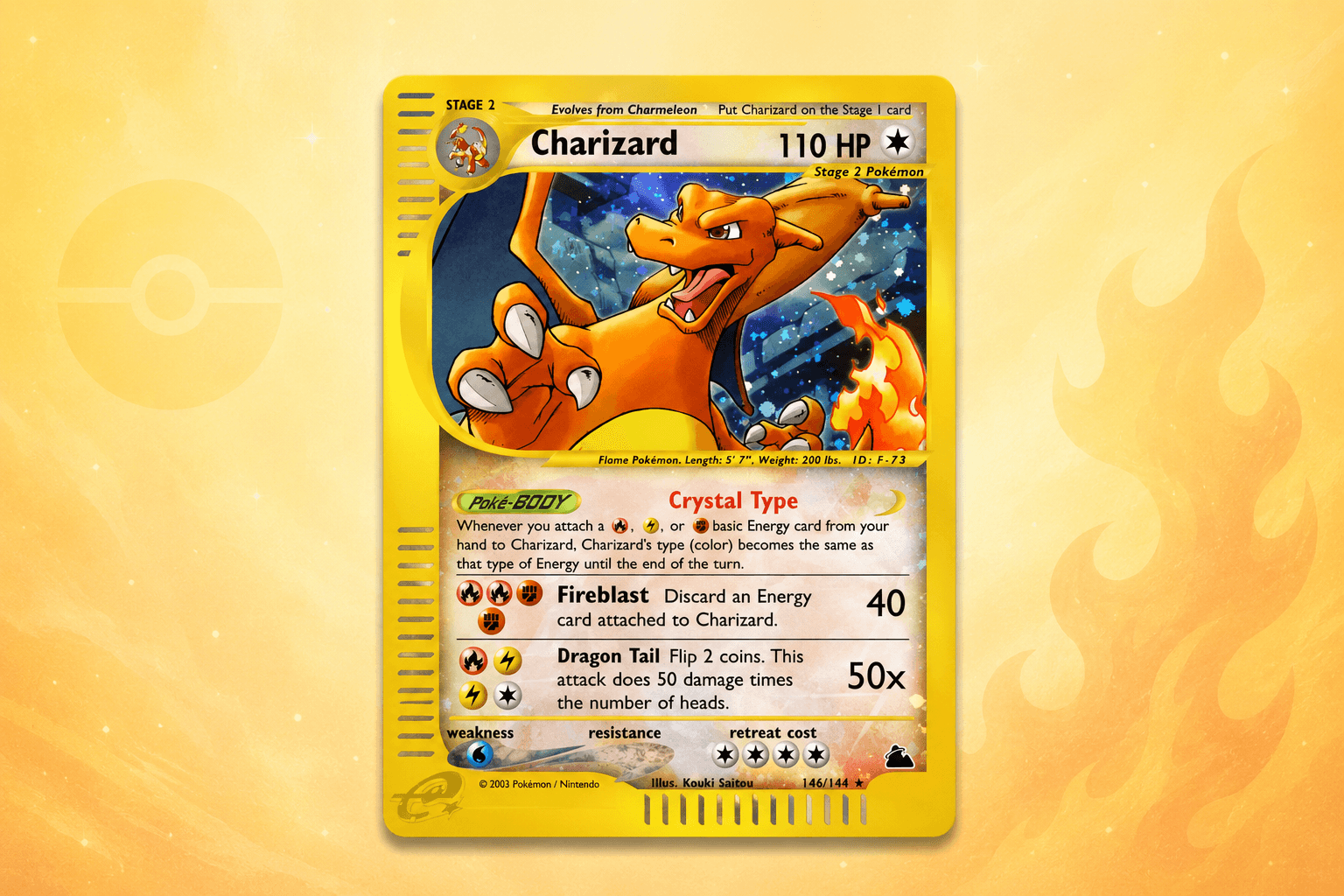
Skyridge Crystal Charizard is Card #146/144 — a secret rare beyond the standard checklist. Released May 2003. The card uses a translucent crystalline overlay pattern that no other Pokemon TCG print has ever replicated.
The Crystal-type mechanic existed in three sets: Aquapolis (2003), Skyridge (2003), and briefly in Japanese-only Pocket Monsters Card e series. Crystal Charizard specifically anchors the entire mechanic's collector attention.
For cross-reference on modern Charizard flagship pricing, the Charizard V card page and Charizard VMAX card page track live comps on the character's modern era.
Real 2026 comps for Skyridge Crystal Charizard
Pricing pulled from PSA sold-comp data and JK Index Pokemon TCG market feeds as of August 2026.
| Grade | Recent sale range |
|---|---|
| Raw NM | $2,400–$3,200 |
| PSA 7 | $4,200–$5,800 |
| PSA 8 | $7,500–$10,000 |
| PSA 9 | $11,500–$15,500 |
| PSA 10 | $16,000–$22,000 |
PSA 10 population sits at 62. That's genuinely rare — meaningfully tighter than most WotC-era Charizard variants outside 1st Edition Shadowless Base Set.
The three-year appreciation curve on Skyridge Crystal Charizard PSA 10 has been running at roughly 28% annually. Meaningfully faster than the wider Skyridge Crystal index over the same window.
Why Crystal cards are so hard to grade
The crystalline overlay treatment is what makes this card visually distinctive — and what makes PSA 10 grading brutal.
The specific crystalline surface exaggerates every fingerprint, edge nick, and handling mark. Corner condition on the shard-textured surface degrades faster than on standard holos. Even lightly-handled raw copies frequently grade PSA 8 or below.
The specific implication: raw NM Crystal Charizard at $3,000 does not automatically grade PSA 9 or 10. Most surviving copies cap at PSA 8 due to the surface-specific condition sensitivity.
Is Skyridge Crystal Charizard worth grading in 2026?
Almost always yes. The math clears at every realistic outcome.
Grading math:
- All-in cost: ~$150 PSA tier (declared value $5K+)
- Break-even minimum: PSA 6 recovers cost easily. PSA 6 sells for $3,000 average versus $2,700 raw + $150 fee = $150 profit at the worst realistic outcome.
- Real target: PSA 8 clears $8,750, PSA 9 clears $13,500, PSA 10 clears $19,000
- Downside: essentially none — every graded outcome returns above cost
When NOT to grade:
- Any visible whitening on the specific crystalline overlay
- Any observable back-side edge damage (Skyridge-era backs whiten similarly to Neo-era prints)
- Corner scuffs on the shard-textured surface (grades cap at PSA 7)
If the card has been sleeved since 2003 with no observable handling, submit. If there's any visible surface damage, sell raw — the grading downside on Crystal cards specifically is worse than typical vintage.
The four-point authentication test for Skyridge Crystal Charizard
Skyridge Crystal Charizard fakes exist but are usually poor quality. Four specific checks catch nearly every counterfeit.
1. Weight test. Real Skyridge-era cards weigh 1.7–1.9g. Fakes come in under 1.5g.
2. Crystalline surface texture. Real Crystal Charizard has a genuine tactile crystalline pattern that catches light at specific angles. Fakes use flat holographic printing that lacks the specific 3D depth. Touch the card in bright light — if the surface feels smooth rather than faceted, it's fake.
3. Set number verification. Skyridge Crystal Charizard is specifically Card #146/144 — a secret rare beyond the standard 144-card checklist. Verify this exact numbering in the lower-right corner.
4. Card back indigo tone. Real 2003 Skyridge backs carry a specific deeper indigo tone. Fakes tend to use lighter cyan that reads too bright in comparison photos.
Why Crystal Charizard sits at the WotC-era peak tier
Three specific dynamics support ongoing pricing.
Zero possibility of reprint. The Crystal-type mechanic existed only in 2003. Pokemon Company hasn't returned to it in 22 years and shows no signs of doing so. That's structural scarcity, not marketing-driven scarcity.
Charizard character-canon weight. The same brand-canon dynamic that anchors Base Set Charizard supports Crystal Charizard specifically. Cross-reference the Team Rocket Dark Charizard blog for the broader Charizard-variant market context.
**WotC-era finish. **Skyridge was the final English set produced by Wizards of the Coast. Post-2003 Nintendo-produced sets have qualitatively different print quality and holo treatment. Crystal Charizard is the specific end-of-era artifact.
Final take
If you have a Skyridge Crystal Charizard sleeved since 2003 with no observable surface handling, grade it. The math is generous even accounting for the crystalline-surface grade ceiling.
If you're buying — target PSA 8 at $8,750 for value, PSA 9 at $13,500 for the specific step-up tier, or PSA 10 at $19,000 for the grail-tier position. Skip raw purchases from sellers who can't clearly show crystalline surface condition in high-resolution angled photos.
Cross-check current PSA-graded comps on JK Index Marketplace before every purchase. The specific grade-tier price gaps on Crystal Charizard are meaningfully wider than most casual collectors realize.
Skyridge Crystal Charizard is the WotC-era Charizard that closed the door on the entire mechanic. Nothing about the supply floor changes going forward. The direction is one-way.