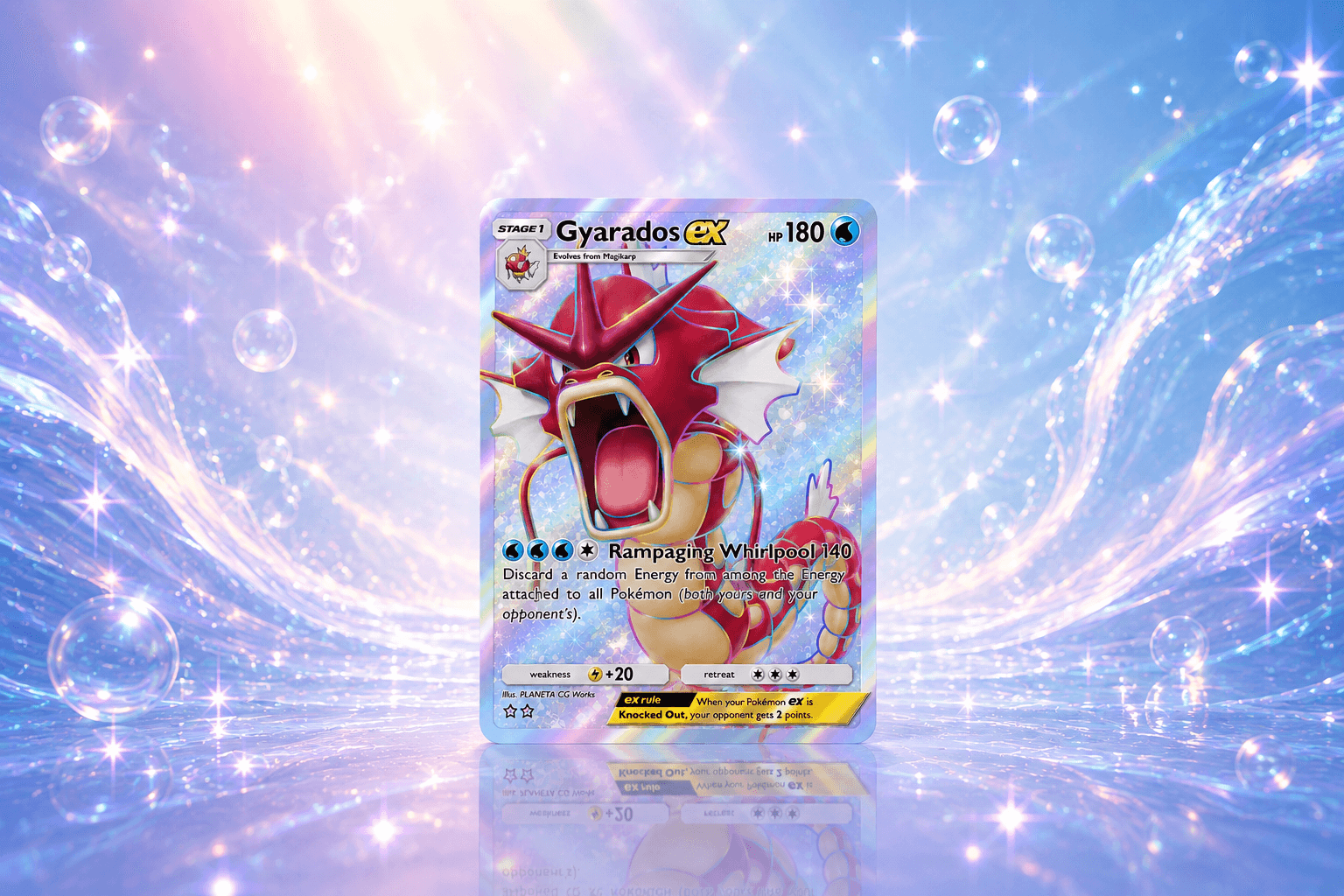
How Much Is a Shining Gyarados Worth in 2026 (Neo Revelation Guide)?
Published by JK Index · Updated August 2026
Here's the thing nobody tells you about Shining Gyarados.
The card only works because Gyarados was already the wrong color.
In the mainline Pokémon games, Gyarados is blue. Everyone knows this. But in the very first Pokémon Silver Version cartridge — released in 1999 — the game explicitly features a red Shiny Gyarados at Lake of Rage as a plot device. That red Gyarados is canon. It's why Shining Magikarp became gold (evolutionary logic: a gold Magikarp evolves into a red Gyarados). The Neo Revelation TCG designers weren't inventing anything — they were rendering the video game's actual canonical shiny into card form.
That specific narrative canon is why Shining Gyarados occupies a different collector position from every other Shining card. It's the only one that's supposed to look wrong. And that's why the market keeps repricing it upward.
What Shining Gyarados actually is
Shining Gyarados is Card #65 from the Neo Revelation set, released April 2001. It's one of four "Shining" rarity cards in that set — the mechanic WotC invented specifically to render video-game shinies into TCG form. The card features Gyarados in a deep red palette with black scaling accents, holo pattern concentrated on the illustration panel.
The Neo Revelation print run was smaller than the Neo Genesis / Neo Discovery sets that preceded it, and Shining rarity pull rates were roughly 1 in 216 booster packs. Combined with the narrower distribution of Neo Revelation English boxes, that produces the specific scarcity math that's kept Shining Gyarados in the collector conversation for 24 years.
Real 2026 comps for Shining Gyarados
Pricing pulled from PSA sold-comp data and JK Index Pokémon TCG market feeds as of August 2026:
| Grade | Recent sale range |
|---|---|
| Raw NM | $520–$720 |
| PSA 7 | $850–$1,150 |
| PSA 8 | $1,600–$2,200 |
| PSA 9 | $3,400–$4,800 |
| PSA 10 | $7,500–$10,500 |
PSA 10 population is 84 as of the most recent census update. That's tighter than Shining Magikarp (128) and comparable to Shining Charizard (approximately 68 without the reprint variant). The three-year appreciation curve on Shining Gyarados PSA 10 has been running at roughly 22% annually — meaningfully faster than the wider Neo-era index.
For collectors tracking modern Gyarados market behavior alongside this vintage anchor, the Gyarados card page provides useful cross-reference on how the character has held value across eras.
Is Shining Gyarados worth grading in 2026?
Almost always yes. Here's the honest math.
- All-in grading cost: roughly $40 PSA Value tier plus $8 return shipping. Round to $50 total.
- Break-even minimum: PSA 7 recovers cost immediately. PSA 7 sells for $1,000 average versus $600 raw + $50 fee = $350 profit at the worst realistic outcome.
- Real target: PSA 8 clears $1,900 median. PSA 9 clears $4,100 median. PSA 10 clears $9,000 median.
- Downside protection: even PSA 6 returns above raw plus fees.
The specific reason grading math works so well on Shining Gyarados is a known print defect — the red-to-black gradient on the Gyarados body tends to show minor centering issues on the top border, which historically caps PSA 10 hit rates at roughly 8-12%. That defect keeps the PSA 10 population tight, which keeps the graded premium wide. It's a genuine market inefficiency.
When NOT to grade: if the card shows any visible whitening on the back edges (a common Neo Revelation-era print quality issue), your ceiling is PSA 7. At PSA 7 the math still works, but the upside gets meaningfully compressed. Grade only if the card has been sleeved since 2001 and shows no observable handling.
The four-point authentication test for Shining Gyarados
Because Shining Gyarados has appreciated fast, fakes have entered circulation. Four specific checks catch nearly every counterfeit:
1. Weight. Real Neo-era cards weigh 1.7–1.9g. Fakes almost always come in under 1.5g due to cheaper card stock.
2. Rarity symbol. Look at the bottom-right corner of the illustration panel. Real Shining Gyarados has a small white star (⭐) — not the standard rare-symbol diamond. If you see a diamond or circle, the card is either a fake or a different Gyarados print from a different set entirely.
3. Holo pattern. The genuine Shining Gyarados uses a fine cosmos-foil pattern concentrated on the illustration only. Fakes tend to spread the holo across the entire card face (a mistake counterfeiters make because it's easier to reproduce). Real Shining cards keep the holo inside the art panel.
4. Card back. Turn it over. Real Neo-era backs have a slightly deeper indigo tone versus modern reprints. Fakes tend to use standard cyan that reads too light in comparison photos.
Four checks, roughly 90 seconds total. If all four pass, the card is legitimate.
Why the market keeps repricing Shining Gyarados upward
Three specific dynamics that most casual collectors don't think about:
First, the video-game canon connection. Red Gyarados is famous in Silver Version specifically — an entire plot arc turns on it. That narrative weight means Shining Gyarados isn't just a rare card, it's the TCG rendering of a specific canonical Pokémon moment. Cards with genuine video-game canon tend to hold value better than pure TCG artifacts.
Second, the "Shining" rarity mechanic ended with Neo Destiny. Shining as a rarity category existed only in Neo Revelation and Neo Destiny — total four cards across both sets. That's a genuinely finite universe, and Shining Gyarados is one of the two most iconic Shinings in the entire history of the mechanic (alongside Shining Charizard).
Third, evolutionary partnership with Shining Magikarp. Collectors chasing complete Shining sets need both — and Magikarp is the more accessible entry point, which means every Magikarp buyer eventually becomes a Gyarados prospect. That specific demand-funnel keeps the market for Shining Gyarados structurally supported.
Final take
If you have a Shining Gyarados that's been sleeved since childhood — grade it. The math is generous at every realistic grade outcome, and the 3-year appreciation curve suggests the ceiling still has room to move.
If you're buying — target PSA 9 for value at the $4,000 range. That's the honest sweet spot: verified authentic, high enough to command a real collector premium, entry point still below $5,000. Skip raw purchases from unverified sellers, and be prepared to walk from any listing under $500 raw that can't produce clear authentication photos.
The red Gyarados that started as a video game plot device is now one of the most quietly appreciating vintage cards in the entire English catalog. That's the whole story.