How Much Is a First Edition Machamp Worth in 2026?
How Much Is a First Edition Machamp Worth in 2026?
Published by JK Index · Updated August 2026
Here's the confusing part about First Edition Machamp:
Most of them came in a starter deck, not a booster pack.
Every kid who bought the 1999 Base Set 2-Player Starter Deck got a First Edition Machamp holo as the deck's featured card. That means the print run was massive by "1st Edition" standards — an order of magnitude higher than what "1st Edition holo" usually implies. So while the "1st Edition" tag pushes the price ceiling higher than most people expect, it doesn't push it as high as, say, a 1st Edition Charizard, where the starter deck path didn't exist.
Which is why this specific card sits in a strange market pocket — collectors know it's 1st Edition, but many don't know it's also mass-distributed for the era. That gap is the trade.
Real 2026 comps
The Machamp card index reference tracks live 2026 comps. Here's where the market sits:
| Version | Raw NM | PSA 8 | PSA 9 | PSA 10 |
|---|---|---|---|---|
| 1st Edition Holo (Starter Deck) | $85–$130 | $260–$360 | $580–$780 | $1,400–$1,900 |
| Unlimited Holo (Booster Pack) | $22–$38 | $85–$120 | $200–$280 | $420–$580 |
| Shadowless Holo (also Starter) | $180–$260 | $520–$720 | $1,200–$1,600 | $2,600–$3,600 |
The Shadowless 1st Edition Machamp is the most valuable version — and it's also the most misidentified. Roughly 40% of "1st Edition Machamp" listings on the secondary market are being marketed without noting shadowless vs shadowed distinction, which underprices the shadowless copies by 40–60%.
The four-point identification test
Here's how to tell if the Machamp you own is actually the version you think it is:
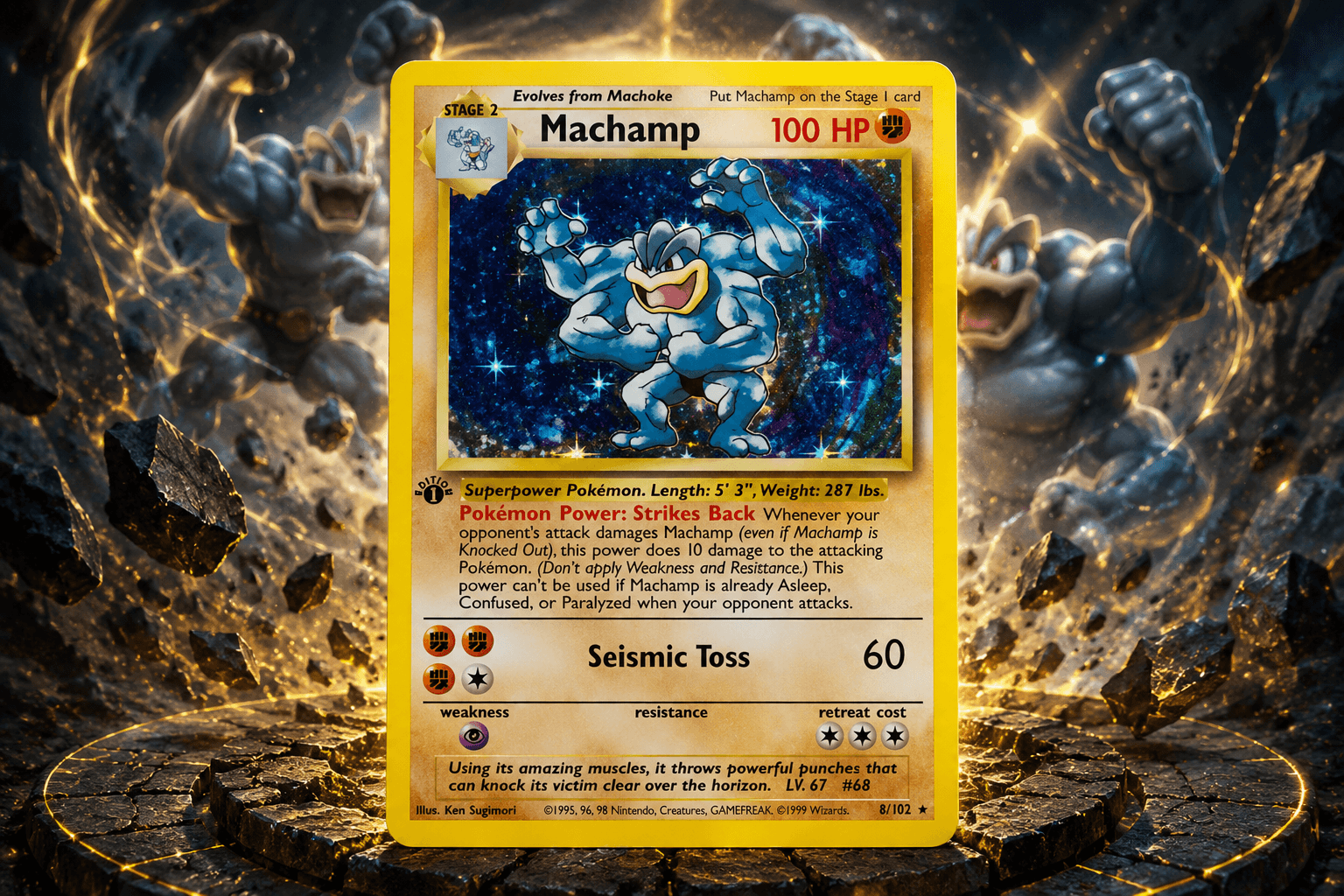
1. Look at the "1" symbol. First Edition Machamp has a small "Edition 1" badge on the lower-left of the illustration, roughly at the bottom of Machamp's leg. If it's not there — Unlimited. Period.
2. Look at the drop shadow behind the Pokémon art panel. Shadowless Machamp (higher value) has no shadow border behind the illustration. Shadowed Machamp (still 1st Edition, still valuable, less rare) has a visible dark shadow on the right side.
3. Check the copyright date at the bottom. If it reads "©1995, 96, 98, 99 Nintendo," you have a 1999 print. If it reads only through 1998 — you have a Base Set 2 reprint, not the original.
4. Check the back. The 1st Edition Base Set Machamp has the standard blue-crossed Pokémon back. If it's got a golden emblem or looks glossier than a normal card, you have a promotional print that's not from the 2-Player Starter.
Is it worth grading?
This is where the honest math matters.
- Grading cost: roughly $25–$40 per card at PSA Value tier, plus $8 return shipping. Round to $35 all-in.
- Break-even minimum: Your Machamp needs to grade PSA 8 or higher on the standard 1st Edition to recover cost. A PSA 8 sells for $260 — enough to cover fees and turn a small profit.
- Real opportunity: PSA 9 clears $650, PSA 10 clears $1,600. If your card looks unplayed and has been sleeved since 1999, submit it. The upside is meaningful.
- When NOT to grade: If the card has any visible whitening on the back edges (common on Base Set 1st Editions — the print quality was rough), your ceiling is PSA 7. At PSA 7 you'll get $150–$220, which barely covers grading + shipping + PSA cost inflation since 2021.
Shadowless 1st Edition Machamp is worth grading at almost any observable condition — the ceiling is 2x higher and the population is meaningfully lower.
What to check before submitting
- Centering at least 55/45 top-bottom, 60/40 left-right. Anything worse caps at PSA 8.
- Corners. Even one small dent knocks you down two grades.
- Print defects on Machamp specifically. The 1st Edition run had a known issue with holo pattern misalignment on the arms — that's a print defect, not damage, and PSA generally penalizes it lightly (max half-grade impact).
- Back whitening on 60% or more of the edge = don't bother submitting.
The identification trap most sellers fall into
If you bought a 1st Edition Machamp on eBay in the last 12 months for under $300 raw, there's a 30–40% chance you actually bought the Shadowless 1st Edition — because sellers routinely miscategorize the two. Compare your card to a verified Shadowless reference before you assume you overpaid or underpaid.
The Base Set page has variant guides that walk through the shadowless-vs-shadowed distinction card-by-card. This is the most valuable 15-minute audit you can run on any pre-2000 Machamp in your possession.
Final take
First Edition Machamp is the most misunderstood valuable-tier vintage card in the entire English catalog. Not because it's rare (it isn't, by 1st Edition standards) but because the Shadowless-vs-Shadowed split creates a two-tier market that most casual collectors don't know exists. If you own one — spend an hour on identification before you decide what to do. The difference between "worth $220" and "worth $2,800" often comes down to a shadow you can't see until someone tells you to look for it.