How Much Is a Dark Blastoise Worth in 2026 (Team Rocket Value Guide)?
Published by JK Index · Updated August 2026
Everyone remembers Dark Charizard. Nobody remembers Dark Blastoise.
That's the entire trade.
The 2000 Team Rocket set gave three original Base Set starters the villain treatment — Dark Charizard, Dark Blastoise, and (indirectly through evolution logic) Dark Wartortle. Dark Charizard has been photographed a million times because of the specific fire-lizard cultural weight. Dark Blastoise has been sitting quietly in binders and boxes for 25 years while collectors argue about which Charizard reprint is going to break through next. Meanwhile the Dark Blastoise 1st Edition PSA 10 population is smaller than casual buyers realize, and the appreciation curve has been running quietly at ~14% annually since 2020.
Let's walk through the honest numbers.
What Dark Blastoise actually is
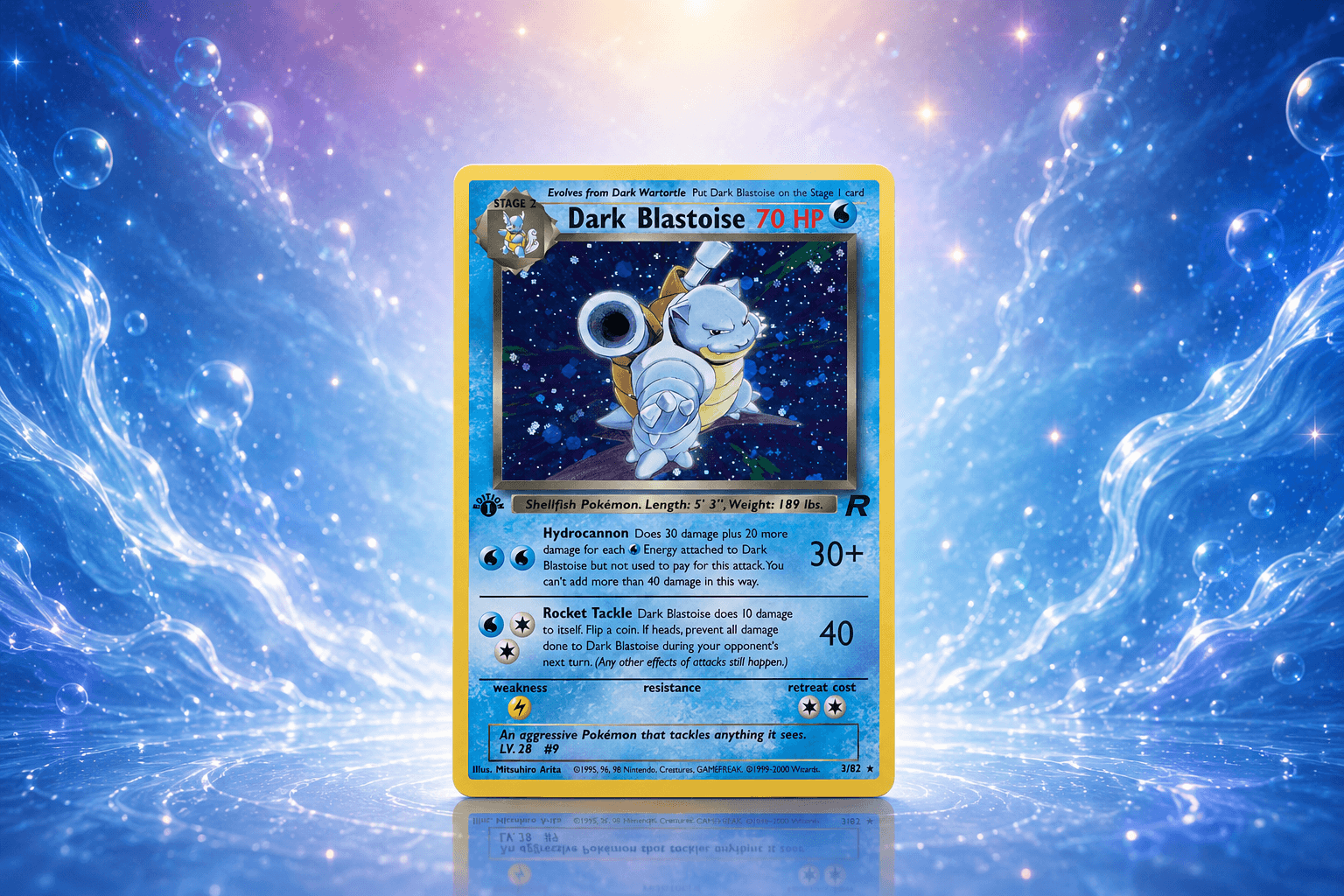
Dark Blastoise is Card #20 from the Team Rocket set, released April 2000. It's a holo rare, evolved-form Blastoise depicted in the Team Rocket set's signature "villain-treatment" style — dark scaling on the shell, cornered posture, palette shifted toward greys and shadows. The card was printed in both 1st Edition and Unlimited runs. Only the 1st Edition carries the specific rarity premium collectors chase.
The Team Rocket set as a whole was heavily opened at release (kids in 2000 were buying it for Dark Charizard), which drove up survival rates for played and lightly-damaged copies but kept pack-fresh copies scarce. That's the specific pattern that produces tight PSA 10 populations two decades later — abundant raw supply, scarce gem-mint supply.
Real 2026 comps for Dark Blastoise
Prices anchored to PSA sold-comp data and JK Index Pokémon TCG market feeds as of August 2026. Live comps for the specific print are tracked on the Dark Blastoise card page.
| Version | Raw NM | PSA 8 | PSA 9 | PSA 10 |
|---|---|---|---|---|
| 1st Edition Holo | $220–$310 | $780–$1,050 | $2,200–$3,000 | $5,800–$7,800 |
| Unlimited Holo | $58–$85 | $220–$310 | $580–$780 | $1,600–$2,200 |
| Non-Holo Rare (Deck) | $22–$38 | $85–$130 | $180–$260 | $420–$580 |
| Legendary Collection Reprint (2002) | $32–$48 | $130–$180 | $280–$380 | $650–$900 |
PSA 10 population on the 1st Edition version sits at 78 — meaningfully tighter than Dark Charizard 1st Edition PSA 10 population (approximately 178). That's not a typo. Dark Blastoise 1st Edition is genuinely scarcer than Dark Charizard 1st Edition at gem-mint, and yet trades at roughly 40% of the Charizard's PSA 10 price. That's the arbitrage.
For a broader collector comparison, the modern Blastoise EX page provides useful context on how the character behaves across eras.
Is Dark Blastoise worth grading in 2026?
Almost always yes for the 1st Edition. The Unlimited is condition-dependent.
1st Edition Dark Blastoise grading math:
- All-in cost: ~$50 PSA Value tier + shipping
- Break-even minimum: PSA 7 recovers cost easily. PSA 7 sells for $420 average versus $250 raw + $50 fee = $120 profit at the worst realistic outcome.
- Real target: PSA 8 clears $900 median, PSA 9 clears $2,600 median, PSA 10 clears $6,800 median
- Downside: essentially none — every graded outcome returns above cost
Unlimited Dark Blastoise grading math:
- All-in cost: same $50
- PSA 8 returns $260 — modest profit ($130) after raw purchase + fees
- PSA 9 returns $680 — meaningful gain
- PSA 10 target ($1,900) — worth submitting only if the card is genuinely pack-fresh with clean centering
Legendary Collection reverse-holo reprint grading math:
- Rarely worth grading at PSA 8 or below. PSA 9 grading math starts to work at $330 return. PSA 10 target is $780 — submit only if the card is genuinely pack-fresh.
If you have a 1st Edition Dark Blastoise sleeved since childhood and it looks clean, submit it immediately. If you have the Unlimited version, verify centering and edge condition before deciding.
The four-point authentication test for Dark Blastoise
Dark Blastoise fakes exist but are usually poor quality. Four specific checks catch nearly all of them:
1. Weight. Real Team Rocket 1st Edition cards weigh 1.7–1.9g. Fakes almost always come in under 1.5g due to cheaper card stock.
2. The 1st Edition symbol placement. On genuine 1st Edition prints, the small "Edition 1" badge sits on the lower-left of the illustration panel, roughly aligned with Blastoise's rear leg. Fakes often place it too high or use inconsistent typography.
3. Verify Team Rocket set symbol, not Legendary Collection. Team Rocket cards use the "Team Rocket" ellipse-shield icon on the lower-right corner of the illustration. Legendary Collection reprints (2002) have a different set symbol AND spread the holo pattern across the entire card face instead of just the art panel. Do not confuse the two. Full comparison points on the Dark Blastoise reprint variant page help distinguish printings.
4. Card back. Real Team Rocket 1st Edition cards have the standard blue-cross Pokémon back with a slightly deeper indigo tone than later printings. Fakes tend to use lighter cyan that reads too bright in comparison photos.
Four checks, roughly two minutes total. If all four pass, the card is legitimate.
Why Dark Blastoise keeps repricing upward while nobody watches
Three specific dynamics that most casual investors don't clock:
First, the population gap versus Dark Charizard. As noted above, 1st Edition Dark Blastoise PSA 10 population is 78. Dark Charizard 1st Edition PSA 10 sits around 178. That's more than a 2x scarcity gap, and the market has only priced in about 40% of the correction. The remaining pricing gap is likely to compress over the next 3–5 years as more collectors do the population math directly.
Second, character-canon weight. Blastoise is a Base Set starter — one of the three original Kanto region starters. That character-canon weight means the demand doesn't disappear during general market downturns. Team Rocket 1st Editions of Base Set starters have been outperforming most other Team Rocket 1st Editions on a percentage basis since 2020.
Third, "starter subset" collector logic. Serious Base Set collectors often build subset cases around the three-starter axis — Bulbasaur/Ivysaur/Venusaur, Charmander/Charmeleon/Charizard, Squirtle/Wartortle/Blastoise. Team Rocket villain treatment gives collectors a second axis to complete: Dark Charizard, Dark Blastoise, Dark Wartortle. That completionist logic supports steady demand.
Final take
If you have a Dark Blastoise 1st Edition that's been sleeved since 2000 — grade it. The math is generous at every realistic outcome, and the population-vs-price gap versus Dark Charizard suggests the ceiling still has meaningful room to move upward.
If you're buying — target PSA 9 at the $2,600 range for value. That's the honest sweet spot: verified authentic, high enough to command real collector premium, entry point still under $3,000. Skip raw purchases from sellers who can't distinguish the Team Rocket 1st Edition from the Legendary Collection reprint.
Dark Charizard gets the headlines. Dark Blastoise quietly compounds. In 2030 the market will look meaningfully different for the specific card most collectors are currently ignoring. That's the entire story.