How Much Is a Base Set Charizard Worth in 2026 (And Is It Worth Grading)?
Published by JK Index · Updated August 2026
Base Set Charizard is the single most valuable modern-era Pokemon card outside the Pikachu Illustrator tier.
The 1st Edition Shadowless PSA 10 has become the anchor point of the entire vintage Pokemon TCG market. But most casual collectors don't fully understand how sharply the specific edition-tier pricing splits across the three main Base Set Charizard variants.
This guide walks through every version, real 2026 comps, and honest grading ROI math per edition.
What Base Set Charizard actually is
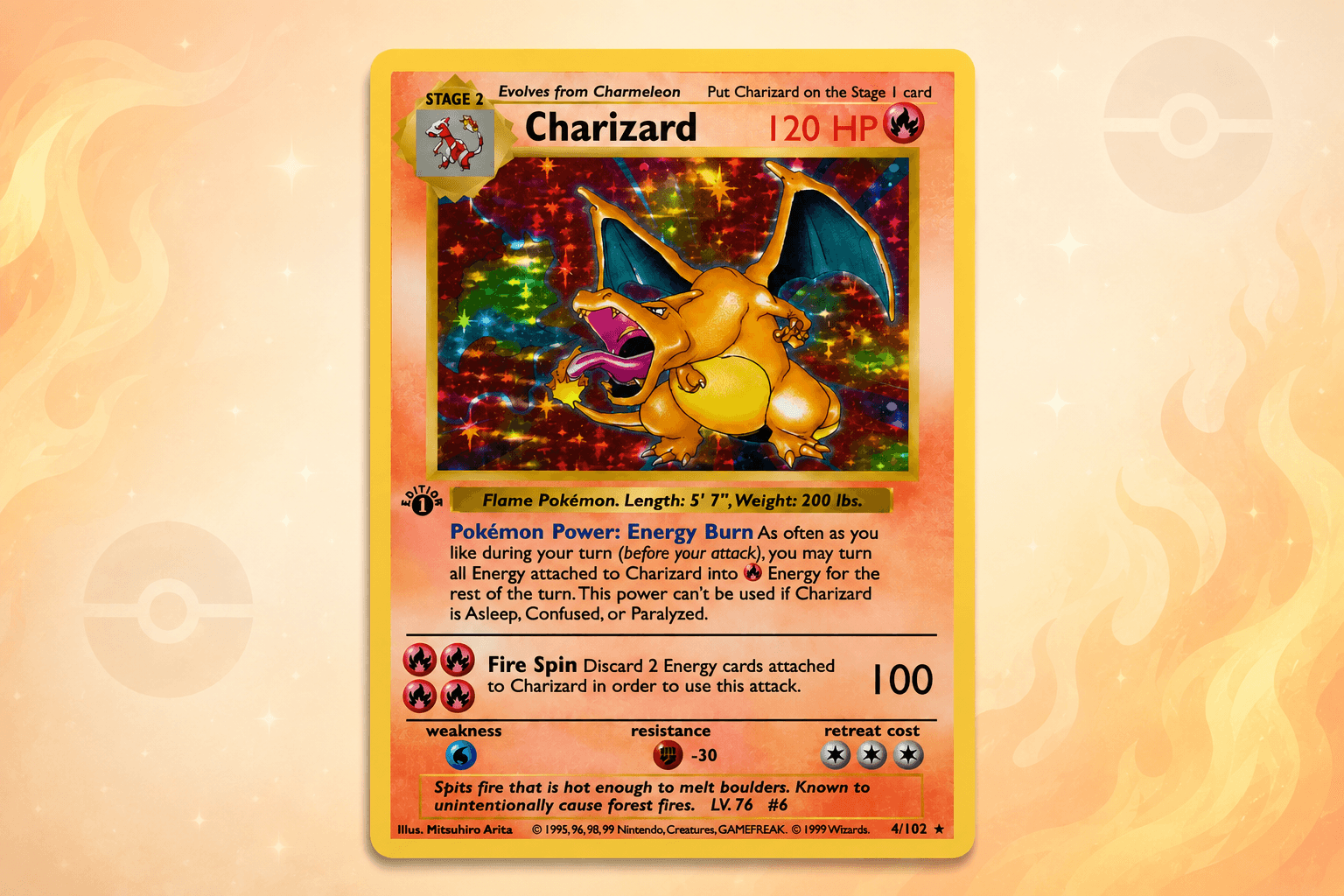
Base Set Charizard is Card #4/102, released January 1999 in the original English Base Set. Holo rare. Illustrated by Mitsuhiro Arita.
The card was printed in three editions: 1st Edition Shadowless (the grail tier), Unlimited Shadowless (mid-tier), and Unlimited Standard (volume tier). The Evolutions 2016 reprint delivered the same illustration at meaningfully lower pricing.
That reprint validates the pricing math on the 1999 original — same art, roughly 8% of original PSA 10 price.
Real 2026 comps for Base Set Charizard
Pricing pulled from PSA sold-comp data and JK Index Pokemon TCG market feeds as of August 2026.
| Version | Raw NM | PSA 8 | PSA 9 | PSA 10 |
|---|---|---|---|---|
| 1st Edition Shadowless Holo | $8,500–$12,000 | $22,000–$32,000 | $58,000–$85,000 | $180,000–$260,000 |
| Unlimited Shadowless Holo | $1,200–$1,700 | $4,200–$5,800 | $12,000–$16,500 | $28,000–$38,000 |
| Unlimited Standard Holo | $520–$720 | $1,900–$2,600 | $4,800–$6,500 | $8,500–$12,000 |
| Evolutions Reprint (2016) | $32–$48 | $130–$180 | $260–$360 | $580–$780 |
The 1st Edition Shadowless PSA 10 population sits at 178. Meaningfully tight for the specific ceiling-of-the-market card that anchors the entire vintage Pokemon TCG index.
For modern Charizard comparison, cross-reference the Charizard V card page and Charizard VMAX card page.
Is Base Set Charizard worth grading in 2026?
Depends heavily on which version you have.
1st Edition Shadowless grading math:
- All-in cost: ~$500 PSA Premium tier (declared value $50K+)
- Break-even minimum: PSA 5 recovers cost. PSA 5 sells for $16,000 average versus $10,000 raw + $500 fee = $5,500 profit at worst.
- Real target: PSA 8 clears $27,000. PSA 9 clears $72,000. PSA 10 clears $220,000.
- Downside: essentially none — every graded outcome returns above cost.
Unlimited Shadowless grading math:
- All-in cost: ~$150 PSA tier
- PSA 8 returns $5,000, minus $1,450 raw + $150 fee = $3,400 profit
- PSA 9 returns $14,250 — meaningful gain
- PSA 10 target ($33,000) — worth submitting only if the card looks genuinely pack-fresh
Unlimited Standard grading math:
- All-in cost: ~$100 PSA tier
- PSA 8 returns $2,250 — modest profit ($1,530) after raw + fee
- PSA 9 returns $5,650 — meaningful gain
- PSA 10 target ($10,250) — grade only if pack-fresh with obvious PSA 10 potential
Evolutions reprint math:
- Rarely worth grading unless the card is genuinely pack-fresh. PSA 10 target $680 barely covers costs + modest gain.
The four-point authentication test for Base Set Charizard
Base Set Charizard is the single most-faked vintage Pokemon card. Four checks catch nearly every counterfeit.
1. Weight test. Real Base Set cards weigh 1.7–1.9g. Fakes come in under 1.5g due to cheaper card stock. Every serious purchase over $500 raw NM should be weighed.
2. Shadow test. Look at the illustration panel border. Genuine Shadowless cards have NO drop shadow on the right side of the art panel. Shadowed cards have a visible darker line. This is the single most valuable distinction — separates the $180K tier from the $10K tier.
3. Edition badge and font check. On 1st Edition prints, the "Edition 1" badge sits on the lower-left of the illustration panel. Fakes often place the badge incorrectly or use inconsistent typography.
4. Card back indigo tone. Real 1999 cards have a specific deeper indigo tone on the blue Pokemon back. Fakes tend to use lighter cyan that reads too bright in comparison photos.
Why Base Set Charizard sits at the market ceiling
Three specific dynamics support the ongoing pricing.
Character-canon durability. Charizard is the flagship character of the entire Pokemon franchise. That specific brand-canon weight has held for 26 years and will continue to hold. Unlike Charizard's cross-set cousins (Dark Charizard is covered in a dedicated guide), the Base Set specifically anchors character-canon pricing.
Investor-tier attention. Non-TCG-native investors deploying capital into Pokemon cards buy Base Set Charizard because they recognize the character. That specific investor demographic supports pricing above what pure TCG-collector demand would produce.
Population math. 1st Edition Shadowless PSA 10 population sits at 178 globally. Nothing about that supply changes. Every year some percentage of the population enters permanent private collections. The direction is one-way.
Final take
If you have a Base Set Charizard sleeved since 1999, grade it — regardless of visible condition. The math is generous at every edition tier.
If you're buying — target Unlimited Standard PSA 9 at $5,500 for value, Unlimited Shadowless PSA 9 at $14,250 for a step up, or 1st Edition Shadowless PSA 8-9 for anyone deploying five-figure capital. Skip raw purchases from sellers who can't distinguish Shadowless from Shadowed.
Cross-check current PSA-graded comps on JK Index Marketplace before every purchase. The specific pricing gap between Shadowless and Shadowed versions is where most casual buyers leave the most money on the table.
Base Set Charizard is not just a card. It's the specific market anchor that every other vintage Pokemon TCG price references against.