Hitmonchan Card Value 2026: Every Print Compared
Prices based on recent sold listings | Updated September 2026
There was a time when Hitmonchan was the most feared card in the game.
Not Charizard. Not Mewtwo. Hitmonchan. Card number 7 from the original Base Set, with 70 HP and an attack called Special Punch that cost one Fighting energy for 20 damage. On paper, that sounds unremarkable. In practice, it was devastating. A turn-one 20 damage from a Basic Pokemon with no evolution requirement was faster than anything else in the format. Pair it with Electabuzz and Scyther, and you had the Haymaker deck, the first truly dominant archetype in Pokemon TCG history.
Brian Brokaw coined the name "Haymaker" in 1999 after spotting a printing error in a Wizards of the Coast magazine that accidentally labeled Special Punch as "Haymaker." The name stuck, the deck terrorized tournaments for two years, and Hitmonchan became the card that taught an entire generation of players what tempo meant.
That was 1999. It is now 2026, and Hitmonchan's card line tells the story of a Pokemon that peaked early and never quite found its footing again. Twenty-three unique English cards across 22 sets, most of them quietly forgotten. But the ones that matter still carry weight, and the collection as a whole costs less than you would expect for an original 151 holo rare.
What the Collection Looks Like
Hitmonchan's card pool is small compared to most Gen 1 Pokemon. No Gold Star. No VMAX. No Alternate Art. No Special Illustration Rare. The TCG has largely moved past Hitmonchan in terms of premium card treatments, which keeps the price ceiling lower but also means there are no overpriced chase cards inflating the total cost.
The full raw collection runs about $930 across all printings. PSA 10 across every card would cost roughly $38,800, though that figure is dominated by a couple of extreme outliers. Most of the line sits comfortably in single-digit territory.
| Stat | Detail |
|---|---|
| Unique English cards | ~23 across 22 sets |
| Price range | $0.22 to ~$100 raw |
| Total raw collection cost | ~$930 |
| Cards under $5 | 15+ |
| Most expensive raw | Aquapolis Holo (~$100) |
| Most expensive PSA 10 | Base Set 2 (~$12,699) |
The Cards That Carry the Collection
Hitmonchan #7 | Base Set 1st Edition Holo (1999) Raw NM: $40 to $80 | PSA 9: ~$900
The original. The Haymaker itself. Ken Sugimori's artwork shows Hitmonchan in its classic boxing stance, gloves up, ready to throw a Special Punch that cost tournaments their predictability.
First Edition PSA 9 copies recently sold around $900, which is a respectable number for a non-chase Base Set holo. The 1st Edition stamp transforms this from a $10 to $15 card (Unlimited pricing) into something with real collector gravity. If you played during the WOTC era, you remember what this card meant. That memory has a dollar value attached to it now.
The condition trap on Base Set holos applies here in full. Hitmonchan was heavily played. It was the centerpiece of competitive decks for two years, which means most surviving copies have shuffling wear, edge whitening, and holo scratching. Finding a true near mint copy that was sleeved from the start and never played is harder than the supply numbers suggest.
Hitmonchan | Aquapolis H11 Holo (2003) Raw NM: ~$100 | PSA 10: $400 to $800
The most expensive raw Hitmonchan card, and it is entirely because of the set it sits in. Aquapolis is one of the three e-Card era sets that have been climbing relentlessly since collectors discovered them. The Hitmonchan holo from this set features a cleaner, more modern artwork style than the Base Set version, with the distinctive e-Card dot strip running along the bottom edge.
At $100 raw, this is a serious card. It was not $100 two years ago. The e-Card appreciation trend lifted it from roughly $30 to $40, and it has not come back down. Whether it continues climbing depends on the broader trajectory of Aquapolis as a set, but that trajectory has been pointing one direction for three years running.
Hitmonchan #7 | Base Set Shadowless Holo (1999) Raw NM: $30 to $60 | PSA 10: $800+
The Shadowless variant of the Base Set holo. No 1st Edition stamp, but the missing drop shadow on the card art frame identifies it as an early print run. Shadowless holos occupy a middle ground between the premium of 1st Edition and the accessibility of Unlimited. For collectors who want something more special than Unlimited without paying 1st Edition prices, Shadowless is the answer.
Hitmonchan #7 | Base Set Unlimited Holo (1999) Raw NM: $8 to $15 | PSA 10: $300+
The workhorse. This is the Hitmonchan that most people own, and at $8 to $15 it remains one of the better value propositions in vintage Pokemon collecting. A 25-year-old holo rare from the most famous set in the hobby, for the price of a fast food meal. The PSA 10 at $300+ makes it a reasonable grading candidate for truly flawless copies.
Hitmonchan | Base Set 2 #8 Holo (2000) Raw NM: $5 to $10 | PSA 10: ~$12,699
The Base Set 2 grading story again. Raw price is trivial. PSA 10 is astronomical. The print quality on Base Set 2 was poor enough that Gem Mint copies are vanishingly rare. If you happen to have a flawless copy, the grading math is life-changing. But most copies are not flawless, and submitting a card that grades PSA 8 returns a $20 to $30 card that cost you $25 to grade.
The Middle of the Binder
These cards span the years between Hitmonchan's competitive peak and its quiet retirement from the TCG spotlight. None are expensive. All are worth knowing about.
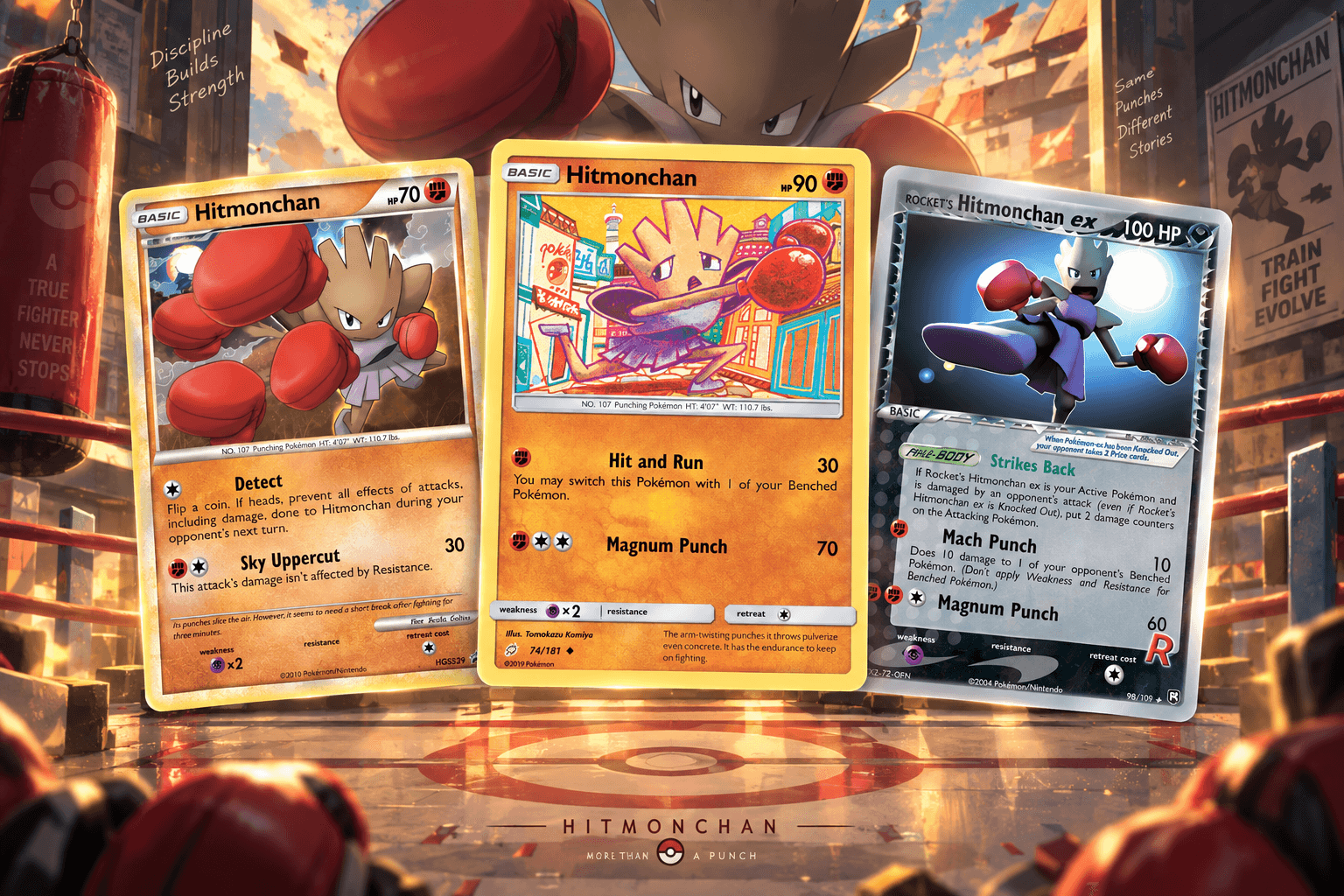
Gym Heroes Rocket's Hitmonchan #11 (2000) at $8 to $15. The Gym Leader connection gives this card narrative weight. Rocket's Hitmonchan is a corrupted version of the Pokemon, fighting under Team Rocket's control. The darker artwork contrasts nicely with the heroic Base Set version.
Scarlet and Violet 151 #107 (2023) at $0.50 to $2. The modern Kanto callback. SV 151 gave every original Pokemon a new card, and Hitmonchan's entry is a solid common that pairs well with the rest of the 151 set. The Poke Ball reverse holo variant from the Japanese printing carries a small premium for pattern collectors.
Evolutions #62 Holo (2016) at $1 to $3. The nostalgia reprint of the Base Set card. Updated printing technology, same classic Ken Sugimori artwork. If you want the Base Set look without the Base Set price, this is the card.
Furious Fists #48 (2014) at $0.50 to $1.50. The Fighting-type themed XY set gave Hitmonchan a new print with updated artwork. Nothing remarkable about the card itself, but it fills the XY era slot in a master set.
Legends Awakened #99 (2008) at $0.50 to $1.50. A Diamond and Pearl era entry. Legends Awakened is an underappreciated set, and the Hitmonchan from it is thoroughly unremarkable. Budget pickup for completionists.
Evolving Skies #078 (2021) at $0.22. The cheapest Hitmonchan card. Evolving Skies is remembered for its Eeveelution chase cards, not for its Hitmonchan common. At twenty-two cents, this is a rounding error in a collection budget.
The Haymaker Legacy
Here is something that gets lost in price guides. Hitmonchan's value is not just in the cardboard. It is in the history.
The Haymaker deck changed how people thought about the Pokemon TCG. Before Haymaker, most players built decks around Stage 2 evolution lines. You set up Charizard or Blastoise, powered them up over several turns, and hoped your opponent could not do the same thing faster. It was slow, methodical, and vulnerable to disruption.
Haymaker threw that out. Why spend four turns setting up a Stage 2 when you could attack for 20 damage on turn one with a Basic? Hitmonchan, Electabuzz, and Scyther hit hard, hit early, and forced the opponent to react instead of build. It was the first aggro deck in Pokemon, and it reshaped the entire competitive landscape.
That matters to collectors because it gives the Base Set Hitmonchan a story that most holo rares do not have. A Nidoqueen from the same set is a fine card. But nobody built their competitive identity around Nidoqueen. Hitmonchan was the card you sleeved up when you wanted to win, and the people who remember that will always value it differently than a price chart suggests.
When those players buy Hitmonchan cards now, they are not really buying a holo rare from 1999. They are buying the feeling of going first, attaching a Fighting energy, and watching their opponent realize the game was already slipping away from them. You cannot put a market price on that. But you can see its effect in the steady demand that keeps Base Set Hitmonchan trading above what its raw numbers would otherwise justify.
The Hitmon Family
Hitmonchan does not exist in isolation. Hitmonlee (the kicker) and Hitmontop (the spinner) complete the trio, and many collectors build all three simultaneously. All three share Tyrogue as a baby pre-evolution, creating a branching family tree that lends itself to a clean binder page layout.
Hitmonlee has a similar card count and price profile to Hitmonchan. Hitmontop is less heavily printed and generally cheaper. Building the complete Hitmon family across every set where all three (or at least two) appear gives the collection a thematic coherence that goes beyond individual cards.
The combined Hitmon family master set is a mid-budget project that fits comfortably under $2,000 for all three Pokemon across every English printing. That is three complete collections for the price of one decent vintage chase card from another Pokemon.
Grading: Be Realistic
The grading story for Hitmonchan is straightforward. Grade the Base Set 1st Edition or Shadowless if you have a genuinely clean copy. The multipliers are there. Grade the Aquapolis holo if it survived the e-Card era in top condition. Consider grading the Base Set 2 holo only if the card is truly flawless, because the PSA 10 market for that card is built on extreme scarcity.
Skip grading on everything modern. The raw prices do not support it. A PSA 10 of the Evolving Skies Hitmonchan is worth maybe $5 to $10. The grading fee alone exceeds the upside.
The most common mistake collectors make with Hitmonchan grading is submitting Base Set Unlimited holos that are "pretty clean" but not truly mint. A PSA 7 or 8 Hitmonchan is worth roughly the same as a raw near mint copy. You are paying $25 to $50 for the privilege of confirming what you already knew. Save the submission slot for a card where the grade genuinely changes the value.
Detailed service comparison in our PSA vs CGC vs BGS guide.
Conclusion
Hitmonchan is a card collector's character study. The Pokemon that defined competitive play for two years, named a deck archetype, and taught the hobby what speed meant. Then it faded from the competitive scene and never came back. The TCG moved on to bigger HP, flashier attacks, and multi-prize knockouts that made a 70 HP Basic with a 20-damage punch look quaint.
But the cards remain, and they tell that story across 22 sets and 25 years. The Base Set holo still looks right. The Aquapolis print is quietly climbing on e-Card era momentum. And the collection itself, all 23 cards for under a thousand dollars, is a manageable project that gives you a complete portrait of a Gen 1 icon who earned its place in the history books before most collectors were old enough to read them.
For current pricing and set data, visit JK Index. For protecting vintage holos from the WOTC era, our card storage guide covers the full approach.
FAQs
What is the most valuable Hitmonchan card?
By raw price, the Aquapolis H11 Holo at roughly $100. By PSA 10, the Base Set 2 holo at $12,699. The Base Set 1st Edition holo sits around $40 to $80 raw with PSA 9 copies selling near $900.
How many Hitmonchan cards exist?
23 unique English cards across 22 sets, with 74 total variants when including reverse holos and alternate printings.
What was the Haymaker deck?
The first dominant competitive deck in Pokemon TCG history, built around Hitmonchan, Electabuzz, and Scyther. It prioritized fast, cheap attacks from Basic Pokemon instead of evolving into Stage 2 powerhouses. The name came from a WOTC magazine misprint that labeled Hitmonchan's Special Punch as "Haymaker."
Is the Base Set Hitmonchan holo worth grading?
The 1st Edition and Shadowless versions, yes, if the card is in genuine near mint condition. The PSA 9 and PSA 10 multipliers are significant. The Unlimited version is marginal since a PSA 7 or 8 barely exceeds raw market value. Only submit Unlimited copies you are confident will hit 9 or higher.
Why is the Base Set 2 PSA 10 so expensive?
Print quality inconsistency. Base Set 2 had poorer quality control than the original Base Set, making Gem Mint copies extremely rare in the PSA population. The scarcity at the top grade creates a premium that far exceeds the raw card's value.
Can I build a complete Hitmonchan collection on a budget?
The full raw collection costs about $930, but most of that is concentrated in the Aquapolis holo ($100) and the Base Set variants ($50 to $80 for 1st Edition). Excluding those top cards, the remaining collection costs well under $100.
How does Hitmonchan compare to Hitmonlee in card value?
Very similar profiles. Hitmonlee has a comparable number of cards and a similar price distribution. Neither Pokemon received modern premium treatment (no V, VMAX, or Alternate Art), so both collections are anchored by their vintage prints. Building both together is a natural pairing.
Has Hitmonchan appeared in recent sets?
Yes. Scarlet and Violet 151 (2023) included Hitmonchan as a modern Kanto callback. It has not appeared in 2024 or 2025 mainline sets, suggesting the TCG is cycling it less frequently than many other Gen 1 Pokemon.