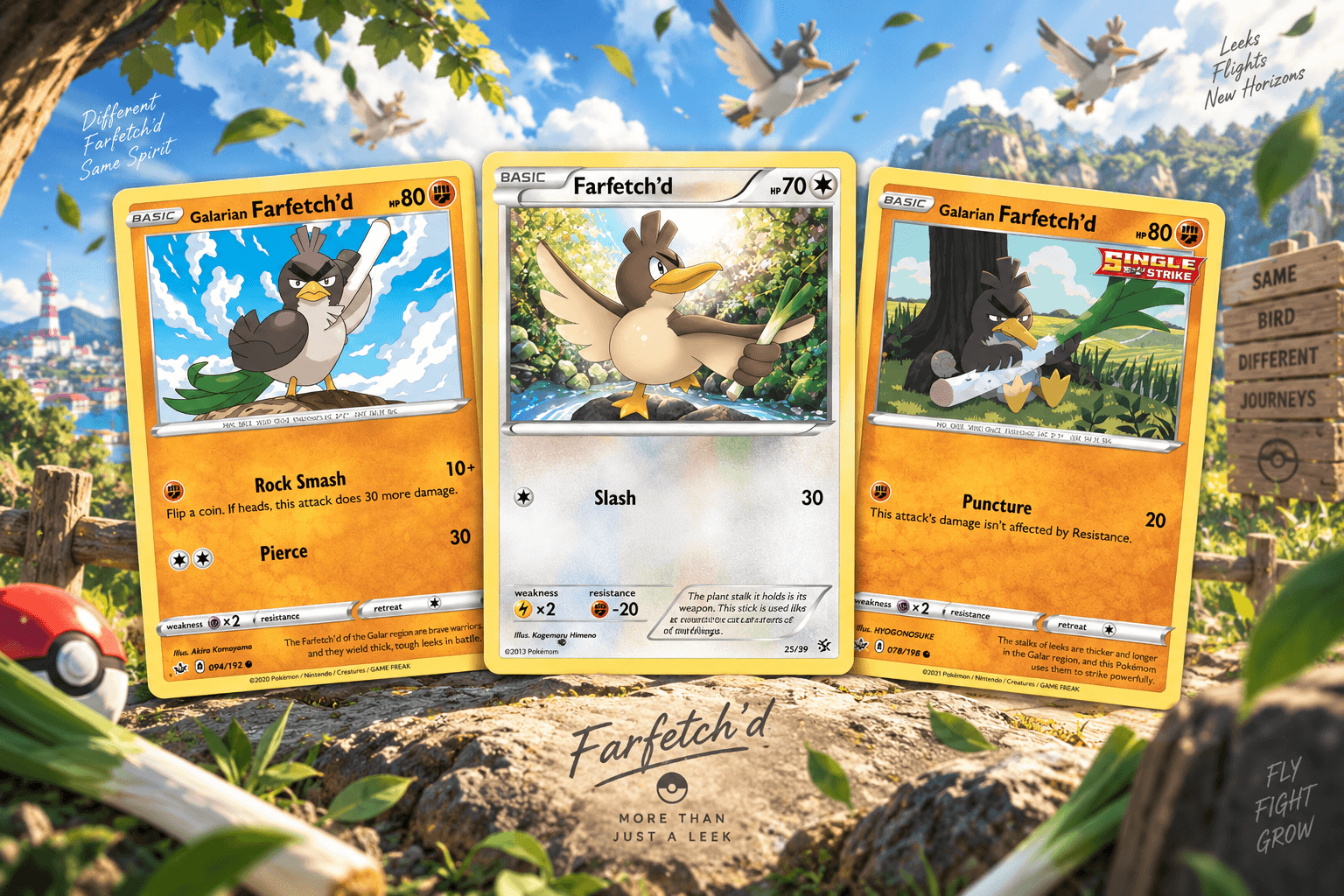
Farfetch'd Card Value 2026: Every Print Compared
Prices based on recent sold listings | Updated September 2026
For twenty years, Farfetch'd was a dead end. A single-stage Normal/Flying Pokemon from Generation I with no evolution, no competitive viability, and no reason to exist in the TCG beyond filling a Pokedex slot. Every other original 151 Pokemon that lacked an evolution eventually felt like an oversight. Farfetch'd felt like a punchline. A duck carrying a leek that the game itself described as nearly extinct. Even the franchise seemed to be admitting this was not a Pokemon built to last.
Then Pokemon Sword and Shield gave it a Galarian form and an evolution into Sirfetch'd, and overnight, the punchline became a knight. A literal Fighting-type knight wielding its leek like a lance and its leaves like a shield. The transformation was so complete and so well-received that it retroactively changed how people thought about the original Farfetch'd. The duck with the stick was no longer a joke. It was the origin story of one of the most beloved Gen 8 designs.
That before-and-after is what makes the Farfetch'd card line worth examining. Thirty-two unique Farfetch'd cards across multiple sets, plus the entire Galarian Farfetch'd and Sirfetch'd extension. Prices from $0.08 to roughly $50. And a market split that tells you exactly how an evolution announcement changes the economics of a card line.
Two Markets, One Pokedex Number
Here is the insight no competitor page offers. Kanto Farfetch'd cards and Galarian Farfetch'd cards are moving in opposite directions.
Kanto Farfetch'd is down 8.8% year-to-date. The original form, the duck with the leek, is drifting. Not crashing, but not participating in the Gen 1 appreciation wave that is lifting cards like Magmar and Dugtrio.
Sirfetch'd (the evolution of Galarian Farfetch'd) is up 87.6% year-to-date. The knight form is surging on the same Galar nostalgia wave that lifted Scorbunny and Copperajah earlier in this series.
That divergence is unusual. Normally, when a Pokemon gets a new evolution, the original form appreciates alongside the new one because collectors building the full line need both. With Farfetch'd, the market is treating the two forms as separate products rather than connected evolutionary stages. Kanto Farfetch'd collectors and Galarian Sirfetch'd collectors are apparently not the same people.
Understanding this split matters if you are buying. Kanto Farfetch'd at current prices is at or near a floor. The 8.8% decline is modest and may represent the end of a correction rather than the start of a slide. Sirfetch'd at current prices might still be climbing, with the 87.6% YTD suggesting the Galar nostalgia wave is in an early-to-mid phase. The strategy depends entirely on which form you care about and whether you believe the two markets will eventually reconnect.
History suggests they will. When previous Pokemon received late evolutions (Magmortar for Magmar, Electivire for Electabuzz, Togekiss for Togetic), the original form eventually appreciated alongside the new evolution as collectors built complete lines. It took time, sometimes years, but the gravitational pull of the evolution chain eventually drew both forms into the same demand pool. If that pattern repeats, Kanto Farfetch'd cards at 2026 prices could look like a buying opportunity in retrospect.
Kanto Farfetch'd: The Vintage Side
Farfetch'd Secret Rare | Emerald #Pokemon (2005) Raw NM: ~$50
The most valuable Farfetch'd card comes from an unexpected place. Emerald Secret Rares were reprints of popular cards with a gold-bordered Secret Rare treatment that only appeared in the Emerald set. The Farfetch'd Secret Rare benefits from the scarcity of the format (few Secret Rares existed in the EX era) and the growing collector interest in EX-era chase cards.
At $50, it is the ceiling for the Kanto form. Not a four-figure grail, but a legitimate anchor for a Farfetch'd collection.
Farfetch'd | Base Set #27 (1999) Raw NM: $1 to $3 | PSA 10: $100+
The original. Card #27 in the set that started everything. An uncommon that most collectors passed over in 1999 because it sat between more exciting pulls. The 1st Edition version pushes to $10 to $20 raw, and PSA 10 copies of Base Set 1st Edition Farfetch'd carry the standard premium that any original 151 card in top grade commands.
Farfetch'd | Jungle #27 (1999) at $0.50 to $2. The second English Farfetch'd, printed the same year as the Base Set version. Jungle gave Farfetch'd a different illustration and a slightly different move set. Two different artists interpreting the same duck-with-a-leek concept in the same year is a small collecting pleasure. The 1st Edition version pushes to $3 to $5 and is worth owning for the edition stamp if you are building a comprehensive WOTC spread.
Farfetch'd | Various mid-era reprints (2003 to 2015) at $0.50 to $5 each. Farfetch'd appeared in Aquapolis, Team Rocket Returns, Legend Maker, Roaring Skies, and several other sets during the long middle period where it had no evolution and no competitive relevance. These cards are cheap because the demand during those eras was minimal. But they fill the timeline between the WOTC originals and the Galarian rebirth, and at $0.50 to $5 per card, the cost of filling those gaps is negligible.
Farfetch'd | SV 151 #83 (2023) at $0.50 to $1.50. The modern Kanto callback. SV 151 gave every original Pokemon a fresh card, and the Farfetch'd entry is clean if unremarkable.
Galarian Farfetch'd and Sirfetch'd: The Modern Side
The Galarian form and its evolution create the contemporary collector interest. These cards are cheap individually but the 87.6% YTD appreciation suggests the market is waking up to them.
Galarian Sirfetch'd V Full Art | Vivid Voltage #174 (2020) at $1 to $2. The Full Art V is the most visually impressive standard Sirfetch'd card. The knight aesthetic comes through clearly in the extended artwork, with the leek-lance prominent in the composition.
Galarian Sirfetch'd V | Rebel Clash #95 (2020) at $0.50 to $1.50. The base V card from one of the earliest Sword and Shield sets. Decent artwork, budget pricing.
Galarian Sirfetch'd VMAX | Darkness Ablaze #183 Rainbow Rare (2020) at $2 to $5. The Rainbow Rare VMAX gives Sirfetch'd the hyper-foil treatment. For a Pokemon this cheap, the Rainbow Rare is genuinely fun to own. Multi-colored hyper-foil on a leek-wielding knight is exactly the kind of absurd premium treatment that makes the TCG entertaining.
Galarian Farfetch'd | Shining Fates Shiny Vault SV63 (2021) at $2 to $3.36. The Shiny variant swaps the coloring for an alternate palette. Shining Fates Shiny Vault cards have their own collector following, and this Galarian Farfetch'd is a solid entry.
Galarian Sirfetch'd | Chilling Reign #79 (2021) at $0.25 to $1. Standard rare. Fills the Chilling Reign era slot.
The Redemption Arc as a Collecting Concept
Farfetch'd's journey from dead-end single-stage to knight with an evolution is one of the best character arcs in the franchise. And the TCG reflects it.
The early cards (Base Set, Jungle, EX-era reprints) show a Pokemon that looks slightly lost. The artwork is fine but unremarkable. There is no energy, no narrative. Just a bird holding a vegetable. The card designers had nothing to work with because the Pokemon itself had no story to tell beyond "it exists and it might go extinct."
The Galarian and Sirfetch'd cards are different. The Fighting-type reframing gave artists direction. The leek becomes a weapon. The posture shifts from passive to active. Sirfetch'd VMAX cards show a Pokemon that has purpose, momentum, something to prove. That progression from aimless duck to determined warrior plays out visually across the binder page in a way that very few Pokemon collections can replicate.
This is the narrative argument for collecting Farfetch'd. Not the prices. Not the grading multipliers. The story. A Pokemon that was written off for two decades, given a second chance, and earned respect. The cards are the visual record of that transformation, and they cost almost nothing to assemble.
The Full Line: Farfetch'd to Sirfetch'd
Building the complete evolution line across all available sets creates a collection with genuine storytelling range. Start with the 1999 Base Set duck. Walk through the quiet years of Jungle, Emerald, and scattered reprints where Farfetch'd existed without direction. Then reach the Galarian Farfetch'd from Rebel Clash and Shining Fates, where the Fighting-type reframing begins. End with the Sirfetch'd V and VMAX cards, where the transformation is complete.
The total cost for both Farfetch'd and Sirfetch'd across every English set sits around $150 to $200. That buys you the full narrative arc from forgotten Gen 1 oddity to beloved Gen 8 knight. Our investing guide covers whether the 87.6% Sirfetch'd YTD has room to continue.
Grading
The Emerald Secret Rare at $50 raw is the only Farfetch'd card where standalone grading submissions make clear sense. PSA 10 premiums on Emerald Secret Rares are consistently strong.
The Base Set card at $1 to $3 raw is worth including in a batch if you have a flawless copy. Base Set 1st Edition PSA 10s carry standard premiums regardless of the Pokemon.
Everything else trades too low. The Sirfetch'd V and VMAX cards are modern bulk that would cost more to grade than the PSA 10 premium returns. Sleeve, topload, and let the nostalgia cycle do its work. Our PSA vs CGC vs BGS guide covers service selection. Our storage guide covers protection.
Conclusion
Farfetch'd is the only Pokemon in this 20-blog series where the collecting story is a redemption arc. Twenty years of irrelevance, then a Galarian evolution that changed everything. The cards mirror that journey, and the Kanto-down / Sirfetch'd-up market split proves the transformation resonated with collectors as much as it did with players. Total cost under $200 for the complete line. The final blog in this batch, and the one that reminds you why Pokemon card collecting works: sometimes the story on the cardboard is worth more than the price on the sticker.
For set data and current pricing across all Farfetch'd and Sirfetch'd home sets, visit JK Index.
FAQs
What is the most valuable Farfetch'd card?
The Emerald Secret Rare at approximately $50 raw. It is a gold-bordered reprint exclusive to the Emerald set from 2005.
How many Farfetch'd cards exist?
32 unique Kanto Farfetch'd cards across multiple sets. Adding Galarian Farfetch'd and Sirfetch'd cards pushes the total beyond 50 unique prints.
Why is Kanto Farfetch'd down but Sirfetch'd up?
Different collector bases. Kanto Farfetch'd attracts Gen 1 completionists who are not specifically seeking it. Sirfetch'd attracts Galar-era fans who are actively building Sword and Shield collections. The two groups do not overlap as much as the shared Pokedex number would suggest.
Is Sirfetch'd worth collecting alongside Farfetch'd?
Absolutely. The evolution line tells a visual narrative that neither Pokemon captures alone. The shift from aimless duck to determined knight across matching set prints is one of the more compelling collection arcs in the modern TCG.
What is the cheapest Farfetch'd card?
Standard commons from recent sets trade at $0.08. Galarian Farfetch'd from Rebel Clash sits at $0.06. Bulk pricing across both forms.
Will Galarian Farfetch'd cards appreciate?
The 87.6% Sirfetch'd YTD suggests Galar-era nostalgia is building. Whether that wave lifts the pre-evolution Galarian Farfetch'd cards (currently declining) depends on whether trio/evolution-line collectors create demand for the full chain.
Does the Emerald Secret Rare have good grading potential?
Yes. Emerald Secret Rares are scarce in top grades due to the set's limited print run and the gold border's tendency to show edge wear. PSA 10 premiums on Emerald Secret Rares are consistently strong across all Pokemon in the set.