How Much Is an Exeggcute Card Worth in 2026?
Here is a fact that surprises people about Exeggcute: the 1999 Jungle version was painted by Mitsuhiro Arita, the same illustrator behind the legendary Base Set Charizard. Same artist, wildly different price tag.
That contrast sums up the card nicely. Exeggcute, a walking cluster of six eggs, has appeared across almost every era of the hobby, yet it has never once climbed out of the low-value tier. The most expensive copy trades for about ten dollars.
None of that makes it worthless to understand. A few prints carry modest value, one is worth grading, and knowing which is which keeps you from overpaying. Figures here reflect recent sales and shift over time.
The Pokémon that is technically six eggs
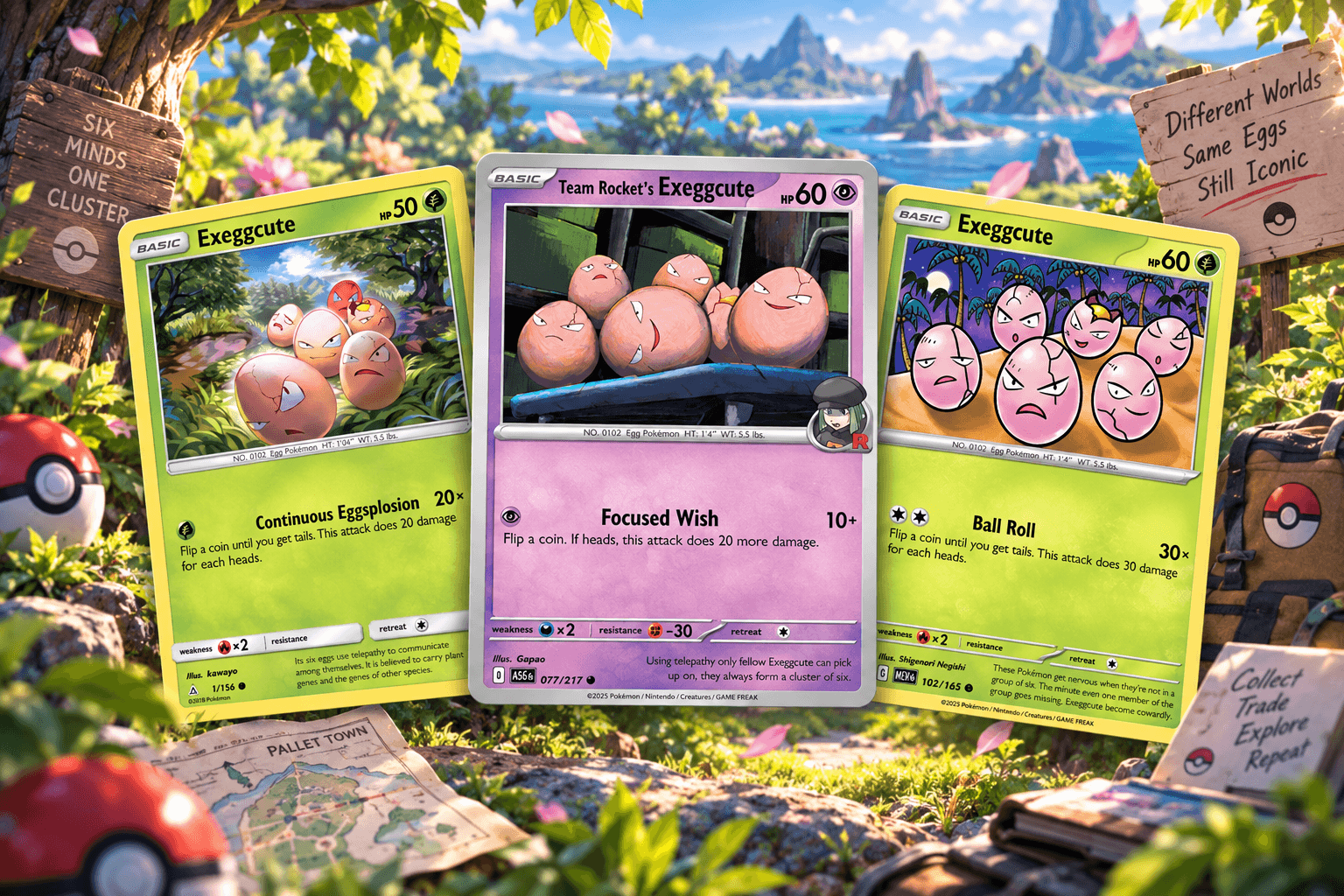
Exeggcute (#102) is a Grass and Psychic Egg Pokémon from Kanto, oddly depicted as six separate eggs that behave as one creature. It evolves, against all logic, into the tall palm-tree Exeggutor, and later gained the meme-famous stretched Alolan form.
In the card game it has almost always been a basic, low-rarity card. There is no Exeggcute ex, no full art, no secret rare. Its ceiling has always been set by vintage age, not by rarity or hype.
The short list of Exeggcute cards worth knowing
Only a handful of Exeggcute prints rise above pocket change. Here they are, from the top down.
Legendary Collection #75 (2002)
The most valuable Exeggcute in raw form. The base version trades near ten to twelve dollars, and the reverse holo, with the set's distinctive cracked-ice foil, climbs higher and grades for a solid premium.
- Raw: about $10 to $12
- Reverse holo: a further premium, more again in a PSA 10
Jungle #52, 1st Edition (1999)
The one collectors actually chase, thanks to the Arita art and the 1st Edition stamp. Raw copies are inexpensive, but a clean PSA 10 has sold in the low hundreds, since gem-mint vintage commons are scarcer than their print run suggests.
- Raw NM, 1st Edition: about $5 to $12
- PSA 10: roughly $80 to $150
Jungle Unlimited and Base Set 2
The affordable vintage tier. The Unlimited Jungle and its Base Set 2 reprint are a dollar or two raw, with graded copies in the $30 to $60 range if pristine. Cheap nostalgia rather than an investment.
Modern and Japanese prints
Everything after the early 2000s, including the Japanese e-Card and later reprints, sits under five dollars. These are collect-for-completeness cards.
When grading is worth it
For nearly every Exeggcute, skip it. A two-dollar card inside a thirty-dollar slab is money lost.
The single exception is the Jungle 1st Edition. If yours is genuinely sharp, with clean corners and centering, a PSA 10 turns a cheap card into a low-hundreds one, and Arita's name gives it staying power. Run it through the JK Index Grading Readiness Scan first to gauge the likely grade.
Buying advice by budget
A few dollars: the Unlimited Jungle or Base Set 2 print, for the Arita artwork at pocket-change prices.
Around $12: the Legendary Collection card, the priciest raw Exeggcute, and its reverse holo if you can track one down.
Up to the low hundreds: a graded Jungle 1st Edition, the only Exeggcute with genuine collector pull.
Not worth it: grading commons, or paying vintage prices for modern reprints.
Bottom line
Exeggcute is a study in how far a famous illustrator alone will carry a card, which turns out to be not very far. The Jungle art is beautiful and the six-egg design is charming, but the market has never treated it as more than a low-tier vintage common.
Own the Arita Jungle print for a few dollars because it is lovely, chase a graded 1st Edition if you want the best version, and leave the rest in the binder. Exeggcute rewards affection more than ambition.