Every Tepig Card Variant Ranked by Value (2026)
Prices based on recent sold listings | Updated September 2026
A 140.8% year-to-date gain on a basic-stage Fire-type starter that has never had a V card, a VMAX, an EX, or a GX printed with its name on it. Every other card in this guide has at least one premium variant driving prices. Tepig has none. It is, across its entire 31-card line, a collection of commons, reverse holos, promos, and one recently printed Illustration Rare. And it is up 140% anyway.
That number alone makes Tepig one of the most interesting market stories in the current Pokemon TCG. Something is happening with Unova-era cards that goes beyond any individual Pokemon's popularity, and Tepig is sitting right in the middle of it.
Fifteen unique English cards across eleven sets. A price ceiling of roughly $39. And a story about generational nostalgia that the top-ranking competitor guides completely ignore because they are too busy listing card numbers and eBay links to ask the obvious question: why is a pig that breathes fire worth 140% more than it was in January?
What the Competitors Miss
I read the top results for this search term before writing this. Here is what they offer: card grids sorted by price. eBay links. Pull rate percentages. Set names. The occasional affiliate disclaimer. Not one of them addresses the 140.8% YTD figure with anything resembling analysis. Not one mentions the Unova nostalgia cycle. Not one compares Tepig to the other Unova starters to give collectors context for where value is concentrating.
This guide does all three.
The White Flare Illustration Rare Changed Everything
For most of its existence, the most expensive Tepig card was a Legendary Treasures reverse holo worth maybe $10 on a good day. Tepig had no premium treatment of any kind. No full art. No rainbow rare. No secret rare. It was a Pokemon that the TCG treated as a basic-stage stepping stone to Emboar and nothing more.
Then White Flare dropped in 2025, and everything changed.
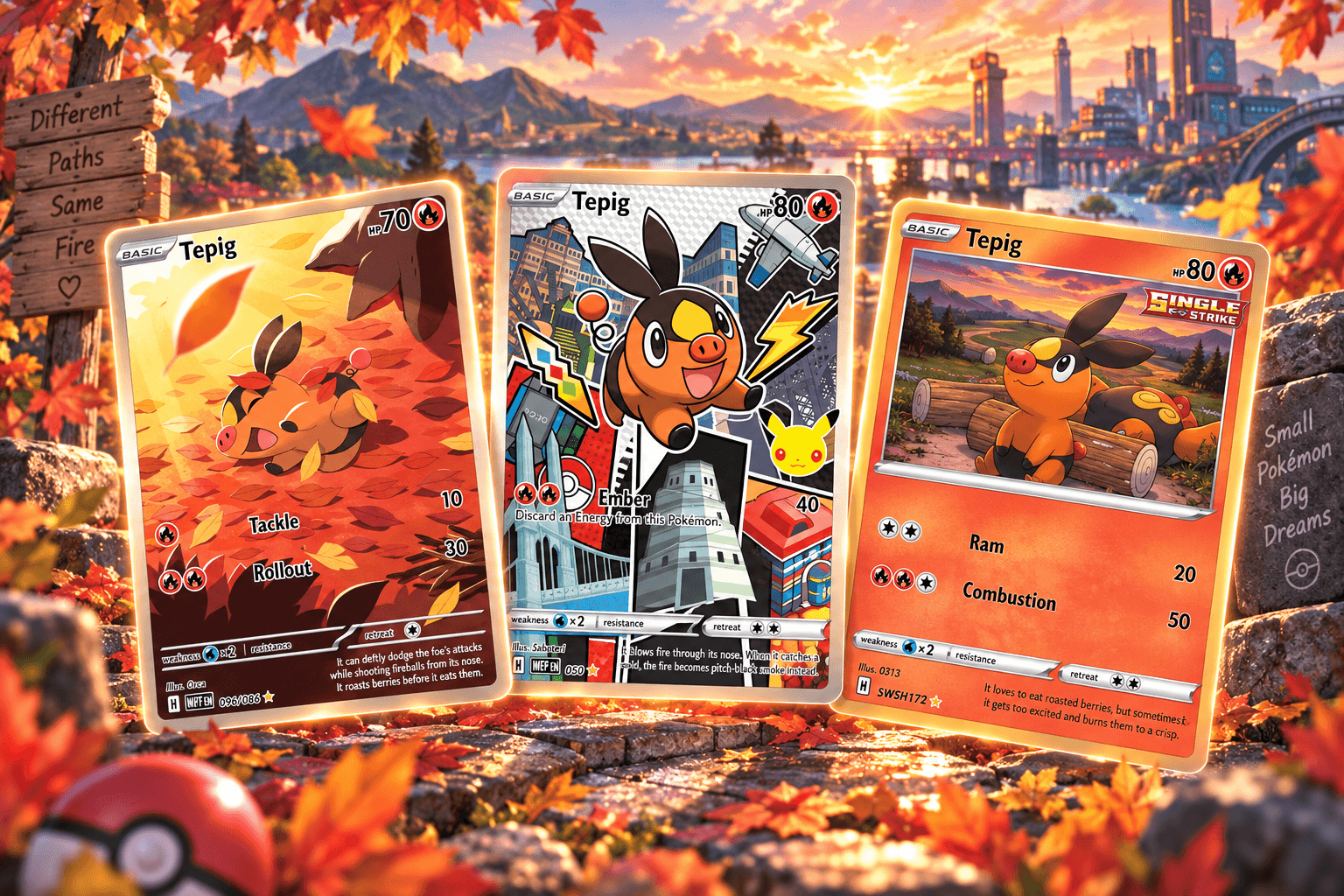
Tepig | White Flare #096 Illustration Rare (2025) Raw NM: ~$39
The first (and currently only) Tepig card with premium rarity treatment. Orca's illustration places Tepig in a scene rather than just a pose, which is what the Illustration Rare format does best. After fifteen years of standard commons, this single card gave Tepig collectors something to anchor a collection around.
At $39, it immediately became the most valuable Tepig card by a factor of two. It is also the card that pulled the rest of the line up with it. When a Pokemon gets its first premium card, the entire catalog benefits. Collectors who buy the IR go looking for the rest of the set, and that secondary demand lifts even the cheapest commons by a few percentage points. Multiply that across 30 cards and you get meaningful aggregate appreciation.
The Rest of the Top Cards
Tepig | Legendary Treasures #25 Reverse Holo (2013) Raw NM: ~$19
The previous price leader before White Flare. Legendary Treasures is a special set from the Black and White era that included reprints of popular cards. The reverse holo Tepig from this set has been climbing steadily as Unova-era collecting gains momentum. A $19 reverse holo common is unusual, and it tells you exactly how thin the Tepig supply is at the top of the condition spectrum for BW-era cards.
Tepig | Black and White #15 Cosmos Holo (2011) Raw NM: ~$8.50
The very first English Tepig card, from the very first Black and White set. The Cosmos Holo variant adds a special holo pattern that was distributed through specific retail products rather than standard booster packs. This is the card that Unova nostalgia collectors reach for first because it represents the beginning of the Tepig story in the TCG.
Tepig | McDonald's Collection 2011 #3 (2011) Raw NM: ~$6.86
Another 2011 card, this time from the McDonald's Happy Meal promotion that ran alongside the Black and White game launch. McDonald's Pokemon cards have developed their own collector following, and the 2011 set catches the crossover energy between fast-food memorabilia collectors and Pokemon enthusiasts. Up 6.2% in the last 30 days.
Tepig | BW Black Star Promo BW02 (2011) Raw NM: ~$3.32
The promo distributed through starter boxes and promotional events tied to Pokemon Black and White's release. The BW02 numbering places it among the very first Black and White promos, which gives it "debut era" significance. Ken Sugimori illustrated this card with the same official art used across the game's marketing materials. For collectors who want the most "authentic" representation of how Tepig looked when the world first met it, this is the card.
Tepig | Boundaries Crossed #24 Reverse Holo (2012) at $5.45. Mid-era Black and White print with the reverse holo treatment. Up 5% in the last month. The BW reverse holo pattern has a metallic sheen that photographs differently from modern reverse holos, giving these cards a period-specific look.
Tepig | Cosmic Eclipse #31 Reverse Holo (2019) at $2.49. The Sun and Moon era entry. Cosmic Eclipse was the final SM set, and Mina Nakai's illustration gives Tepig a softer, more whimsical treatment than the BW-era artwork. Up 16.4% in 30 days.
Tepig | Ascended Heroes #29 (2026) at $0.09 to $0.30. The most recent print. Current production, bulk pricing. The Friend Ball reverse holo variant carries a small premium. Protect even cheap cards properly if you are holding for the nostalgia cycle. Our storage guide covers the basics.
The Unova Nostalgia Thesis
Here is what none of the competitor pages explain. Tepig's 140.8% YTD is not about Tepig specifically. It is about the entire fifth generation entering its nostalgia window.
Pokemon Black and White launched in 2010 (Japan) and 2011 (international markets). The kids who chose Tepig as their first Pokemon were roughly eight to twelve years old at the time. In 2026, those same kids are 23 to 27 years old. They have jobs. They have disposable income. And they are starting to feel the pull of collecting the cards from the era that shaped their relationship with Pokemon.
This is the same pattern that drove Gen 1 card appreciation in the mid-2010s, Gen 2 appreciation in the late 2010s, and Gen 3/4 appreciation in the early 2020s. Each generation of players enters their nostalgia spending phase roughly 15 to 17 years after the games that defined their childhood. For Unova, that window is opening right now.
The Black and White era also has a unique advantage that earlier generations lacked. It was the first Pokemon generation where significant numbers of players were active on social media during their initial playthrough. That means the nostalgia triggers are not just personal memories. They are shared cultural references that communities reconstruct together on Reddit, Twitter, and YouTube. When someone posts "which Gen 5 starter did you pick?" in 2026, the thread generates hundreds of responses, each one a micro-activation of collecting intent. That collective nostalgia amplification did not exist for Gen 1 or Gen 2 in the same way.
Tepig catches this wave because it was one of three starters. Starters are the emotional anchor of every Pokemon generation. You chose one. You lived with that choice for the entire game. That personal connection converts to purchasing behavior more reliably than any other factor in the hobby.
The question is whether the wave has peaked or is still building. Comparing to previous generations, the Unova cycle appears to be in its early-to-mid phase. Gen 1 appreciation lasted roughly five to six years from initial uptick to peak. If Unova follows a similar timeline, the 140.8% gain might be the opening act rather than the finale.
For broader context on how generational cycles drive card values, our investing guide covers the framework.
Tepig vs Oshawott vs Snivy
The three Unova starters are all riding the same wave, but not equally. Tepig leads in YTD appreciation. The fire-type starter premium that has held across every generation (Charmander over Squirtle and Bulbasaur, Cyndaquil over Totodile and Chikorita, Torchic over Mudkip and Treecko) continues with the Unova trio.
Oshawott benefits from its recent appearance in Pokemon Legends: Arceus (2022), which gave it a relevance bump outside of Unova nostalgia. Snivy has the smallest collector base of the three, consistent with Grass-type starters historically trailing Fire and Water types in collecting demand.
For trio builders, the combined cost of all three Unova starter master sets is manageable. Tepig's $39 White Flare IR is the priciest single card across all three starters. The rest is sub-$20 territory for every card in every line.
Grading Tepig
The White Flare Illustration Rare at $39 raw is the only card where grading economics might work. If PSA 10 values settle in the $80 to $120 range (data is still thin since the card is recent), the multiplier would justify submission for perfectly centered copies.
Everything else in the line trades too low. The Legendary Treasures reverse holo at $19 is borderline, but reverse holos are notoriously difficult to grade at PSA 10 due to surface issues on the reverse holo coating. Skip grading for the sub-$10 cards entirely. Our PSA vs CGC vs BGS guide covers which service works best for modern Illustration Rares.
Conclusion
Tepig has no EX. No GX. No V. No VMAX. Just commons, promos, one Illustration Rare, and a 140.8% year-to-date gain that outpaces the majority of Pokemon with ten times more cards. That disconnect between card treatment and market performance is the entire story. The Unova nostalgia wave does not care whether the Pokemon Company gave Tepig premium rarity. It cares that a generation of collectors chose this pig fifteen years ago and wants it back.
The White Flare IR gave the collection a centerpiece it never had before. The BW-era debut cards carry the nostalgia. And the 140% run suggests the market is still figuring out what Unova starters are worth to the people who grew up with them. Protect what you own, watch the cycle, and check current set data on JK Index.
FAQs
What is the most valuable Tepig card?
The White Flare Illustration Rare (#096) at approximately $39 raw. It is the first and only premium-rarity Tepig card in the line.
How many Tepig cards exist?
Fourteen to fifteen unique English cards across eleven sets, with 31 to 33 total variants including reverse holos, Cosmos Holos, and promo stampings.
Why is Tepig up 140% this year?
The Unova generation is entering its nostalgia spending window. Players who chose Tepig in 2010/2011 are now in their mid-twenties with disposable income. This generational demand shift, combined with the White Flare IR giving the line its first premium card, created the conditions for rapid appreciation.
Does Tepig have any EX, GX, V, or VMAX cards?
No. Tepig is a basic-stage Pokemon, and the TCG has not given it any premium card treatment beyond the 2025 White Flare Illustration Rare. Emboar (the final evolution) has received GX and V treatment, but Tepig itself has not.
How does Tepig compare to the other Unova starters?
Tepig leads in YTD appreciation, consistent with the fire-type starter premium that holds across every Pokemon generation. Oshawott benefits from a Pokemon Legends: Arceus relevance bump. Snivy trails both in collector demand.
Is the 140% gain sustainable?
If the Unova nostalgia cycle follows the pattern of previous generations, the appreciation window typically lasts five to six years from initial uptick. At roughly one to two years into the cycle, the early data suggests room for continued growth, but past patterns do not guarantee future outcomes.
Where can I buy Tepig cards?
TCGPlayer and eBay are the primary marketplaces. Card shows and local shops also carry BW-era cards, often at prices below online market rates. For the White Flare IR specifically, TCGPlayer verified sellers offer the most consistent pricing. For current set data, visit JK Index.