Every Raticate Card Variant Ranked by Value (2026)
Prices based on recent sold listings | Updated September 2026
Every Pokemon player has caught a Rattata. Almost none of them kept the Raticate.
That is the entire collector psychology of this Pokemon distilled into two sentences. Raticate is the evolution you grind through on Route 1 and replace with something better by the second gym. It is the Pokemon on your rival's team that you barely notice between their Pidgeot and their starter. It is, in the kindest possible reading, forgettable.
And forgettable Pokemon make surprisingly interesting collections. When nobody is paying attention to a card line, prices stay low, supply stays available, and the collector who does care gets to build something comprehensive without competing against hype buyers. Raticate's 56 unique cards across 50 sets cost roughly $482 in total. Forty of those cards trade under $5. The entire bottom half of the collection costs less than a booster pack.
But there is a $595 PSA 10 lurking in here, a brand new Illustration Rare from Destined Rivals, and a piece of Pokemon lore dark enough that the community has been debating it for 28 years. This is more interesting than it looks.
The Card Nobody Expected to Be Worth $595
Raticate | Base Set #40 (1999) Raw NM: $1 to $3 | PSA 10: ~$595
A $1 uncommon with a $595 PSA 10. That multiplier exists because Base Set cards from 1999 have been handled, played, traded, bent, water-damaged, and sun-faded for 27 years. The raw supply is enormous. The Gem Mint supply is not. Most surviving Raticate cards from Base Set have corner whitening, edge wear, or holo-adjacent surface issues that drop them below PSA 10 threshold.
The 1st Edition variant pushes the raw price to $8 to $15 and the PSA 10 into four-figure territory. For a card that was never a pack-seller, never a tournament staple, and never appeared on a single poster, that is a testament to the power of Base Set as a brand. Everything from Base Set 1st Edition in PSA 10 carries a premium that transcends the individual Pokemon's popularity.
This is the card that anchors a Raticate collection with unexpected authority. Visitors who flip to the Raticate page in your binder will not expect to see a PSA 10 Base Set card worth nearly $600. That surprise is half the fun.
The Brand New Chase Card
Team Rocket's Raticate | Destined Rivals #202 Illustration Rare (2026) Raw NM: Early pricing, estimated $5 to $15
Destined Rivals is the most recent set to feature Raticate, and it gave the Pokemon something it has never had before: premium rarity treatment. The Team Rocket's Raticate Illustration Rare (#202/182) is the first Raticate card to break past the standard common/uncommon/rare ceiling in the card's entire 27-year history.
The "Team Rocket's" prefix adds narrative weight. This is not a cheerful binder filler. It is a villain's Pokemon rendered in the Illustration Rare extended-art format, with the darker, more aggressive aesthetic that Team Rocket cards carry. For collectors who have been building Raticate sets with nothing but commons and uncommons, this card is a genuine milestone.
Early pricing is still settling as the set is fresh. Watch this one over the next six months as the market finds its level.
The Villain Connection
Raticate has an unusually deep relationship with the antagonist side of Pokemon. Three different trainer variant cards exist tying it to villain or rival characters.
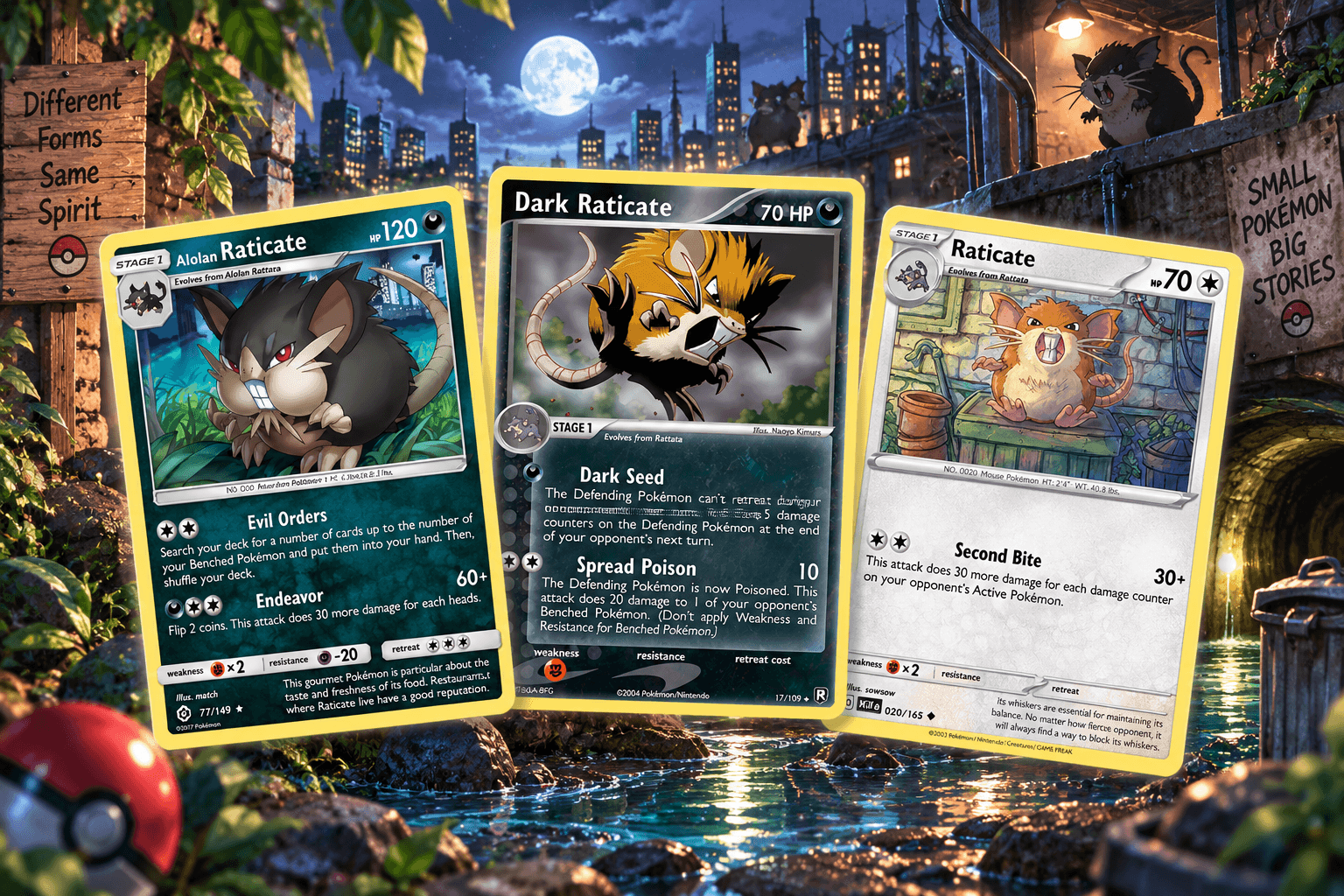
Dark Raticate | Team Rocket #51 (2000) at $1 to $3 (Unlimited) / $5 to $8 (1st Edition). The original dark variant from the fourth English set. Dark Raticate was part of Team Rocket's corrupted Pokemon lineup, and it carries the darker artwork aesthetic that defines the Dark subset.
Lt. Surge's Raticate | Gym Challenge #51 and #53 (2000) at $1 to $3. Lt. Surge's gym included Raticate as part of his Electric-themed team, which is an odd pairing for a Normal-type. The Gym Challenge versions give Raticate a military edge that suits Lt. Surge's character design.
Dark Raticate | Team Rocket Returns #17 (2004) at $2 to $5. The EX-era revival of the Dark mechanic. Team Rocket Returns revisited the villain-Pokemon concept with updated artwork and gameplay mechanics.
These villain cards create a sub-collection within the broader Raticate line. A binder page dedicated to "Raticate as the bad guy" across multiple eras is a display concept that no other guide suggests, and it carries more visual personality than a standard chronological layout.
The Quiet Corners of the Collection
Raticate | Southern Islands #6 (2001) at $3 to $6. Southern Islands was a Japanese promotional set that received a limited English release. The cards feature tropical, watercolor-style artwork that is unlike anything else in the TCG. The Raticate from this set shows the Pokemon in a beach setting that softens its usual aggressive design into something almost serene. Southern Islands cards have a dedicated following, and this Raticate benefits from the set-level collector demand. If you want to own one Raticate card that catches people off guard with its artwork, this is the pick.
Raticate | FireRed and LeafGreen #48 (2004) at ~$18 to $22 (up 26.3% in 30 days). The EX-era remake set card that is quietly climbing. FireRed and LeafGreen cards have been appreciating as the GBA-era nostalgia wave builds. This is the same generational demand shift driving Tepig and other era-specific appreciation stories covered earlier in this blog series. The Raticate here is riding set-level momentum, and the 26% monthly gain suggests the wave has not crested yet.
Raticate BREAK | BREAKpoint #89 (2016) at $1 to $3. The gold landscape-format BREAK card. Same distinctive format that appeared in the Xerneas blog earlier in this series. BREAK cards have a cult collector following, and the Raticate BREAK is a budget entry into that format. The gold foil on a Pokemon this mundane creates an entertaining visual contrast.
Raticate | SV 151 #20 (2023) at $0.50 to $1.50. The modern Kanto callback. Every original 151 Pokemon received a card in this set, and Raticate's entry fills the modern binder slot cleanly.
Alolan Raticate | Pokemon GO #42 (2022) at $1 to $3. The Alolan regional variant gives Raticate a Dark/Normal typing and a heavier, rounder design. The Pokemon GO crossover set added it to the modern card pool, and the reverse holo variant is currently the most valuable Alolan Raticate card according to PriceCharting data. Alolan forms create the same dual-track collecting dynamic seen in the Dugtrio and Exeggutor guides earlier in this series. Kanto Raticate and Alolan Raticate attract overlapping but distinct buyer pools.
Raticate | Perfect Order #61 and #99 (2026) at $0.10 to $0.50. The most recent prints. Perfect Order gave Raticate both a standard card and what appears to be an Art Rare variant (#99), which would be another premium treatment milestone for the line if confirmed. Pricing is still settling on the newer entries.
Your Rival's Raticate
There is a fan theory that has circulated since 1996, and it gives Raticate a weight that no price chart captures.
In Pokemon Red and Blue, your rival Blue has a Raticate on his team when you battle him on the S.S. Anne. The next time you encounter Blue, at Pokemon Tower (a cemetery for Pokemon), his Raticate is gone. It never appears on his team again. Pokemon Tower is where trainers go to mourn dead Pokemon. The community connected the dots and concluded that Blue's Raticate died between the two encounters, possibly as a result of the S.S. Anne battle against you.
Game Freak has never confirmed or denied this theory. But it has persisted for 28 years, making it one of the longest-running pieces of Pokemon fan lore. And it gives Raticate a narrative gravity that Route 1 Normal-types simply do not carry.
Collectors who know this theory look at Raticate cards differently. The Base Set Raticate is not just a forgettable uncommon. It is the card representing a Pokemon at the center of one of the franchise's darkest unconfirmed stories. Whether you find that reading compelling or dismissible, it adds a layer of cultural context that enriches the collecting experience. Few common Pokemon can claim their own lore mystery.
The theory also creates a collector niche that is entirely unique to Raticate. Some people specifically seek out Blue's Raticate in the context of the S.S. Anne and Pokemon Tower storyline. Cards depicting Raticate alongside rival or villain trainers (Dark Raticate, Lt. Surge's Raticate) take on a different tone when viewed through this lens. The Destined Rivals Illustration Rare, with its Team Rocket framing, becomes the latest chapter in a story that started on the S.S. Anne in 1996. Whether intentional or not, the TCG keeps giving Raticate narrative context that reinforces the theory's emotional weight.
Grading Raticate
The Base Set card is the only one where the PSA 10 premium justifies a standalone submission. At $1 to $3 raw going to $595 at the top grade, the math is overwhelmingly positive if the card is genuinely flawless. Check the corners under magnification and examine the surface under direct light. Base Set uncommons were printed in huge quantities but handled carelessly by most owners.
The FireRed and LeafGreen card at $18 to $22 raw is borderline. If PSA 10 values sit above $80 to $100, the multiplier works. Data is still building.
Everything else in the line fails the grading economics test. The Destined Rivals IR might develop grading demand as pricing stabilizes, but it is too early to call. For service guidance, our PSA vs CGC vs BGS comparison covers what works at each price point. For keeping ungraded vintage cards protected, our storage guide has the basics.
Conclusion
Raticate is the Pokemon everybody released and nobody expected to collect. A $595 Base Set PSA 10, a brand new Illustration Rare, a lore mystery 28 years old, and 56 cards across 50 sets that cost less combined than a sealed booster box. For the collector who enjoys building where nobody else is looking, this is the line.
For current pricing and set data, check JK Index.
FAQs
What is the most valuable Raticate card?
Base Set #40 in PSA 10 at approximately $595. The raw card trades at $1 to $3, making the grading multiplier one of the most extreme in the Gen 1 uncommon pool.
How many Raticate cards exist?
56 unique cards across 50 sets in English and Japanese printings. Forty of those trade under $5 raw.
Does Raticate have an Illustration Rare?
Yes, as of 2026. Team Rocket's Raticate #202 from Destined Rivals is the first Illustration Rare in the line's history. Early pricing suggests $5 to $15 raw.
What is the dead Raticate theory?
A fan theory from Pokemon Red and Blue. Your rival Blue has a Raticate on the S.S. Anne but not at Pokemon Tower (a Pokemon cemetery). The community theorizes Blue's Raticate died between the two encounters. Game Freak has never confirmed or denied it.
Is a Raticate collection worth building?
At roughly $482 total for every variant, with 40 cards under $5, it is one of the most affordable Gen 1 master sets available. The villain variant sub-collection (Dark Raticate, Lt. Surge's Raticate, Team Rocket's Raticate) adds genuine collecting depth that most price databases ignore.
How does the FireRed and LeafGreen Raticate compare to other vintage cards?
At $18 to $22 raw with a 26.3% monthly gain, it is the most actively appreciating Raticate card in the line. The GBA-era nostalgia wave is lifting cards from this set, and Raticate is riding the momentum. Our investing guide covers how these era-specific appreciation cycles work.
What is the cheapest Raticate card?
Unbroken Bonds #144 at $0.03. Three cents for a Pokemon card from 2019.