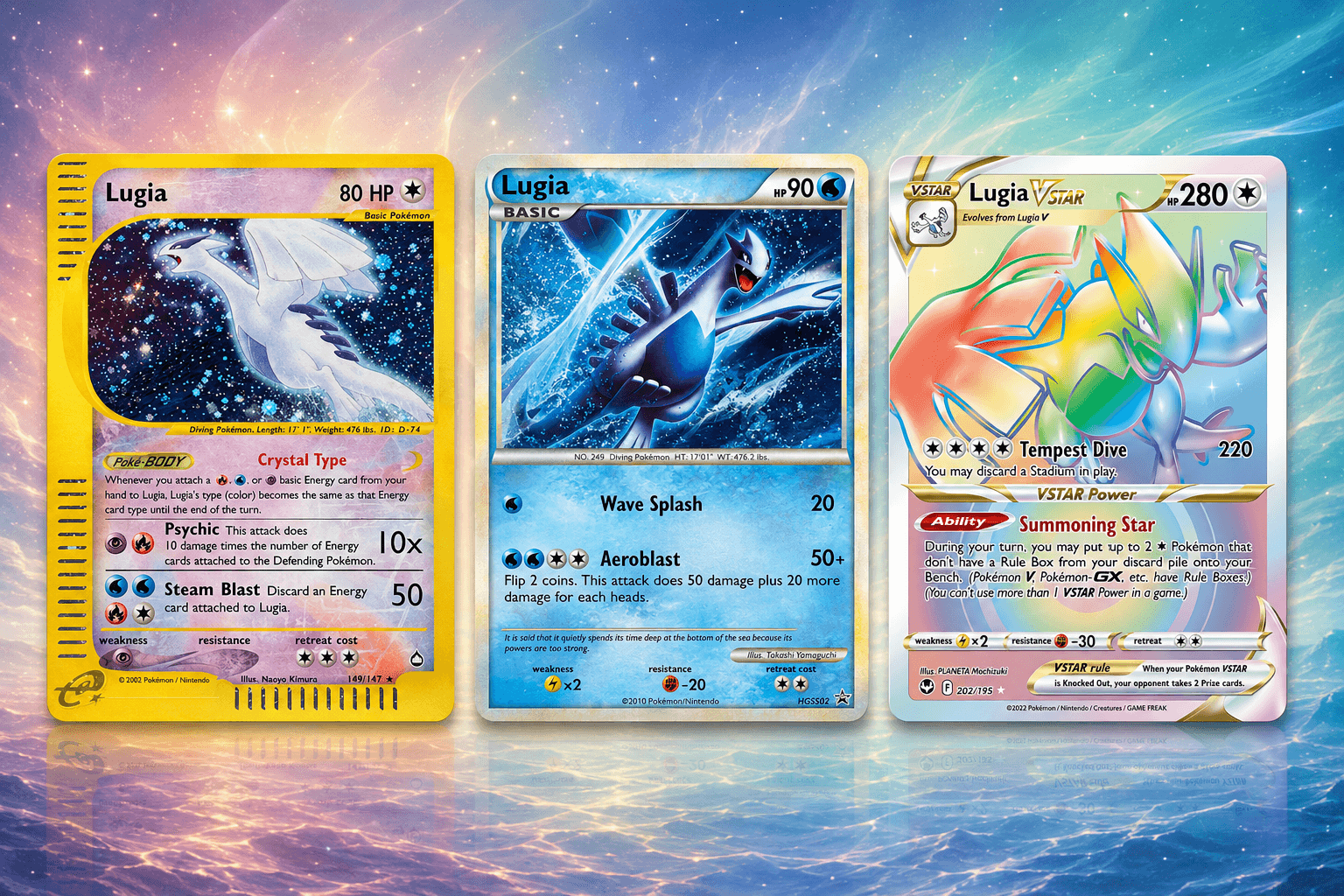
Every Lugia Card Variant Ranked by Value (2026)
Every Lugia Card Variant Ranked by Value (2026)
Published by JK Index · Updated August 2026
There's a reason serious vintage collectors talk about Lugia before they talk about Charizard.
Lugia has never been overprinted. There is no Lugia equivalent of the twelve different modern Charizard ex prints crowding shelves right now. The Pokémon Company has treated Lugia carefully across every era, and the result is a cleaner, more predictable price ladder — where every notable version actually earned its way onto the list.
This is that list, ranked by 2026 PSA 10 clearing prices, with the context on why each one matters.
The one that started it: Neo Genesis 1st Edition Holo
The Neo Genesis Lugia (#9/111) is the most valuable non-Charizard vintage Pokémon holo, and the 1st Edition version sits comfortably at the top of any Lugia ranking you'll ever see.
- Raw NM: $2,400–$3,200
- PSA 8: $6,500–$9,000
- PSA 9: $19,000–$26,000
- PSA 10: $52,000–$78,000
The 1st Edition PSA 10 population is only 91 cards. Not "rare among Neo Genesis holos" — genuinely rare in the entire vintage graded market. This card has climbed from $12K in 2018 to a $60K–$70K center of gravity in 2026, and the appreciation curve shows no sign of flattening.
If someone offers you a "1st Edition Lugia" under $2,000 raw with visible whitening on the back, walk. The card has a notorious print defect on the reverse that tanks grades — factor that into any raw purchase.
Neo Genesis Unlimited: the accessible vintage
For collectors who want the iconic Lugia without the 1st Edition price bracket:
- Raw NM: $220–$310
- PSA 9: $850–$1,150
- PSA 10: $2,400–$3,200
The Unlimited version has the same beautiful artwork and the same historical weight — just without the "1st Edition" stamp that adds two zeros to the price tag. This is where most collectors actually enter the Neo Genesis market.
Aquapolis Crystal Lugia (2003)
The crystal-type mechanic only existed in three sets, and Aquapolis Crystal Lugia is the second-most valuable crystal card ever printed. The card has a translucent shard treatment that photos never do justice. For comparison, the Skyridge set — the WotC-era release that closed out the crystal treatment — has similar grading behavior on its own crystal chase cards.
- Raw NM: $1,400–$1,900
- PSA 9: $4,200–$5,800
- PSA 10: $11,000–$15,000
PSA 10 population sits at 118. Aquapolis wasn't heavily opened, and crystal cards are notoriously hard to grade — corner condition on the shard-textured surface is brutal.
Lugia Legend (HeartGold & SoulSilver, 2011)
The Lugia LEGEND card is a two-card puzzle — top half and bottom half — and both halves are needed for the full card to be considered complete. Grading the pair together is a rare feat, and completed PSA 10 pairs command a premium beyond the individual halves.
- Individual halves PSA 10: $180–$260 each
- Matched PSA 10 pair: $600–$850
The Lugia LEGEND is one of the most underrated vintage cards on the market. It's the only Lugia that requires effort to actually collect, which keeps casual buyers away and prices reasonable. The earlier Lugia LV.X from the Majestic Dawn expansion is its natural counterpart — different mechanic, similar collector challenge, and often bundled together in themed vintage cases. Between the LEGEND and LV.X, the mid-2010s Lugia BREAK card sits as an underappreciated middle rung — a specialty rarity treatment that never got the collector attention its scarcity deserves.
Modern-era: Lugia V Alt Art (Silver Tempest, 2022)
Modern Lugia's flagship. The Silver Tempest Lugia V Alt Art (#186/195) features Lugia mid-flight over ocean spray — one of the best-received modern illustrations of the Sword & Shield era. Japanese-print collectors should also track Explosive Birth Lugia [Holo] — the sv-era Japanese counterpart with its own separate PSA population and grading floor.
- Raw NM: $95–$130
- PSA 10: $340–$480
Silver Tempest has been out of print since late 2023, so the reprint risk on this specific art has passed. The card behaves like a mid-tier vintage in appreciation pattern.
Full ranking
| Rank | Card | Set (Year) | PSA 10 (Aug 2026) |
|---|---|---|---|
| 1 | Lugia 1st Edition Holo | Neo Genesis (2000) | $52,000–$78,000 |
| 2 | Lugia Crystal | Aquapolis (2003) | $11,000–$15,000 |
| 3 | Lugia Unlimited Holo | Neo Genesis (2000) | $2,400–$3,200 |
| 4 | Lugia LEGEND (top + bottom) | HGSS (2011) | $600–$850 |
| 5 | Lugia V Alt Art | Silver Tempest (2022) | $340–$480 |
| 6 | Shadow Lugia (unreleased promo, 2004) | Neo prototype | $2,800–$4,500 (sealed, ungraded) |
| 7 | Lugia EX Full Art | Ancient Origins (2015) | $220–$310 |
| 8 | Lugia V Rainbow Rare | Silver Tempest (2022) | $95–$140 |
| 9 | Lugia VSTAR Rainbow | Silver Tempest (2022) | $110–$160 |
| 10 | Silver Lugia (Neo Genesis promo) | Neo Genesis (2000) | $180–$260 |
Everything below rank 10 falls into three groups: base Neo Genesis non-holos, Skyridge foil, and modern Standard-legal reprints that haven't earned collector attention yet.
Which Lugia should you actually buy?
Entry-level buyers should start with the Neo Genesis Unlimited holo. It's the iconic image, it's under $3,500 PSA 10, and it's a foundation piece that will hold value in any market cycle.
Mid-tier collectors should look at the Aquapolis Crystal. It's less recognized than the Neo Genesis 1st Edition, which means it's still available at prices that don't require a mortgage conversation.
If you're buying for grade upside, focus on raw Neo Genesis Unlimited copies with clean backs. That specific set had significant print defects on the reverse, so a raw copy that grades cleanly to a PSA 9 or 10 is a genuine event.
Final take
Lugia is the vintage collector's card. It has been treated well by the Pokémon Company, printed sparingly, and given real artistic weight in every appearance. The price ladder reflects that discipline. Unlike Charizard — where every new set threatens a new print — Lugia's population is stable, its ceiling is climbing, and its floor doesn't move much. If you're building a collection meant to last 20 years, Lugia should be in it. Track live comps and raw-to-slab spreads on the JK Index marketplace before committing to a specific print.