How Much Is a Chatot Card Worth in 2026?
Every so often a Pokémon is more interesting than its cards, and Chatot is a clear example. The music-note parrot from Sinnoh is famous for one thing: its signature move Chatter, which in Diamond and Pearl actually recorded your voice through the Nintendo DS microphone and played it back to confuse opponents.
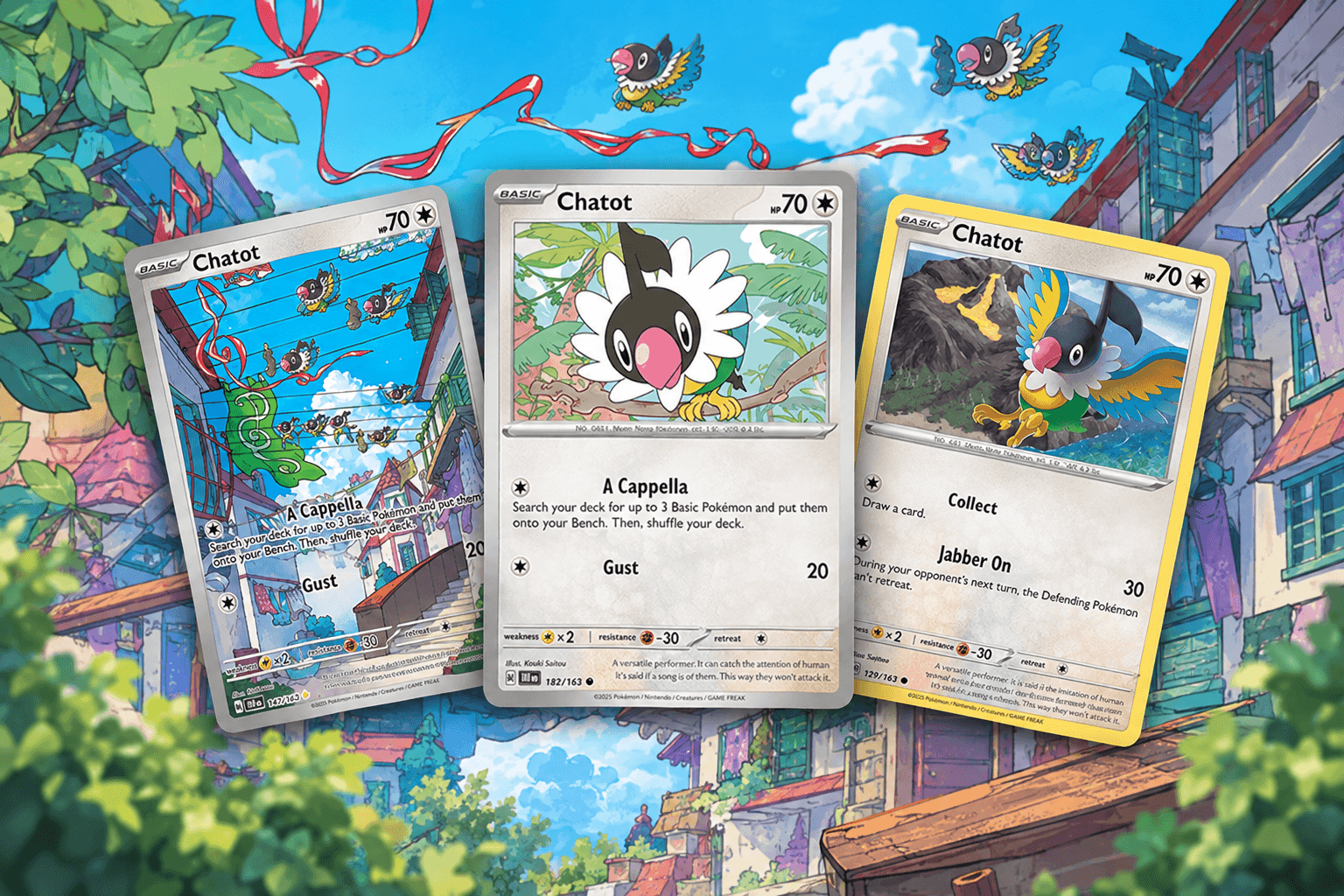
That gimmick made Chatot a novelty in the games. On cardboard, it has been far quieter. Across roughly seventeen prints in ten sets, nothing Chatot has appeared on breaks past about $51, and even that takes a graded Japanese promo.
None of this makes Chatot valuable, but it does make it collectible for the right person. What follows is a rundown of its prints, where the modest value clusters, and whether any of it is worth slabbing. Expect the figures to shift, since these cards trade rarely.
Chatot card value 2026: the top variants ranked
Two Japanese cards sit at the top, and both are affordable. The numbers here come from live 2026 sales data, with estimates flagged wherever a card changes hands too seldom to pin down.
| Rank | Card | Set (Year) | Raw NM | PSA 10 |
|---|---|---|---|---|
| 1 | Chatot Japanese Promo | DPt-P Promo, JP (2009) | $10–$15 (est) | ~$51 |
| 2 | Chatot #081 Art Rare | Wild Force, JP (2024) | $6–$10 (est) | ~$30 |
| 3 | Chatot #055 | Majestic Dawn (2008) | $2–$4 | ~$40 (est) |
| 4 | Chatot #064 1st Edition | Megalo Cannon, JP (2013) | $2–$4 (est) | ~$30 (est) |
| 5 | Chatot #162 | Unbroken Bonds (2019) | $1–$2 | ~$20 (est) |
| 6 | Modern commons and reverse holos | Various | $0.15–$1 | $12–$20 |
Chatot's Japanese promo and Wild Force Art Rare value 2026
Chatot's ceiling is set by imports. The 2009 Japanese promo is the priciest, reaching about $51 in a PSA 10 off a raw price in the low teens, a scarce event card rather than a set pull.
The newer standout is the 2024 Wild Force Art Rare, a Japanese print that finally gives Chatot a piece of genuinely attractive full-scene artwork, landing near $30 graded. Between them, these two carry whatever demand Chatot has, and both stay well within reach.
Chatot's Diamond & Pearl and modern prints value 2026
The English side is quieter still. The 2008 Majestic Dawn base card is the nostalgic Diamond and Pearl pick, cheap raw but climbing to roughly $40 in top grade thanks to how few clean copies survive.
After that, the drop is steep. The Unbroken Bonds print, the Megalo Cannon 1st Edition, and a spread of commons and reverse holos rarely ask more than a dollar or two, and their graded ceilings sit in the teens. These belong in a Sinnoh binder, not an investment folder.
Should you grade a Chatot card in 2026?
Grading Chatot is hard to justify, and the math shows why.
Japanese promo and Wild Force Art Rare:
- Roughly $6 to $15 raw, and $30 to $51 in a PSA 10
- The premium exists, but a graded copy barely outruns the fee, so slabbing pays only if you already own a flawless raw and want it protected
Majestic Dawn base:
- Cheap raw with a graded copy near $40, an interesting multiple but too small in absolute terms to bother most people
Everything else: leave it raw, since the grading cost swallows the value.
Which Chatot card should you actually buy in 2026?
Pocket change: any modern common or reverse holo, the simplest way to add the parrot to a binder.
Around $3: a raw Majestic Dawn base, the Diamond and Pearl throwback.
Around $10: a raw Japanese promo or Wild Force Art Rare, the two best-looking Chatots.
Around $50: a graded Japanese promo, the practical top of the market.
The takeaway
Chatot is a card you buy because you like the character, not because you expect it to move. Its legacy lives in that voice-recording Chatter move, and its cards remain a cheap, cheerful corner of the Sinnoh catalog with two nice Japanese prints on top.
If the mimic bird appeals, grab the Wild Force Art Rare or the Japanese promo for the best of it, and skip grading unless you want a favorite protected. Treated as an investment it goes nowhere, but as a quirky, low-cost collectible, it earns its place.
FAQ
What is the most valuable Chatot card?
The 2009 Japanese promo, which reaches about $51 in a PSA 10 from a raw price in the low teens. The 2024 Wild Force Art Rare follows near $30 graded, and both are Japanese prints.
Why are Chatot cards so cheap?
Chatot is a minor Pokémon with no competitive relevance and a small fanbase, so demand is thin. Its charm lives in the games, through the Chatter voice-recording move, rather than in a valuable card lineup.
Should I grade my Chatot?
Rarely. Even the best Chatot tops out near $51 in a PSA 10, so a grading fee eats most of the value. Slab one only if you own a flawless copy and simply want it preserved.
What is Chatot known for?
Its signature move, Chatter, which in Generation 4 recorded the player's own voice through the Nintendo DS microphone. That, plus its musical-note body and speech mimicry, is what makes the parrot memorable.
Are Japanese Chatot cards better than English?
In value terms for Chatot, yes. Its two priciest cards, the 2009 promo and the 2024 Wild Force Art Rare, are both Japanese, while the English prints sit lower and cheaper.