Charizard vs Pikachu: Which Pokémon Card Holds Value Better in 2026?
Published by JK Index · Updated August 2026
The honest answer up front: Charizard holds value more reliably in the short-to-medium term. But Pikachu carries the two highest-value cards in the entire market — the $5.275M Pikachu Illustrator PSA 10 and the Trophy Pikachu variants that trade $100K–$550K.
So the question isn't which character wins on absolute peak value. It's which character is more likely to hold value on the cards you're actually going to buy. That distinction changes the answer meaningfully.
This guide walks through the PSA-graded price comparison, the character-cultural-weight dynamics, and which character deserves the budget you're planning to deploy in 2026.
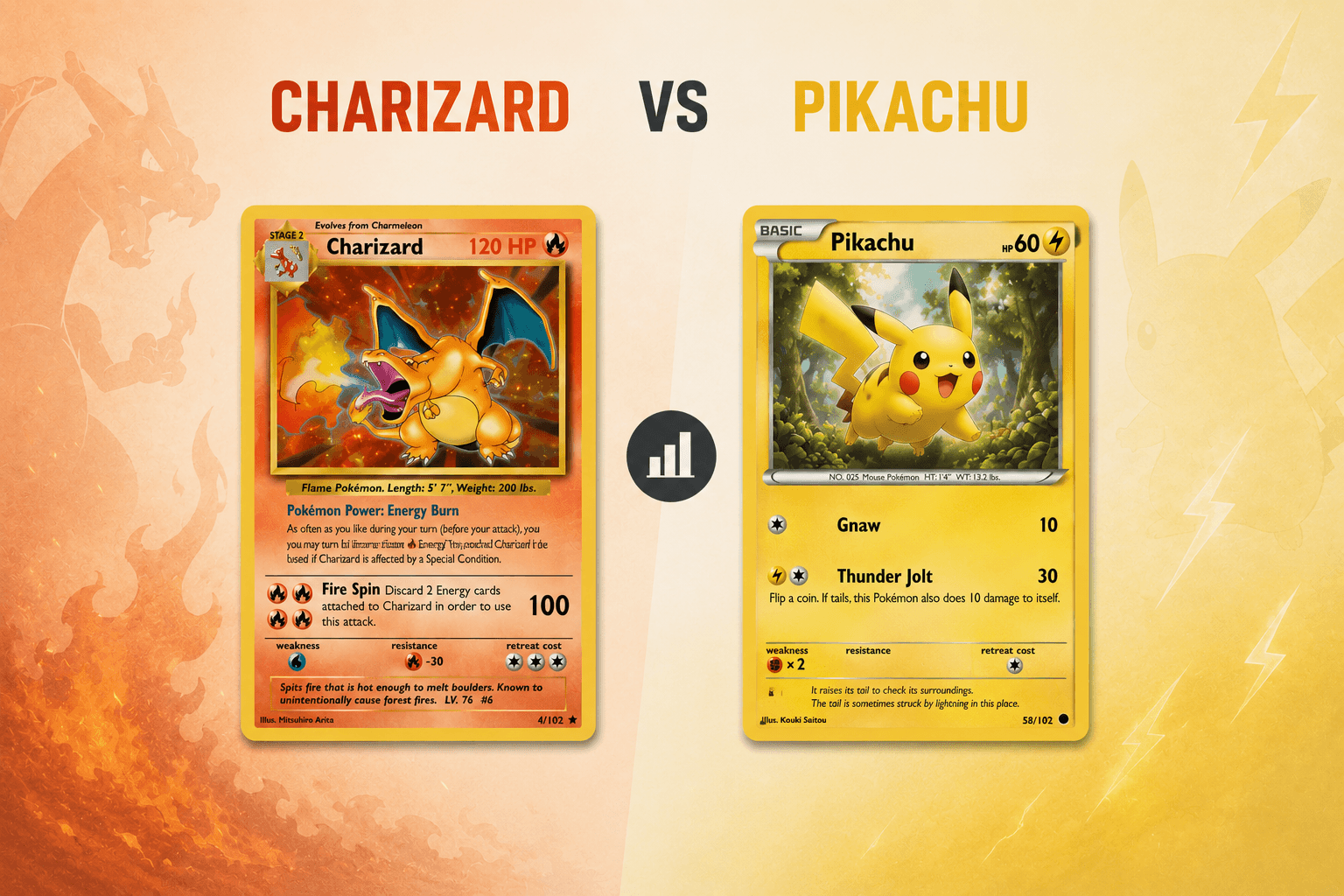
Charizard vs Pikachu card value in 2026: the market data
Head-to-head PSA 10 pricing has consistently favored Charizard on volume and Pikachu on absolute ceiling. On r/PokeInvesting, a specific value-comparison thread captured a useful data point.
The comparison: Charizard LCRV CGC 10 at roughly $6,000 versus Pikachu Gold Star PSA 10 at roughly $8,000. Same era, comparable scarcity, different character-tier pricing. That specific $2,000 gap favoring Pikachu Gold Star reflects the wider structural pattern at the extreme scarcity tier.
Ultra-scarce Pikachu variants command absolute-peak pricing because Pikachu is the Pokemon Company's official mascot. Pikachu appears on the official logo, in every marketing campaign, and carries brand-level demand extending beyond TCG collector attention.
But that pricing advantage only applies at extreme scarcity. Below the Gold Star / Trophy / Illustrator threshold, the dynamics reverse. Base Set 1st Edition Shadowless Charizard PSA 10 clears $28,000–$42,000 in mid-2026. Comparable Pikachu prints from the same era struggle to clear $4,500–$6,500.
The Charizard advantage: reliability and market depth
Charizard's specific market advantage is depth. Dozens of Charizard cards trade in the $500–$50,000 PSA 10 range across every era — 1st Edition Shadowless, Delta Species, Team Rocket villain prints, XY BREAKthrough Full Art, and modern Sword & Shield alt arts.
For cross-reference on modern Charizard pricing, the Charizard V and Charizard VMAX card pages provide useful comp data. The Base Set page tracks the historical anchor pricing that all modern Charizard variants reference against.
Reprint density supports collector attention. Charizard is reprinted more frequently than any other Pokemon character. Every new set brings new Charizard prints. That constant refresh keeps the character in active collector conversation, supporting vintage-tier pricing on the specific rare original prints.
The sports-card investor demographic prefers Charizard. Non-TCG-native investors who allocate capital into Pokemon cards buy Charizard because they recognize the character from broader cultural attention. That specific buyer demographic supports higher prices at the sub-$50K tier.
Charizard's demand curve is less peak-concentrated. Because the character carries broad appeal across every era of the TCG, demand distributes across a wider range of cards. That distribution reduces the peak-concentration risk that limits Pikachu's mid-tier pricing.
The Pikachu advantage: absolute-peak scarcity
Pikachu's advantage is at the extreme scarcity tier. The Pikachu Illustrator card reference reflects the ultra-grail tier — sub-40 known copies globally, $5.275M PSA 10 sale record, and appreciation running 25-40% annually since 2019.
Below Illustrator, the Trophy Pikachu family occupies the same scarcity-tier logic. Gold No. 1 Trainer Trophy Pikachu variants have appreciated 45-70% over five-year windows — with no meaningful downturn even during broader collectible market corrections.
That outperformance reflects the character-canon logic. Pikachu is inseparable from Pokemon Company brand identity in a way no other character quite matches. That specific inseparability drives the ultra-grail pricing dominance.
The absolute-peak advantage doesn't extend meaningfully into the mid-tier. Base Set Pikachu (holo and non-holo) trades at meaningfully lower PSA 10 pricing than Base Set Charizard. Team Rocket Dark Pikachu is basically a bulk card.
The specific pattern that separates them: Pikachu wins the top 5-10 cards. Charizard wins the next 500. That structural difference is the entire investment case.
Which one should you actually buy in 2026?
Three budget-tier profiles frame the honest decision.
Under $5,000 total budget: Charizard. Every Charizard collection under $5,000 will produce cleaner appreciation math than any Pikachu collection under the same budget. Focus on Base Set Unlimited holos, Team Rocket 1st Editions, XY-era Full Arts, and modern Trainer Gallery prints.
Cross-check current comps on the Charizard V PSA 10 marketplace reference before committing to specific pieces.
$5,000–$50,000 budget: Split allocation. Buy 1st Edition Shadowless Base Set Charizard at PSA 8-9 as the core position. Add mid-tier Pikachu prints for diversification — Base Set 1st Edition holo, Base Set Shadowless, Team Rocket 1st Edition variants.
Both characters carry real long-term demand at this tier. The correlation between them is meaningfully lower than most casual investors realize.
$50,000+ budget: Pikachu grail tier. At this budget, the accumulation logic reverses. Trophy Pikachu variants, Gold Star Pikachu, and Illustrator-adjacent prints carry the strongest multi-year appreciation trajectory. This is the only tier where Pikachu's absolute-peak scarcity advantage clears better returns than comparable Charizard allocation.
Skip: modern Pikachu Standard-legal prints as investment. Radiant Pikachu, Pikachu V, and current Scarlet-Violet-era Pikachu prints carry deep reprint risk and volume-tier populations. Modern Pikachu works as opening-fun, not investment.
Verdict: Charizard vs Pikachu in 2026
Both characters carry genuine long-term demand. Both will still be culturally central to Pokemon in 2050. But at 2026 pricing, the honest answer to which one holds value better depends heavily on the specific budget you're deploying.
Under $50,000, Charizard wins on reliability, depth, and market breadth. Above $50,000, Pikachu wins on absolute scarcity and character-brand-canon dominance at the ultra-grail tier.
Before committing capital to either character, verify current PSA-graded comps on JK Index Marketplace. The specific pricing gaps between vintage Charizard variants and Pikachu variants at comparable rarity tiers are meaningfully wider than most casual collectors realize.
The cards don't compete with each other. The characters do. And the character your specific budget matches is the one that will hold value best for you in 2026.